


December 23, 2024
EU's trade agreement with Latin American countries met with protests from French farmers
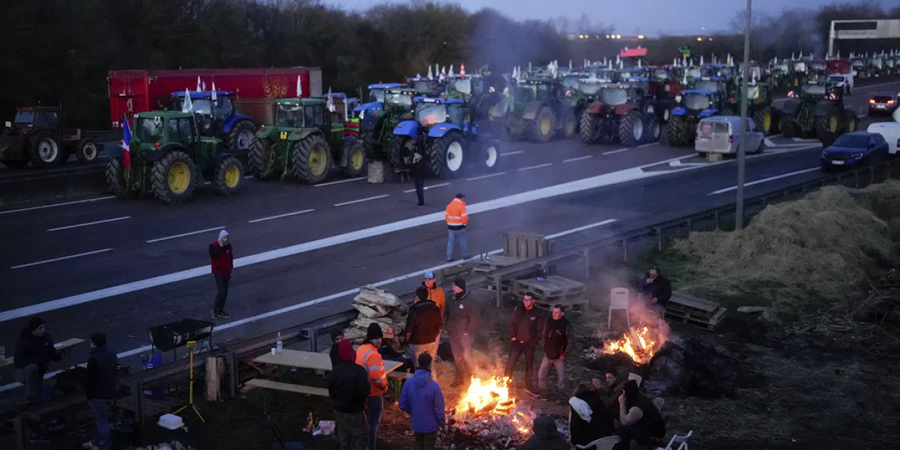
A few days after European Commission President Ursula von der Leyen inked a long-pending trade agreement with four Latin American nations, French farmers were back on the streets protesting against the deal.
France's minister for trade, Sophie Primas, said the deal with the Mercosur bloc — that includes Argentina, Brazil, Paraguay, and Uruguay — "only commits the Commission, not the member states," indicating that France will oppose ratification of the agreement.
At the heart of the farmers' protest is an increase in beef imports, as well as poultry and sugar. But experts believe the margins of these imports are modest and not an existential threat. Moreover, as agricultural products produced in the European Union find millions of new consumers in Mercosur nations, the agricultural sector overall stands to benefit from the agreement.
A so-called Factsheet published by the EU Commission said under the new agreement, the EU will import 99,000 tonnes of beef at lower duties of 7.5%. That is just 1.6% of total beef production in the EU and is less than half of the current imports from Mercosur, which stands at 196,000 tonnes.
For poultry, imports amount to 1.4%.
Bruno Capuzzi, a Brazilian trade economist currently in a fellowship at the European University Institute, told DW the increase in beef imports represents only one and a half burgers for each consumer in the union.
Other experts also said the 99,000 tonnes will not necessarily lead to additional demand and mostly replace a part of the existing imports from Mercosur but at cheaper rates. On average, beef exporters from Mercosur pay 40% duties on current exports.
"It is expected that, rather than creating an equivalent increase in imports, one of the effects of the new quota will be to replace some of the imports that are already taking place," said Christopher Hegadorn, adjunct professor of global food politics at Sciences Po, Paris.
In a report in February, the EU admitted that there will be some impact on producers of beef, poultry, and sugar, and sectoral adjustments will be required. Experts told DW that in the negotiations over the year, however, the EU succeeded in installing various safeguards to soften the impact.
Firstly, the increased but set quota of 99,000 tonnes of beef is not coming in duty-free, and secondly, the EU's high health standards are expected to guard against oversupply.
"Only 20% of the slaughterhouses in Brazil are authorised to export to the EU as it requires individual certification," Capuzzi told DW.
The deal is expected to be phased in over five years to give the beef producers in the EU time to adapt.
"It is assumed there will be financial resources to help affected farmers adjust to any dislocations," Hegadorn said. "But that will likely come up at the [European] Council as the agreement comes for ratification."
Moreover, 99,000 tonnes would be divided among four Mercosur nations, handing each a relatively thin slice of trade in a commodity they have ample amounts to supply.
The experts believe that the deal's overall benefits far outweigh the adjustments, and even the agricultural sector stands to gain.
The EU said that far from being detrimental to the farmers, the development of new markets through preferential trade relations will consolidate the bloc's position as the world's top exporter of agri-food products.
"The overall EU-Mercosur deal is far beyond beef and agriculture, extending to all industrial sectors, and services — from A to Z, meats to medicines, vehicles to chemicals," Hegadorn said.
"Those who are looking at the EU bloc's interest as a whole are sanguine about its expected positive impacts, both in terms of domestic economic benefits and expanding consumer choice, but also for geopolitical reasons including offering a counterbalance to China and the US."
- DW


