


December 5, 2025
European aquaculture organisations meet with EU fisheries official to address industry challenges
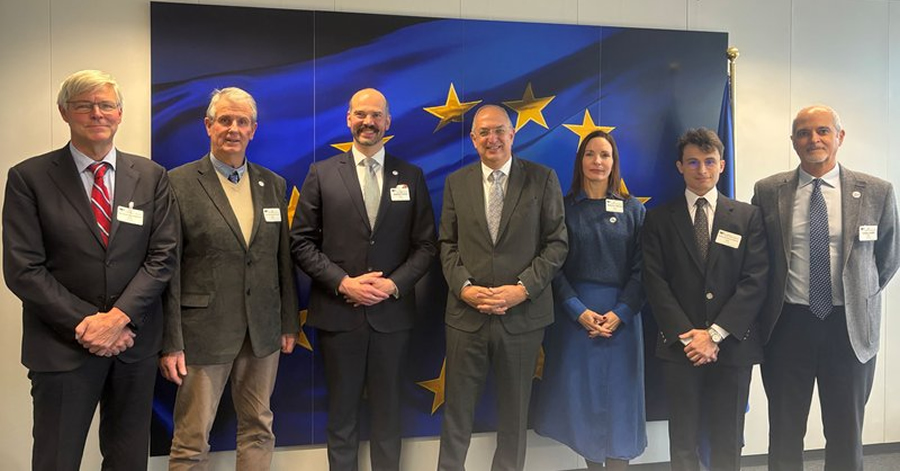
The European Molluscs Producers' Association (EMPA), the Federation of European Aquaculture Producers (FEAP), and the European Aquaculture Technology and Innovation Platform (EATIP) met with European Commissioner Costas Kadis, responsible for Fisheries and Oceans, including aquaculture, to jointly address the urgent challenges facing European aquaculture and contribute to the European Union's Vision for Aquaculture towards 2040, including support for the sector within the upcoming Ocean Research and Innovation Strategy.
Together, these organisations represent the entirety of the EU aquaculture sector.
Held in a small-committee format with the presidents and secretaries general of each organisation, the meeting focused on reversing the long-term decline of EU aquaculture, strengthening policy coherence, and defining clear priorities for competitiveness, spatial planning, research, and innovation.
The organisations stressed that while global aquaculture production continues to grow rapidly, European production has stagnated or declined for over 25 years. This downturn, they underlined, is not due to a lack of entrepreneurship, investment, or innovation within the sector, but rather to excessive bureaucracy, burdensome administrative processes, fragmented initiatives, insufficient recognition in spatial planning, and policy frameworks that generate consultations but deliver few results.
As a consequence, strong EU demand for aquatic food is increasingly met by imports from countries with more coherent aquaculture policies.
The organisations called on Kadis to champion stronger political leadership within the European Commission and across member states, ensuring aquaculture is fully integrated into food policy, competitiveness strategies, research priorities, and environmental legislation.
Kadis welcomed the exchange and reaffirmed his commitment to elevating aquaculture within the EU's food and blue-economy agenda. "Aquaculture is a top priority in my portfolio, both for food security and for competitiveness in coastal and river areas. Promoting aquaculture is also key to reducing our dependency on imported seafood. Demand-driven research must play a central role in future EU research programs," he said in a press release.
The organisations strongly welcomed this message and stressed the need to convert political ambition into tangible results, including regular checks at the farm level to ensure policies reflect operational needs.
Addy Risseeuw, president of EMPA, stressed the need for a dedicated EU policy recognising aquaculture as a distinct strategic sector within the EU food system, essential for food security, climate resilience, and coastal development. He called for clear and quantitative growth objectives, including a 25% increase in EU aquaculture production by 2040, supported by improved access to space, streamlined regulations, and a balanced approach to environmental and food production goals, with a bottom-up approach.
FEAP's secretary general, Javier Ojeda, emphasised that "without clear production targets, there is no accountability and no progress." He stressed that EU environmental legislation must be fully compatible with sustainable food production: strong environmental protection is essential, but regulatory frameworks must also enable responsible growth, innovation, and investment. Aligning ecological and food-production priorities is vital for meeting Europe's geopolitical commitments while responding to growing demand for locally produced, low-impact seafood.
Lorenzo Gennari, president of EATIP, highlighted the need for coherence in aquaculture research and innovation within the development of the new Ocean Research and Innovation Strategy and upcoming Horizon Europe Framework Programme. He noted that, for far too long, EU aquaculture R&I has been under-resourced, particularly with regard to the dissemination, exploitation, and application of research outputs. Specific consideration needs to be given to the fact that research activities are often inaccessible to micro and small enterprises, and that Producer Associations are ready to play a greater role. Research must also be impact-focused and aligned to economic needs and market demands. He called for strong political leadership to ensure that research priorities are consistent across Commission services and that public and private investments are focused on effective and harmonised instruments.
The meeting also reviewed key policy files shaping the sector's future, including the European Ocean Pact, the forthcoming EU Vision for Fisheries and Aquaculture by 2040, the Multiannual Financial Framework (MFF) and the evaluation and potential revision of the Common Fisheries Policy (CFP).
The organisations expressed their appreciation fo Kadis's engagement and concluded that the discussion was constructive and encouraging. They stressed, however, that what matters now is implementation. The EU must convert good intentions, at both the Commission and member state levels, into measurable outcomes that enable a thriving, competitive, and sustainable aquaculture sector.
The coalition reaffirmed its full readiness to push forward and actively accompany the future implementation phase and welcomed the invitation from Kadis for regular follow-up meetings to review progress.
- Aquafeed.com


