November 29, 2018
Warmer climate causing Alaska pollock to spawn earlier, study finds
The spawning time of the Alaska pollock - thetarget of the US' biggest fishery - has been affected by climate change and been found that it varied by as much as three weeks over the past three decades in the Gulf of Alaska.
The study by the US National Oceanic and Atmospheric Administration Fisheries, using an unprecedented 32-year data series, found clear evidence that the changes were driven by both climate and fishing.
Changes in spawn timing have major ecological and management implications, as timing is critical to survival of newly hatched fish because it determines the conditions they encounter. Many marine fish, like pollock, are adapted to spawn in time for offspring to meet the rapid increase of their plankton prey in spring, said the study.
If they arrive too early, there may not be enough food; if they arrive too late, the young fish will have less time to grow and will be small compared with their predators and competitors.
Lauren Rogers, the NOAA Fisheries biologist who led the study, said, "To effectively monitor and manage pollock populations, managers need to understand what causes changes in spawn timing. With ongoing warming of the world's oceans, we need to know how changing climate conditions interact with other processes, like harvesting, to influence spawning time".
Rogers' team therefore investigated how pollock spawn timing has shifted over warm and cool periods and large shifts in age structure in the Gulf of Alaska.
Warmer temperatures and older population
The researchers were able to test for effects of climate and age structure on both mean spawn timing and duration, and forecast spawn timing under different scenarios of warming and fishing mortality.
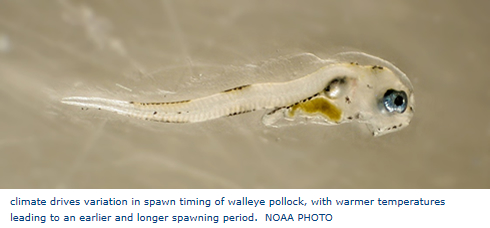
They determined that climate drives variation in spawn timing of walleye pollock, with warmer temperatures leading to an earlier and longer spawning period.
An older spawning population also started spawning earlier and over a longer duration than a population of predominantly young spawners, highlighting the importance of older mothers.
When it comes to fishing, harvesting leads to a younger, smaller population over time. In general, increased mortality reduces the mean age of a population, and this effect is strengthened if older individuals are targeted through size selective harvesting. Besides direct effects of harvesting on age structure, fishing may cause evolutionary change by selecting for reproductive maturation at an earlier age or smaller size.