


November 28, 2023
Increased production costs threaten Malaysia's egg supply chain
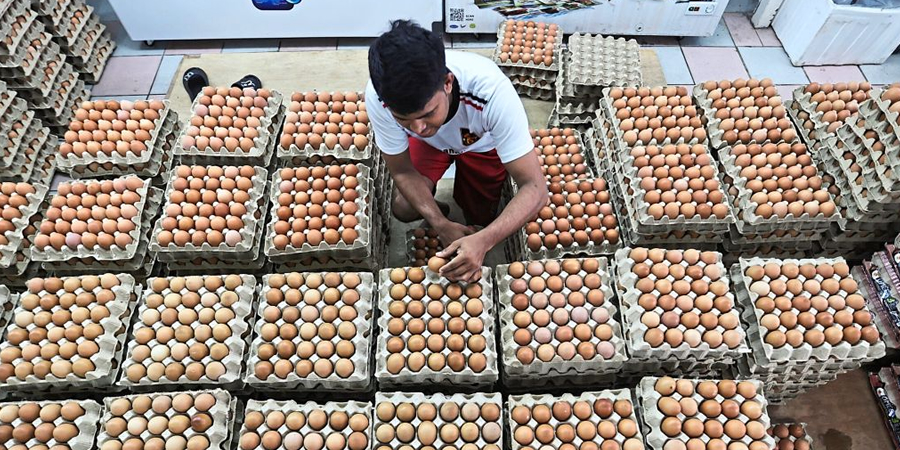
Malaysia's egg industry faces a substantial challenge due to the escalating production costs, mainly attributed to rising feed and chick prices.
This is despite the Malaysian government's plan to allow for variable egg prices.
The Veterinary Services Department (DVS) said the factors significantly influence the price of ex-farm eggs. While acknowledging that the egg supply is stable, DVS noted the poultry industry needs more time to fortify the supply chain against potential disruptions.
"These factors directly impact the ex-farm price of eggs, making it necessary to address them to achieve a sustainable and affordable market rate," the department told The Star.
According to DVS, the Malaysian egg industry is smaller than the broiler industry, with fewer players and a less developed support chain.
"The broiler industry has breeding farms (grandparent stock and parent stock) that provide replacement stock, while the egg industry only has breeding farms (parent stock)," the department pointed out. "Any disruption to the egg industry's replacement stock supply can significantly impact the entire production chain."
It added that the reliance on imported grandparent egg stock exposes the industry to vulnerabilities such as availability, price fluctuations and global chicken disease issues. It noted that chicken egg production was projected to be 737,704,260 eggs in September and 684,577,364 in October.
Johor Small and Medium Poultry Farmers' Association secretary Wong Wei Chang said the rising costs of raw materials and operations as well as the recent climate change have negatively affected chicken health and production.
"As the year-end approaches, adverse weather conditions and diseases are affecting the breeding of chickens on farms, making it impractical to enhance production," Wong commented. "Currently, only large farms with sufficient funds can bolster production, and small- to medium-sized farms are unable to dominate the market in terms of output."
He said eggs are scarce in the market, primarily due to a shortage of breeding chickens in May and June, leading to reduced egg production from September to October. He added that the price of breeding chickens (chicks) on farms has risen from RM2 in 2020 to RM4.20 (US$0.90) per chick, contributing to increased farm costs.
According to Wong, raising chicks into egg-laying hens takes 16 to 17 weeks and the egg production rate is not 100%.
"To sustain egg production on the farm, we have no choice but to postpone the culling of old hens," he added.
Federation of Livestock Farmers' Associations of Malaysia deputy president Lee Yoon Yeau said that the current egg supply in the market has yet to return to its former level.
However, he said that if the government is willing to withdraw subsidies at this stage and allow egg prices to fluctuate in the market, businesses would have the opportunity to increase production with the potential for higher profits.
"The cost of producing a single egg averages 45 sen," Lee said. "If the government were to remove subsidies and allow egg prices to fluctuate freely, the average price of each egg could be around 50 sen.
"It is challenging to lower egg prices this year due to various factors such as exchange rates, feed and chick prices."
- The Star


