



Optimism foiled again: Salmon's 2018 roller coaster ride
Rosy predictions of 10% output increases and a return to normal price levels give way to stocking density issues and output constraints.
By Eric J. Brooks
An eFeedLink Hot Topic
The world salmon market is concluding another roller coaster year of volatile prices. With early 2018's supply-side optimism giving way to the reality of slower-than-expected growth, another strong late-year rally appears likely. But things did not start off that way.
 A year ago, salmon's traditional end-of-year rally was muted by supply-side optimism and an exceptionally strong, Chilean-led output recovery. Partly by bringing in newer, more sustainable methods of growing salmon, partly by opening up new frontier regions, Chile aggressively boosted 2017 output and was expanded production volumes an additional than 20% on-year in H1 2018.
 Having supposedly overcome perennial sea lice problems with a combination of new salmon housing structures and new treatment methods, Norwegian production was expected to jump by 10%, which would have been its strongest increase since the 15.6% achieved in 2012.
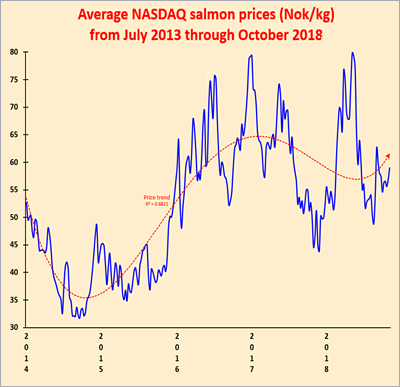
As a result, late 2017 saw salmon skipped its traditional Q4 rally, with prices sagging nearly 11%. They bottomed out at NOK44.60/kg (US$5.50/kg)* before making a weak recovery to NOK55.66/kg (US$6.85/kg) by the start of 2018 –rising a tiny 3% in the traditionally strong end of calendar year quarter.
They opened 2018 30% below the NOK79.40/kg (US$9.34/kg) level seen at the start of 2017. The above mentioned strong Norwegian and Chilean output gains kept prices in check for the first two months of 2018, making them slump 7.5% from opening year levels to NOK51.30/kg (US$7.49/kg) by early February. As a result, Q1 2018 industry revenue fell 1.5% despite a 6% increase in world salmon output relative to the same period of 2017.
Unfortunately, just as lower prices boosted consumption, unusually cold Norwegian winter water temperatures constrained Q1 and Q2 output. Coinciding with minor algal bloom losses in Chile, this forced optimistic projections of up to 10% increases in 2018 Norwegian production to be slashed back to 5% (or 1.41 million tonnes). –That immediately sent prices on a new upward spiral: From NOK51.30/kg (US$6.58/kg) in early February, they skyrocketed approximately 56%, setting a new record price of NOK80.22/kg (US$9.90/kg) by early May.
The unexpected hyperinflationary behavior shocked buyers, leading to a sharp demand drop. With supply not as badly impacted as initially believed, a Q2 withdrawal of buyers induced a mid-year market dive, with the average price bottoming out near NOK48.91 (US$5.84/kg) in August. But the slack market conditions did not last long.

 From the middle of Q3 and into Q4, persistent reports of faltering Norwegian salmon feed consumption and overproduction implied that all was not well supply-wise. A report by Norwegian bank ABG Sundell Collier stated: "The year-on-year biomass growth in Norway has vanished after some months of high harvest volume growth and poor biomass growth."
 Hence, while 2018 Chilean production rebounded by 14% (to 752,000 tonnes), hopes of up to 10% Norwegian output growth were slashed back to around 4.7%. With gill disease losses slashing third ranked Scottish salmon output by 15% to 20% (to 150,000 tonnes) and insignificant output expansion among other minor producers, supply kept pace with demand –but contrary to earlier expectations, it did not overtake it
It did not take long for this H2 2018 deceleration in supply growth to put a rising floor beneath prices: At the time of this article's publication in early November, prices had risen 22% from their August bottom and into the historically high level of NOK60/kg (US$7.16/kg).
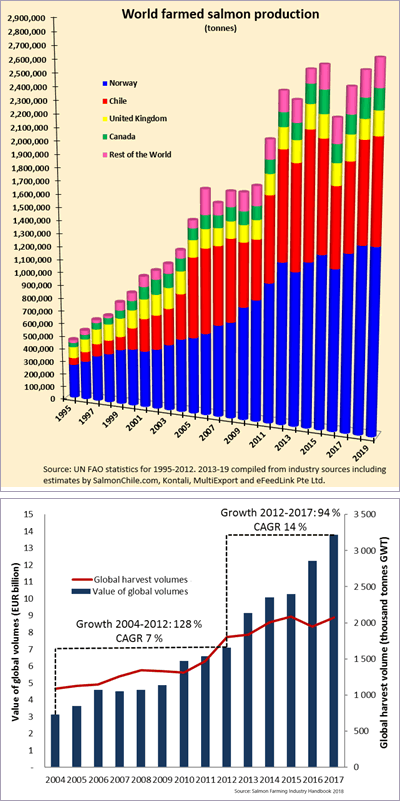
–Going forward, both history and hard facts making a case for an inflationary end to 2018 and high price beginning of 2019. Based on compiled government and industry figures, world farmed salmon output rose by an average of 9.6% annually from 1995 through 2013 inclusive. It allowed world salmon consumption to increase by 5% to 7% annually while making process fall continually for over 30 years ending after 2010.
Unfortunately, the five years since 2013 have seen 2% world salmon output badly trail demand growth, which has grown more than twice as fast. As a result, the past decade has seen the value of salmon production increase far faster than its output.
In particular, the last three years have seen average salmon prices top out in the NOK65/kg to NOK79/kg range. Not only is this likely to happen again but a case can be made that the current (as of November 6) January futures price of NOK67/kg will be exceeded within a few months.
For prices to return to their pre-2015 norm of below NOK50/kg, supply needs to grow faster than the estimated 5% annual demand expansion for at least several years –but the return of old problems are now making this impossible.
According to ABG Sundell Collier's report, despite the recent introduction of new, supposedly protective salmon housing structures, "An increasingly challenging sea lice situation is forcing salmon farmers to increase sea lice treatment activity, leading to loss of feeding days." Hence, Norwegian growers again face the same production dilemma: They must either treat afflicted fish, resulting in lower finishing weights, or lower their stocking densities. Both of which will result in lower-than-expected output growth.
What nature did to Norway, government is doing to Chile: According to a 19 September 2018 report in Undercurrent News, new Chilean government regulations will force fish farms that had been re-stocking farms that had been out of use prior to 2015 at 4kg per cubic meter to reduce their stocking densities back to 2kg per cubic meter. While the new rules are being challenged in court, no judgment is expected before 2019.
Ragnar Nystoyl, managing director of analyst firm Kontali believes that government constraints on production expansion will limit Chile's 2019 Atlantic salmon output growth to 3% and overall salmonid supply expansion to 4% or less.
In Norway, the implications of ABG Sundell Collier's report was confirmed by a 6 November 2018 IntraFish interview with MultiExport CEO Andres Lyons. According to Lyons "Looking into different indicators such as feed sales in Norway, water temperatures, the amount of fish currently in the water and the size of these fish, you can see that the evolution [forecast] for production growth is not good." He predicts that "Next year we should see a reduction in volumes, or at least no growth at all, coming from Norway, and a little increase from Chile."
Even though Lyons expects number three producer Scotland's output to rebound to near 2017 levels, with Norway and Chile accounting for more than 80% of world production and a higher proportion of exports, he expects world production to grow by 2% to 4%.
Lyons estimates that with world demand increasing by 6% to 7% annually, "The price outlook through 2019 remains very positive." With Kontali forecasting output growth of only 3% in the years up to 2021 inclusive, even conservative 4% to 5% demand growth forecasts imply more inflation in 2019 and firm prices thereafter.
From all this, we can make several medium and long-term predictions. Over the medium term, from their present NOK60.00/kg (US$7.13/kg) level, salmon prices should be followed by a much stronger market with prices near NOK70.00/kg (US$8.32/kg) in early 2019. –Moreover, a near 10% depreciation of Norway's currency versus the US dollar since April implies that prices will have to rise even more before they can dampen salmon demand in Asia and the Americas.
Unless a Chilean court overturns its new government mandated stocking density constraints, it will be difficult to make a scenario for prices to drop as sharply as they did in 2018. Unfortunately, the market would not feel the effect of higher Chilean production until after H2 2019. –Even then, under the most optimistic realistic scenarios, 3.5% to 5.0% annual supply growth will continue to lag demand growth.
Over the longer term, despite its record harvest and 5% output expansion, Norway's 2018 production is estimated to be only 7% higher than in its previous peak year. Just as output was stuck below 1.3 million tonnes for many years, a new output ceiling of 1.4 to 1.5 million tonnes could be forming.
A similar situation is also true in Chile, where output has risen swiftly, but to only similar or slightly higher levels than those of four years ago. With no other producers capable of keeping pace with world demand, it is not surprising that Norwegian producers are now talking about establishing land-based salmon farming facilities to expand production.
Such talk implies that traditional water-based salmon farming stocking density limits are becoming hard to transcend. The costly investment required for land-based production means that for such facilities to be profitable, prices will stay well above NOK50/kg (US$5.95/kg). All this implies that while price volatility may wax and wane, average salmon prices will fluctuate in the historically high NOK50/kg to NOK70/kg price range, with much potential for this year's NOK80.22/kg (US$9.90/kg) price record to be broken by this time next year.
* US dollar salmon prices are computed from the exchange rate prevailing at the time and may not always be proportionate to the change in Norwegian salmon price levels.
All rights reserved. No part of the report may be reproduced without permission from eFeedLink.


