



INDUSTRY NEWS
More and more benefits are being discovered about omega 3 fatty acids found in seafood. This time around, researchers have found that they are associated with a higher likelihood of healthy ageing among older adults. This means a lifespan without major chronic diseases and with good physical and mental functioning. This is an added boost to the seafood industry!
GOOD PHYSICAL, MENTAL FUNCTION
Omega 3 fatty acids in seafood linked to healthy ageing
Omega 3 fatty acids found in seafood are associated with a higher likelihood of healthy ageing among older adults, according to the findings of a US study published by The British Medical Journal, or The BMJ, on Oct. 18.
Healthy ageing means a meaningful lifespan without major chronic diseases and with good physical and mental function.
A team of US researchers from the Friedman School of Nutrition Science and Policy at Tufts University in Boston, USA, investigated the association between circulating blood levels of omega 3 polyunsaturated fatty acids (n-3 PUFAs) and healthy ageing among older adults.
The study involved 2,622 adults from 1992 to 2015, with 74 years as the average age of participants at the start of the study. Sixty-three percent were women and 11% were from non-white groups.
The researchers found that 89% of the participants experienced unhealthy ageing over the study period, while 11% experienced healthy ageing.
A possible explanation for this effect, according to the researchers, is that n-3 PUFAs help to regulate blood pressure, heart rate and inflammation.
At the same time, they pointed out that this was an observational study, so no firm conclusions could be drawn about cause and effect, and that they could not rule out the possibility that some of the observed risk might be due to other unmeasured factors.
The study had a long follow-up period (up to 22 years), and results remained largely unchanged after further analyses.
As such, higher levels of circulating n-3 PUFAs from seafood among older adults were associated with a lower risk of unhealthy ageing.
'NO LESS SAFE THAN OTHER SEAFOODS'
UK consumers' concerns over imported shrimp allayed
UK consumers have considered imported farmed shrimp as having inferior quality, but it appears their assumption has no basis.
A new research conducted by scientists from the University of Stirling in Scotland has found that imported shrimp is as safe as any other seafood product.
Experts used European Union data to perform a risk assessment on shrimp imports, which were found to have become much safer to consume in recent years. The findings of the research are published in the Aquaculture journal.
Dr Richard Newton, of Stirling's Institute of Aquaculture, said that the negative reputation of farmed shrimp stemmed from claims that tropical farmed shrimp were grown in polluted water and treated with large quantities of chemicals.
"We hypothesised that we could perform a risk assessment of shrimp imports which would allow us to calculate the amount that an average adult would need to consume to surpass the acceptable daily intake (ADI) for any particular harmful substance", he said.
Acceptable daily intake for antimicrobials
"Our study found that consumers would need to eat more than 300 grammes of shrimp per day to exceed the acceptable daily intake for antimicrobials".
Dr Newton and the team analysed 18 years of data from the EU's Rapid Alert System for Food and Feed (RASFF), which contains information on food and feed imports that have been found to contain banned or excessive quantities of substances, and subsequently removed from the market.
Dr. Newton and Prof. Dave Little, also of Stirling's Institute of Aquaculture, teamed up with colleagues at Shanghai Ocean University in analysing 18 years of data from the EU's Rapid Alert System for Food and Feed (RASFF), which contains information on food and feed imports that have been found to contain banned or excessive quantities of substances, and subsequently removed from the market.
"Based on the information in the RASFF database covering 1998 to 2015, our study found that consumers would need to eat more than 300g of shrimp per day to exceed the ADI for antimicrobials," Dr Newton said.
The scientists also concluded that the ADI is likely to be "much higher" than the 300g calculated because the RASFF database only contained information on contaminated shrimp and not those available to consumers.
Number of alerts drops
"This means that imported farmed shrimp are no less safe than any other seafood product", Newton explained:
Likewise, the research found that over the 18-year period, the number of alerts dropped significantly despite shrimp imports increasing. This means that shrimp have become much safer to consumer as exporting countries meet the safety demands of importers more effectively, the researchers explained.
The research also found media, particularly social media or the internet, to have reinforced the reputation of imported shrimp as being of low quality. The researchers compared the RASFF data with coverage on shrimps that appeared in mainstream media over the same period—and found that it tracked closely with the number of alerts, which are now a fraction of what they were in 2002, when he numbers peaked, in relation to large numbers of consignments contaminated with antimicrobials.
However, the research team found that information available on the internet continued the negative narrative, which is based on practices mostly phased out and does not reflect improvements that have been made in the industry. It noted that many websites promoted the consumption of local, wild-caught species in favour of imports despite some evidence showing that wild shrimp can also be contaminated with various harmful substances, and have ethical and environmental impact issues.
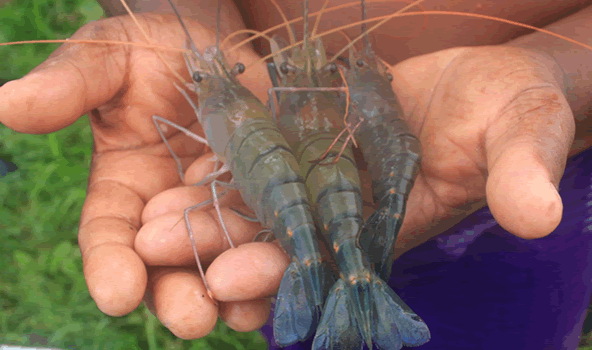
Black tiger shrimp PHOTO COURTESY OF UNIVERSITY OF STIRLING

ANTIBIOTIC, SALMONELLA ISSUES
US refuses entry to 7 shrimp imports in October
In October, the US refused a total of 96 seafood entry lines, of which seven were of shrimp for reasons related to banned antibiotics, unsafe additives and salmonella.
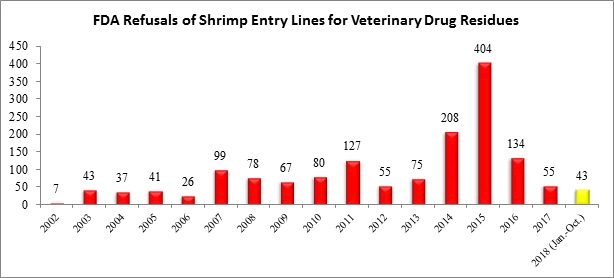
The Food and Drug Administration (FDA) refused entry to four shrimp entry lines for residues of banned antibiotics, the Southern Shrimp Alliance reports. One entry line came from Indonesia, another one from India and two had its origin in China.
An entry line of shrimp from Vietnam was refused for unsafe additives and for being poisonous, while two entry lines of shrimp from two different Indonesian companies were refused due to the presence of salmonella.
Earlier in August, an entry line of shrimp from Indonesia was refused because of banned antibiotics, marking the first time that the FDA has refused shrimp from that country for the presence of veterinary drug residues since August 2015.
During the first 10 months this year, the FDA refused entry to 43 shrimp lines for reasons related to banned antibiotics alone.
22 RESEARCH GRANTS
NOAA awards $11M to advance US aquaculture
The US National Oceanic and Atmospheric Administration announced 22 research grants totalling $11 million for projects around the country designed to expand sustainable US ocean, coastal and Great Lakes aquaculture.
Commerce Secretary Wilbur Ross said growth in the domestic aquaculture industry holds great promise to reduce the country's dependence on seafood imports. "With such vast coastlines, there is no reason the United States should be importing billions of pounds of seafood each year", he said.
The aquaculture research grants, conducted through the 2018 Sea Grant National Aquaculture Initiative, will help address priorities set by the U.S. Department of Commerce and NOAA to support research to advance marine aquaculture.
The grants are for three-year projects that will address priorities such as:
-- supporting new domestic aquaculture systems or technologies,
-- communicating accurate, science-based information about the benefits and risks of marine aquaculture to the public, and
-- increasing the resiliency of aquaculture systems to natural hazards and changing environmental conditions.
"Aquaculture is gaining momentum as a reliable, safe and sustainable source of food in the US, and we are excited to contribute to the growing industry and body of knowledge that supports it", said Jonathan Pennock, National Sea Grant College programme director.
The grant recipients must also match 50% of their funding with non-federal funds. Reflecting the growing interest in the aquaculture industry, NOAA received 100 proposals requesting nearly $48 million in federal funds.
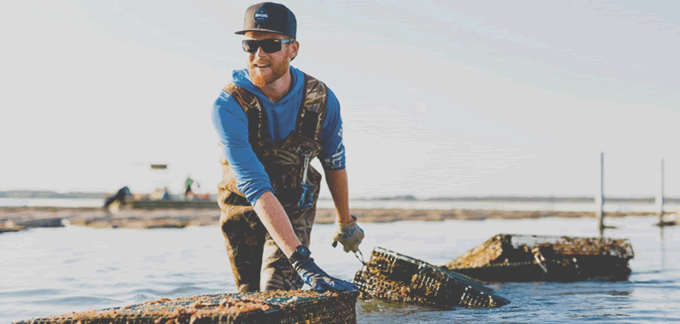
Joe Harned hauls in a line of floating oyster cages at Morris Family Shellfish Farms in Sea Level, North Carolina, where he's sampling
oysters grown using various gear tested by the Sea Grant National Aquaculture Initiative. NOAA PHOTO
UP 11% IN JAN.-SEPT.
EU is largest buyer of Vietnam shrimp
The EU is the largest export market of Vietnamese shrimp, accounting for 24.7% of Vietnam's total shrimp exports, based on latest data, according to the Vietnam Association of Seafood Exporters and Producers (VASEP). As of September, Vietnam's shrimp exports to this market reached US$648.4 million, up 11% over the same period in 2017.
Within the EU, the UK is the largest importer of Vietnamese shrimp, whose shrimp exports to the UK in the first nine months reached nearly $176 million, up 27.6% year-on-year.
Over the past three years, Vietnamese shrimp exports to the UK have grown steadily from $114.6 million in 2014 to $210.6 million in 2017, up nearly 84%.
The Netherlands, meanwhile, is the second-largest export market of Vietnamese shrimp in the EU. In the nine months through September, shrimp exports to the Netherlands reached $158.6 million, up 11.6% year-on-year. Vietnam was the largest supplier of shrimp to the Netherlands, accounting for 37.6% of the total value of imports by this market in 2017.
VASEP claimed that Vietnamese shrimp has a competitive advantage over other major competitors in the EU market, including India and Thailand, noting that these countries have seen a reduction in their exports to the EU due to problems related to quality standards.
Moreover, the EU-Vietnam Free Trade Agreement, which is expected to come into effect next year, will allow Vietnam to import shrimp and processed shrimp tariff-less.


