


November 11, 2025
Maximising corn stover: field cover, feed, or forage?
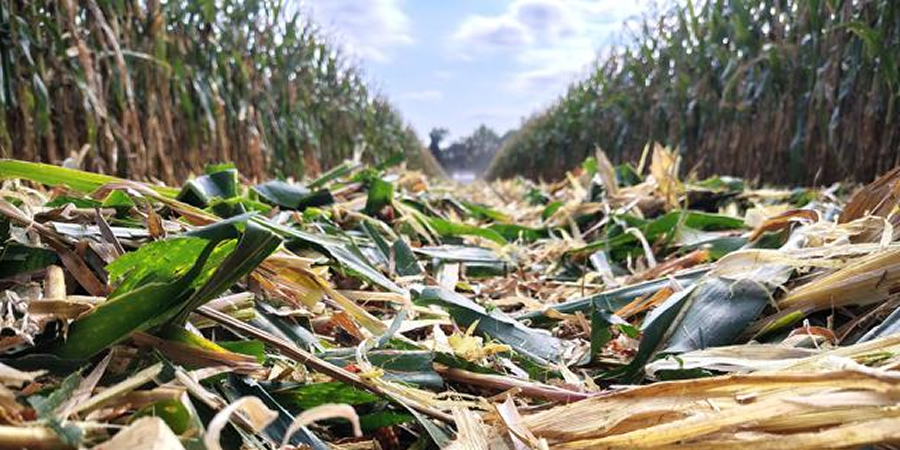
Penn State University extension specialists Tara Felix and Heidi Reed worked together to uncover the potentials of corn stover.
Parsing out corn stover drew three main strategies: keep it in the field, bale it, or graze it. Each has its benefits and drawbacks.
Now is the time for managing corn stover.
As corn harvest progresses throughout the region, you may be wondering about the best strategy to manage your stover.
From a soil health perspective, keeping soil covered is preferred. Erosion is not just an environmental problem.
Iowa State Extension estimates that erosion can cost farmers more than US$20 per acre each year due to lost nutrients, spending more on fertiliser, lower yields, etc. Standing cornstalks and leaf residue increase field roughness, which significantly reduces erosion.
Consider leaving fodder in place on vulnerable soil types and slopes.
Keeping corn fodder in the field also allows nutrients tied up in leaves, stalks and cobs to be released to your next crop as the residue breaks down. These nutrients have fertiliser value.
Corn fodder contains about 22-8-32 pounds of N-P-K (nitrogen, phosphorous and potassium) per dry tonne, according to calculations by Michigan State University Extension. Based on current national average prices, that means each tonne of corn fodder contains US$35.98 worth of fertiliser that will need to be replaced if it is removed from the field.
Grazing corn fodder is one way to extend the grazing season and lower feed costs. For every bushel of corn taken from the field, there are about 18 pounds of stem, 16 pounds of husk and leaves, and 5.8 to 6.0 pounds of cobs left as fodder (all on a dry matter basis).
Cattle will selectively graze any remaining grain first, followed by the husk and leaf, then cob and stalk. Strip grazing can help create a more uniform diet.
Plan to scout the field for excess grain piles and slowly introduce cattle to grain supplementation before turnout to minimise digestive upset.
Note that the quality of the fodder will change as the season progresses, depending on rainfall, stocking rate and other factors. Try to graze during the first months after harvest (October, November, December) instead of using the field in late winter (January, February). Nutrient composition of the fodder at the start of the grazing period is approximately 6% to 7% crude protein and 65% to 70% Total Digestible Nutrients (TDN) compared to 5% crude protein and 40% TDN at the end of the grazing period.
The economics of grazing corn fodder will depend greatly on rental rates (if needed), and costs of fencing, water and transportation.
University of Nebraska Extension found several benefits to grazing fodder compared to baling off fodder.
First, researchers found no significant changes in the status of N-P-K and organic matter in studied fields that were grazed compared to ungrazed when free-choice mineral was provided to meet cattle needs, due to manure and urine deposition.
Second, researchers found no negative impact on soil properties like bulk density and penetration resistance (a measure of compaction). Note that soil was not saturated during grazing.
Third, continuous grazing of fodder did not change corn yields in rotation and slightly improved soybean yields by 3.4 bu/A (bushels per acre).
Grazing can be risky when conditions are too wet or too dry.
If grazed too wet, hooves can rough up the soil surface and cause compaction, causing myriad problems for the next crop.
If grazed in drought conditions, there is risk of nitrate poisoning, though the lower portion of the stalk that has the highest nitrate concentrations will be the last thing the cattle eat.
Grazing fodder may not work for your operation; perhaps fields lack fencing or water infrastructure, there are no livestock on or in proximity to the farm, or you have an established market for harvested forages or bedding. Baling corn stover is another option worth considering.
Corn fodder could replace part of the medium-quality hay in a feed ration when supplemented with additional protein.
Using an Iowa State University calculation and current prices for feed ration components, that translates into a 0.6-ton bale of stover replacing over US$200 worth of feed.
Don't forget about the cost of baling and fertilizer replacement cost mentioned earlier, though. For example, custom hire for stalk chopping, raking, baling, and transporting bales 25 miles to end location using approximate current local prices adds up to $27 per bale.
Accounting for nutrient replacement per 0.6-tonne bale brings the total to produce one bale to approximately US$63. Baling stover with your own equipment and keeping it on-farm will drastically reduce the cost per bale.
Note that stover moisture at harvest and storage conditions can influence dry matter retention and nutritional composition. Plan for losses of material related to storage and feeding.
If stover bales are fed free-choice, anticipate feed refusal of less palatable components. Bale feeders can be moved to allow cattle to access and utilize refused feed as bedding.
If you choose to bale stover, the University of Minnesota Extension recommends not removing fodder from the same fields every year, using manure to replace organic matter, reducing tillage, and planting cover crops as best practices.
Keep fodder in the field when soil conservation is a main goal, fields are sloped, no cover crop will be planted, and bedding or feed are not needed.
Graze when feed is needed on the farm or there is a renter in proximity, fencing and water infrastructure is in place, or there will be a return on investment from installing.
Bale when bedding is needed, when feed is needed but fence and water infrastructure are lacking, when manure is imported, and when fields have high levels of remaining grain and risk of acidosis is a concern
- Lancaster Farming


