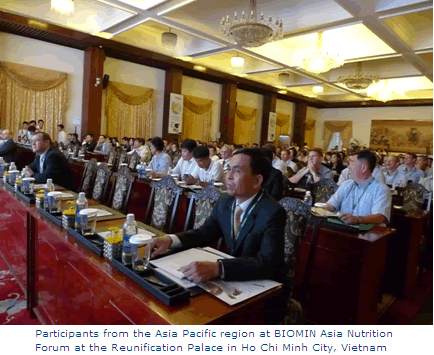
Rethinking fish feed formulation at BIOMIN Asia Nutrition Forum

At the recently-concluded Asia Nutrition Forum organised by animal nutrition company, BIOMIN, over 200 participants from the Asia Pacific region are challenged to rethink aqua feed formulation, looking beyond fishmeal and fish oil.
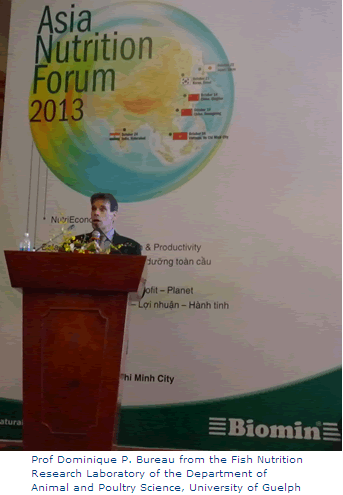
Putting things in perspective, with global aqua feed production of at least 35 million tonnes, of which fishmeal makes up a maximum of 5 million tonnes (14%) and fish oil makes up a maximum of 0.9 million tonnes (3%), fishmeal and fish oil are in fact minor ingredients in aquaculture feed globally. Since fish feed of non-fish origin accounts for about 83% of fish feed, feed producers should channel efforts towards alternative feeds other than fishmeal to ensure sustainability and viability of aquaculture.
"We should be talking more about the balance of the rest of the feed," said Prof Bureau. "Not just about fishmeal and fish oil and replacing it, but focussing on the quality of the 83-85%."
Prof Bureau continued with examples of the formulation of commercial feed for Crucian Carp (Carassius auratus gibelio) in China and for commercial extruded feed for Nile Tilapia in Southeast Asia, where fishmeal and fish oil accounts for only 4% of the feed formula. Instead, grains and tubers, such as corn, wheat, cassava, rice and milling by-products (bran) makes up 25% and 40% of the formulation respectively; while soymeal makes up 19% and 35% respectively.
"For most of the commercial species here in Asia, it is really not about fishmeal and fish oil, it's about using a great variety of ingredients which are plant-based, with minor contribution of rendered or processed animal protein and marine resources. Really the focus should be on grains, tubers, milling oil products and oilseeds if we want to make progress."
He rationalised that plant proteins represent major agricultural commodities that are traded around the world, whereas there are small amounts of fishmeal and relatively small amount of processed animal proteins being used, hence it makes sense to rely increasingly on plant protein resources as a basis of feed formulation.
Justifying his argument based on cost, Prof Bureau shared that fishmeal, on a protein basis, is 2.5 to 3 times more expensive than other protein sources. He also encouraged the use of processed animal protein as it is a cost-effective source of proteins, although it is currently not widely accepted around the world for various reasons.
"I feel it will become a very strategic ingredient in many feeds in the coming years all over the world, and we have done so in Asia already, for many years," he said.
Moving on, Prof Bureau said that "We are trying to find solutions to make things more effective from the perspective of an aquaculture nutritionist and a feed formulator." He elaborated that formulating cost-effective feeds is a delicate balancing act that requires reliable information on the requirements of the animals and the nutritive value and limitations of ingredients, such as anti-nutritive characteristics.
However, he noted it is still common practice to formulate feed and purchase feed ingredients based on approximate composition, or crude content; or focusing on the generic name of the ingredient, instead of the nutrient content.
"What is important is meeting the individual nutrient requirements of the animal, based on the nutrient content of the ingredient, its digestibility, bio-availability and potential limitations of the feed ingredient," he says.
Prof Bureau cautioned that similar ingredients produced using different raw material mixes, manufacturing and drying techniques and processing equipment and conditions can result in varying chemical composition, nutritive value, digestibility and bio-availability. Hence, accurate characterisation of the nutritive value of the different types of ingredients and batches is essential to optimise their use in feeds, although he recognised that this could be time-consuming and expensive.
In order to enhance knowledge of the overall value chain, he urged for closer interaction between feed formulators, nutritionists, buyers and quality assurance specialists, and to include feed ingredient manufacturers in the dialogue.
He also called for collaboration between industry and academic institutions to validate tests that are used or can be used, hopefully eventually arriving at rapid and reliable methods of assessing nutritive value.
Prof Bureau noted that currently, there is a relatively limited amount of high quality systematic work focussing on the characterisation of the nutritive value of the ingredients that now form the bulk of aqua feeds. Besides the 10 essential amino acids, fat and water soluble vitamins and minerals required by aqua species in general, there is a need to better understand nutrients which are species and life stage-specific such as taurine, phospholipids, cholesterol, nucleotides etc.
He shared that in his involvement in the US National Research Council (NRC) in 2011, extensive work has been done to determine nutritional requirements of fish and shrimp over an 18-month period. However, with the large number of aqua species, number of essential nutrients required and varying needs at different life stages of each species, among other variables, the research was far from complete. Nonetheless, it serves as a basis for further studies.
Prof Bureau concluded on a positive note that the need to rationalise research efforts has been answered and further research work in this area now focuses on the main commercially important species.