


October 24, 2025
CSR: A driving force for CCPA's group sustainable transformation
Sustainability lies at the heart of the CCPA Group's mission, which is "Engage our know-how with passion for the competitiveness and sustainability of the livestock sector".
It is expressed through a long-term commitment: contributing to the performance of animal production chains while reducing their environmental footprint. Nutrition, at the center of this approach, is one of the most powerful levers for transforming livestock production sustainably.
A pioneer in sustainable animal nutrition since the 1990s
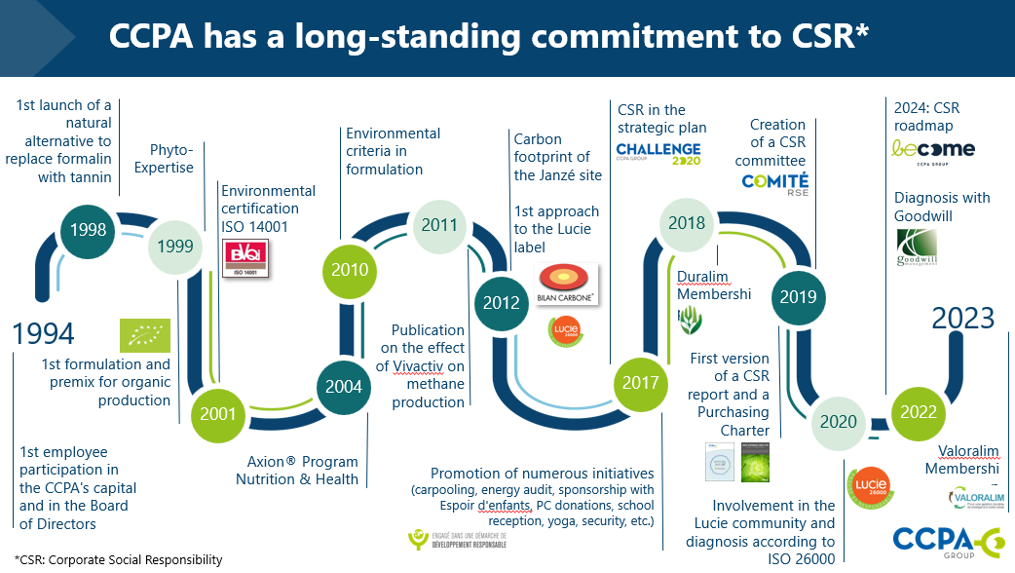
The CCPA Group's commitment to responsible animal nutrition is deeply rooted. As early as 1995, CCPA stood out as a pioneer by developing solutions based on Phyto-Expertise and offering the first formulations suitable for organic farming. This commitment continued with ISO 14001 environmental certification, the launch of the Axion® Nutrition-Health program, and innovative research on methane reduction through Vivactiv'®.
At the same time, the Group initiated strong social and societal actions, such as employee shareholding and participation in collective initiatives like Duralim and Valoralim.
Why such commitment? Because sustainable performance can only be achieved by combining nutritional innovation, environmental responsibility, and social progress. This alignment also responds to the growing expectations of customers, consumers, and society at large.
A clear ambition: creating shared value
In 2021, in line with the Paris Agreement, CCPA took a new step forward by placing CSR (Corporate Social Responsibility) at the core of its transformation. In 2024, this ambition materialized with the launch of a structured roadmap to 2030, accelerating its commitments and clarifying its priorities.
This dynamic is based on a strong conviction: sustainability must involve both internal stakeholders (employees, sites, organization) and external ones (clients, suppliers, partners).
"We are convinced that the sustainable transformation of animal production requires the mobilisation and collaboration of all stakeholders in the value chain. CCPA teams are determined to play their part in this collective effort through their expertise," explains François Pellet, CEO of the CCPA Group.
The 2024 carbon footprint marks the starting point of this strategy. It highlights key levers for action, particularly in scope 3* (raw materials and product use), in order to work in synergy with clients and suppliers to reduce the environmental impact of livestock sectors.
The CCPA Group's ambition is clear: to become a trusted partner, capable of supporting the entire value chain toward sustainable and shared value creation.
1. The Four Pillars of the CSR Roadmap
"CSR is at the heart of the CCPA Group: a collective, collaborative, and complementary commitment to building a responsible, resilient, and sustainable company. This collaboration naturally involves stakeholders from all parts of our value chain in a constantly changing world," says Marisela ARTURO SCHAAN, Group CSR Manager and Head of the Natural Ingredients Division.
CSR applies to all Group entities. To promote best practice sharing, strengthen cooperation, and facilitate the implementation of projects in the field, CCPA has created a network of Group CSR coordinators. This initiative fosters synergies and supports the operational rollout of CSR actions across all entities.
The CCPA Group's CSR strategy is built around four main pillars, each translated into concrete projects that structure the Group's transformation in a progressive and measurable way.
Pillar 1: Reducing Greenhouse Gas Emissions
• Nutritional solutions enabling animal production chains to reduce the carbon footprint of animal products (meat, milk, eggs) by 15%.
Pillar 2: Responsible Sourcing and Production
• 100% of suppliers committed to the Responsible Purchasing Charter by the end of 2025. By 2030, 100% of suppliers representing 90% of CCPA's purchase value will have a D&B ESG score ≤ 3.
Pillar 3: Responsible Innovation
• Deployment of eco-design across all innovation projects.
Pillar 4: Employee Well-being and Societal Engagement
• 100% of sites involved in at least one initiative to improve the work environment.
2. Responsible Purchasing: A Strategic Lever for Sustainability
Every purchasing decision directly impacts the performance, sustainability, and resilience of the value chains. The CCPA Group's Responsible Purchasing Charter formalizes this responsibility and is structured around four pillars:
1. Respect for Social and Ethical Standards
º Eco-designed, low-carbon products
º Transparent, respectful partnerships
4. Fair and Responsible Purchasing
º Traceability, eco-driving training, and optimized logistics
"Every purchase is a decision that matters. It is up to us to make it a lever for shared progress."
— Janic Gouhier, Group Supply Chain Director, CCPA.
3. Eco-Design: Innovation Serving Sustainability
Eco-design lies at the core of the CCPA Group's innovation strategy. It involves integrating environmental criteria right from the design stage of products and nutritional strategies, with the aim of minimizing their ecological footprint.
To guide this approach, CCPA relies on Life Cycle Assessment (LCA), in compliance with ISO 14040 and 14044 standards. This methodology evaluates 19 environmental impact factors, including climate change, water consumption, resource use, air acidification, water eutrophication, air quality, and human health. This multi-criteria analysis helps prevent potential pollution transfers and serves as a key foundation for the future environmental labeling of end products (milk, meat, eggs, etc.).
Close collaboration with upstream stakeholders (scope 3) is crucial to identify the high-impact raw materials on which the CCPA Group should focus its efforts: exploring alternatives, optimizing inputs and transportation, and more. Several areas for improvement have already been identified and implemented, such as designing the premix of the future and integrating ingredients derived from the Group's phyto-expertise research.
Identifying Levers and Quantifying Progress to Reduce Clients' Environmental Impact
In close collaboration with its clients, CCPA teams design tailored support programmes— including audits, scenario modeling, and consulting — to co-develop low-carbon and sustainable pathways for animal production sectors.
Modeling of typical farms across different species — Ruminant, Swine, and Poultry — helps to quantify the potential impact: a 15% reduction in carbon footprint is achievable by activating specific levers for each species.
For ruminants, a holistic approach combines several levers to reduce the environmental footprint while maintaining economic performance. Among these, Turboviv'® simultaneously reduces methane emissions by 6.3% and decreases the feed footprint by 25% (kg CO₂eq.). Meanwhile, Feedstim® Dairy enhances milk production efficiency, leading to a 5.5% reduction in footprint (kg CO₂ eq.). Combined with better management of unproductive periods, improved animal longevity, and health, these solutions contribute to achieving the targeted environmental objectives.
For poultry, the focus lies mainly on feed and feeding programs — key levers for monogastric species. The selection of raw materials can reduce the carbon footprint by 10% to 30% (kg CO₂ eq.). Adjusting feeding programmes and nutritional standards leads to a 10% reduction (kg CO₂eq.). Finally, integrating solutions such as Butirex® improves feed efficiency and digestive health, reducing the footprint by 3.1% (kg CO₂ eq.). All these actions are implemented while carefully considering economic constraints.
4. Future Perspectives and Commitments
The CCPA Group aims to make CSR a genuine driver of transformation, serving its clients and the animal production sectors. This strategy will continue to evolve around three main priorities:
3. Fostering cooperation and transparency, by strengthening scientific and industrial partnerships and contributing actively to future environmental labeling systems for food. Progress on the roadmap will be measured annually through precise indicators, ensuring transparency and accountability.
- CCPA


