


October 24, 2025
Women's dairy business hubs launched in Mudzi, Zimbabwe
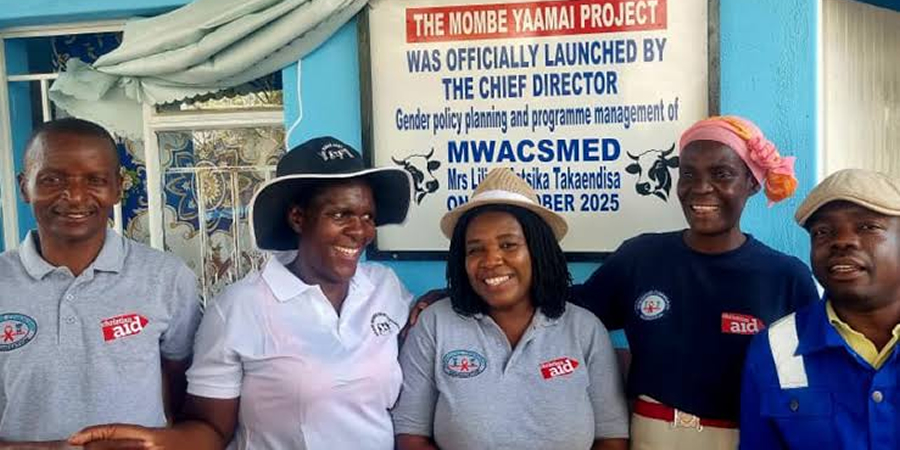
In a bid to transform rural livelihoods and promote gender equality in Mashonaland East province, the Nyahunure Community Organisation (NCO), in partnership with Christian Aid through the In Their Lifetime (ITL) funding initiative, has launched the Women Dairy Business Hubs—known as "Mombe YaAmai" (Mother's Cow)—in Mudzi District, Zimbabwe.
The event, hosted at the Sajen Women Dairy Business Hub in Ward 9, drew an enthusiastic crowd of villagers, Government officials, traditional leaders, business partners and development organisations.
Rooted in the beloved custom of 'mother's cow'—a symbol of care and sustenance in Zimbabwean marriages — the Mombe YaAmai project shifts the narrative from tradition to empowerment. Instead of cattle exchanged solely as dowry, women now become direct owners and managers of livestock enterprises, gaining both economic agency and social standing.
"This project is a transformative opportunity for us and women in our community," said Francis Pawandiwa, director of Nyahunure Community Organisation, in his keynote.
"By localising business investments, we are supporting women entrepreneurs and strengthening the local economy. Empowering women leads to stronger communities, and we are proud to be part of this important initiative."
The Mombe YaAmai initiative targets 3 000 smallholder farmers— 60% of them women—in Wards 3, 7, 9, 13, and 16. Two 4-hectare Women Dairy Business Hubs (WDBs) have been established in Sajeni (Ward 9) and Chaku (Ward 3), each with around 25 women members.
These hubs are equipped with modern infrastructure: security fencing, solar-powered water systems, 1,600 cactus fodder plots, paddocks, a milking parlour, Starlink internet, four T-rex dairy in-calf heifers, and a pedigree bull. Each group also contributed a dairy cow, ensuring local ownership from the outset.
"This is the first time in a long time that Mudzi has had a dairy project of this scale," explained Aulline Chapisa, Country Director for Christian Aid Zimbabwe.
"We are excited to see women moving into high-value chains like cattle and dairy. Not only does this boost financial independence, but it has a huge impact on household nutrition, especially for children."
The hubs are already yielding results. Three cows have delivered healthy calves, and one is producing an impressive 12 litres of milk daily—even during the dry season, generating approximately Z$12 or not less than US$0.01 a day in sales for the group. With improved grazing and fodder—courtesy of partnerships with private sector suppliers such as Mafuro Pastures and Seeds and the Matopo Research Institute's drought-resistant spineless cactus—the potential for growth is substantial.
"By investing in infrastructure and training, we are laying a solid foundation for scaling up gender-transformative approaches within the dairy and beef sectors," said Pepukai Muchazondida Svinurai, Christian Aid's Senior Programmes Officer for Climate Adaptation and Resilience. "The launch event brings together all key stakeholders—private sector, government ministries, traditional leadership, and local communities—to chart a path forward for lasting impact."
The launch was attended by representatives from the Ministry of Women Affairs, Small and Medium Enterprises, Youth, Agriculture, Water, Fisheries, and Rural Development at district, provincial, and national levels. The Mudzi Rural District Council, Agritex officers, and extension services lent their support, alongside private partners like Vision Engineering, Zimbabwe Association of Dairy Farmers (ZADF), Red Dane Farms, Zimbabwe Dairy Services, Farmyard and Farm Distributors, and Diamond Insurance.
Traditional leaders and local chiefs graced the occasion, stressing the project's deep community roots and respect for indigenous knowledge. Civil society and donor organizations, including MEDRA and the newly formed Local Humanitarian Strengthening Forum, were also present, signalling broad-based commitment.
Beyond dairy production, the project leverages the Gender Action Learning System (GALS) methodology to challenge entrenched norms and improve women's decision-making at both household and community levels. Training programs cover technical skills in dairy and beef value chains, governance, commercialization, and financial literacy—ensuring that women are equipped not just to participate, but to lead.
"Women are no longer just doing chickens or small gardens. They are moving into assets and businesses that can lift entire families out of poverty," emphasized Aulline Chapisa. "We want to see real, measurable change—not just gatherings, but tangible impact."
A standout feature of the hubs is the integration of Starlink internet, a first for many villages in Mudzi. This digital leap allows farmers to access new agricultural knowledge, connect with markets, and even enables local students to do research—bridging the rural-urban divide.
"Infusing our traditional way of implementing with technology has been deliberate from the start," said Chapisa. "In the age of AI and digital communication, our farmers must be equipped to solve problems and innovate."
The project aligns with Zimbabwe's Vision 2030, aiming to transform rural communities into upper-middle-income economies.
"If we can replicate this model in more districts, alongside community gardens and other Government initiatives, we will realise true rural development," said Pawandiwa.
With just two dairy hubs established so far, stakeholders are already discussing expansion. "There's potential to scale from four dairy cattle per hub to 10, 20, or even 30," said Svinurai. "But it will require continued support—from technical training to funding and market access."
As the festive crowd at Sajeni Village celebrated with speeches, songs, and the sharing of fresh milk, the sense of hope was palpable.
"In our tradition, the mother's cow is sacred. Today, it is also a symbol of a brighter, more equitable future," said Francis Pawandiwa. "The impossible can happen. Our women have proven it."
- Herald Online


