


October 11, 2013
Olmix inaugurates first algae bio-refinery worldwide in Brittany region of France

Olmix inaugurated Plouénan, the first algae bio-refinery in the world on September 9, built on a former industrial site of Agrival, a subsidiary of the SICA of St Pol de Léon.
Hervé Balluson, PDG of Olmix Group, the first industrial partner in Ulvans project, refers to the refinery in northern Brittany as 'a premiere in the world'. The aim of Ulvans project is to create a channel for the processing and the exploitation of algae in Brittany.
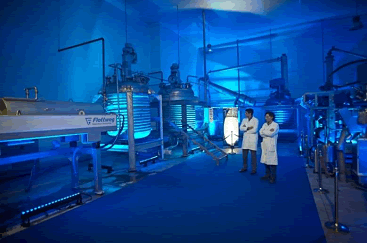
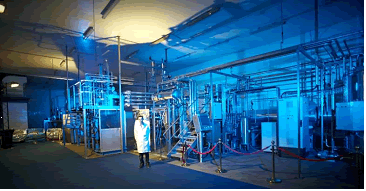
The inauguration was attended by 350 people from 26 countries in the world, including more than 200 guests who attended the Breizh Algae Tour event, the annual meeting on animal husbandry organised by Olmix.
The opening was followed by a technical seminar on the challenges faced by the world agriculture sector. Speakers from Pakistan, Nigeria, Vietnam, Mexico, United States, Ivory Coast, China discussed the challenges of decreasing the use of chemicals, pesticides and antibiotics inputs and to how algae present natural solutions.
The seminar was closed by Dr Pi Nyvall Collen, Olmix research Director, an algae specialist who joined the Olmix team after 10 years of research work on polysaccharides from Red brown and green algae at Roscoff CNRS.
The Breizh Algae Tour 2013, held concurrently during September 8 - 11 was themed 'The Breton Algae Sector for a sustainable agriculture to feed 9 billion people in 2050'. The tour covered Science, resource, industry and in-field application.
The tour was an opportunity to share ideas, views and discuss about significant global challenges impacting our sectors such as the increase of raw material price or other more technical subjects, but also a moment to imagine the agriculture of tomorrow.
Participants visited the historical heart of algae scientific knowledge - the 'station biologique de Roscoff'; observed different modes of algae harvesting on the algae fields of western Brittany; visited high-tech farms, animal husbandry research centres, feed mills and SACE livestock expo in Rennes; and of course visited the newly-opened first algae bio-refinery in the world.
Brittany, heart of livestock production in France, represents more than 55% of the country's pig production, more than 35% of the poultry and 40% of milk production. Agricultural and livestock research for new technologies is actively sought in the region.
Dr Collen says, "Our existing products continue to prove themselves MTX+ increase performance in all species while the latest results with MMis show a significant reduction on separated milk, all resulting in increased revenue for farmers."
Novel products will come based on the patents deposited within the ulvans project with applications in anti-stress, antibacterial and immunomodulation.
She says, "These results give us confidence that algae can be used to answer the challenges of tomorrow and comfort our choice to further develop algae based products."
In recent years more and more publications have demonstrated the relevance of seaweeds in numerous biological mechanisms, particularly in the immune response. In many cases the role of the sulfated polysaccharides in the interaction has been demonstrated, as well as the importance of the sulfate groups. The algal polysaccharides are recognized to influence the immune system by a vast number of pathways.
Olmix focuses on algae to design natural solutions for animal and plants in order to avoid the use of chemicals such as antibiotics. The Olmix programme is based on the industrialised valorisation of algae, from harvesting to extraction of active principles to be used in the eco-concept and algo-bio products. Natural alternatives proposed by Olmix are mainly commercialised overseas, to animal feed and animal hygiene industries.


