


October 6, 2005
Linking the supply chain in Philippine agriculture
An eFeedLink exclusive report
Even as the Philippines' agriculture sector strives to improve efficiency and global competitiveness, the industry cannot afford to ignore the enterprises or sectors that lag behind or fail cope with these new demands.
Such sentiments were echoed among industry players at the 12th International Agriculture Exhibition and Seminar, or Agrilink in the Philippines, with this year's theme, 'efficient supply chain: key to competitiveness', reflecting the core concerns of Philippine agribusiness.
To emphasise the linkages in the entire feed to food chain, Agrilink is once again held in conjunction with Foodlink, the food processing, packaging and products arm of the exhibition which is in its sixth year running.
Small and medium enterprises or SMEs, which account for 99.6 percent of all Philippine businesses, are also very much the backbone of local agriculture, said Pedro Ocampo, co-chairman of the Agrilink/Foodlink event.
"SMEs account for the bulk of Philippine agribusinesses, yet only 32 percent of total gross domestic income from agriculture," he said. "Clearly, there is a glaring weakness in the productive capability and operating efficiency of these companies."
Still, "it is in the SMEs that the nation pins its hope for economic stability," said Ocampo, who also added that instead of allowing free market forces to dictate the survival of such enterprises, much should be done to ensure that the Philippine agri-economy is "safely anchored" on a broad domestic capital and entrepreneurial base.
For this, the private and public sector need to work ever closer together. An active dialogue session between the Department of Agriculture and local agribusinesses, held on the morning of the opening day on Oct 6, provided a "much-needed forum", in the words of one participant, for both the government and private sector to speak out on current issues that affect the agribusiness community.
One of the issues raised was that of the export competitiveness of local agriculture both on the domestic and world stage. "What happened to our mangoes and tuna?" asked one participant at the dialogue, referring to the Philippines' top agri-exports and questioning the lack of more such "signature" agri-produce.
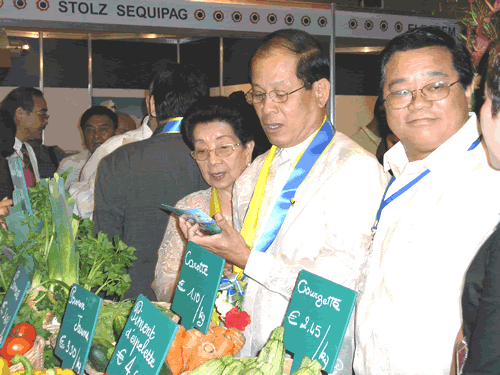
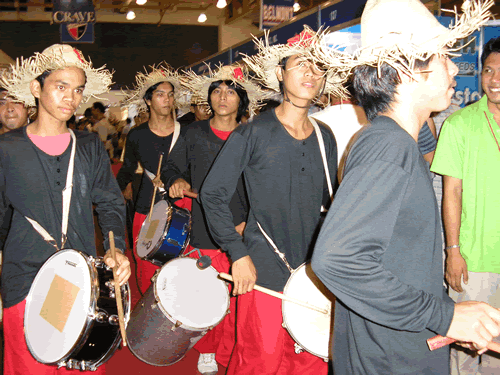
Panganiban inspecting fresh produce at the French A touch of Philippine flavour at Agrilink/Foodlink
Pavillion stand
Domingo Panganiban, the agriculture secretary, affirmed that much was being done to further exports of local food and agri-produce. On a recent bilateral trade session with Japan, the secretary revealed that top on his mind was the issue of Philippine exports of Yakitori (skewered chicken in Japanese-styled sauce) to Japan, which had not increased despite efforts to reach HACCP and hygiene standards as required by Japanese importers. The secretary reassured the dialogue's participants that Japan had promised to mobilise their team in response to the Philippines' request.
On a recent spate between Manila and Jakarta on tuna fishing in Indonesian waters, the secretary affirmed that talks are now underway to strike a bilateral agreement that will give Philippine fishery companies based in Indonesia the rights to process fish trawled from Indonesian seas. An agreement, said the secretary confidently, will be reached by Dec 4.
As the livestock industry is largely private-sector led, Panganiban said that the agriculture department will continue to focus on its role in providing sound regulations that positively impact the local poultry, swine and cattle industry. The import of all key inputs in the livestock and feed sector-feed ingredients such as soymeal, farm machinery and feed equipment to name a few-will continue to enjoy tax and duty-free status. This is just one of many development policies geared towards boosting the competitiveness and strengthening the supply chain of the local agriculture and food sector.
"We will also continue to liaise with all embassies and trade departments in Manila, to ensure that our farmers and agribusinesses get that much-needed exposure to export markets, while at the same time harnessing all available expertise in agro-technology," said Panganiban.
Agrilink/Foodlink is a three-day agribusiness event held annually in the Philippines. This year's event takes place at the World Trade Centre in Manila, from Oct 6 to 8.
All rights reserved. No part of the report may be reproduced without permission from eFeedLink.


