


September 26, 2022
ANDRITZ: A digital leader in pushing tech advancement in hard times
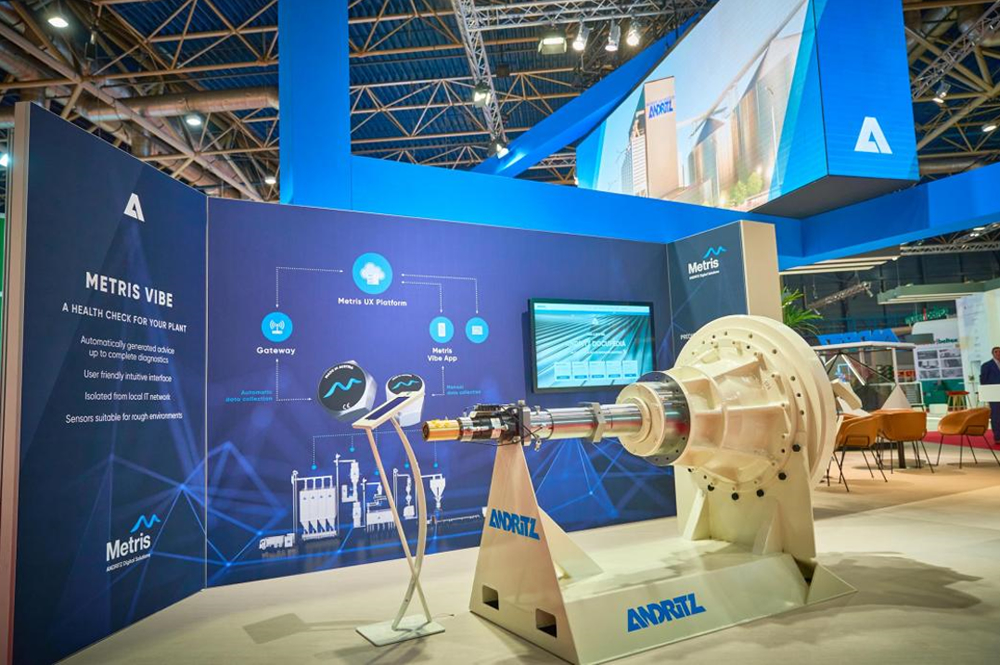
At the recent VICTAM Asia 2022 in Bangkok, Thailand, Andritz introduced new advanced technologies for the animal feed market, namely, the 3-Roll Assembly Upgrade for the Paladin 2000 and Metris Vibe – an integrated solution for condition monitoring.
Against the backdrop of the event, Michael Lierau, Senior Vice President of the Feed & Biofuel division at ANDRITZ, and Stefan de Roo, Global MarCom Manager for Feed & Biofuel, share about ANDRITZ's tackling of major challenges, its continuous efforts in innovation and the company's new solutions introduced at this year's VICTAM Asia.
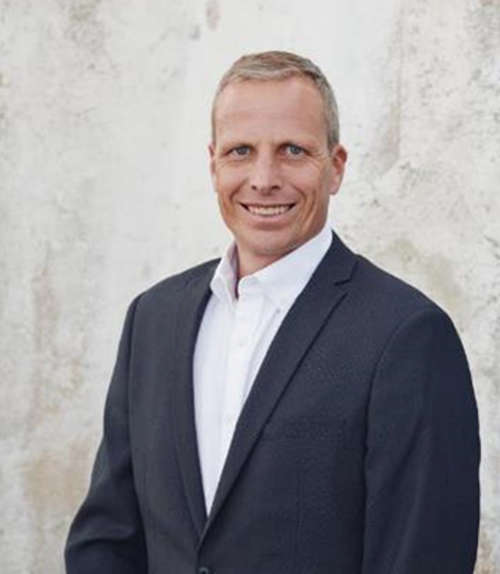
Michael Lierau, Senior Vice President of the Feed & Biofuel division, ANDRITZ
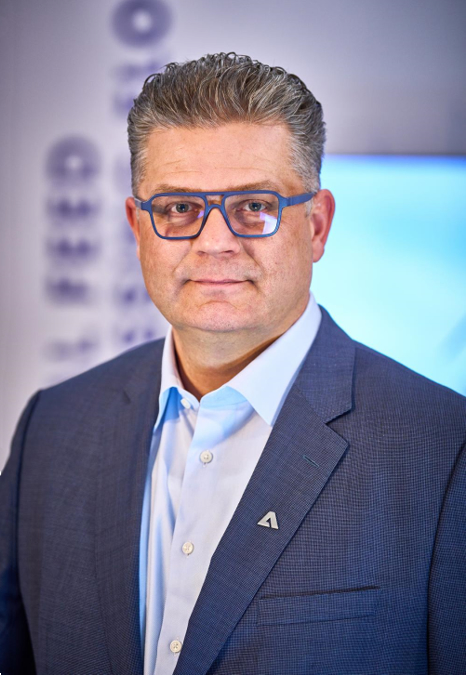
Stefan de Roo, Global MarCom Manager for Feed & Biofuel, ANDRITZ
High energy costs have created a difficult environment for the world. How would ANDRITZ products and solutions serve to address these issues?
Lierau: We have three major drivers: human resource, raw material and energy.
The question is always which one comes first. This time, it is energy. ANDRTIZ's Micro Feed System is an excellent example in this aspect to show how it can help clients take more advantage of an installed capacity. With our technology (as well as the same motor and infrastructure used), the Micro Feed System can produce 50% more capacity. This means you get more output for the energy you use in the process.
We're also looking into how you can use energy more efficiently or reduce heat loss. This is what feed mills tend to overlook. Fans, filters and the ejection of exhaust air into the environment without using the energy that's still in there — these are the areas we're looking into, to improve our solutions.
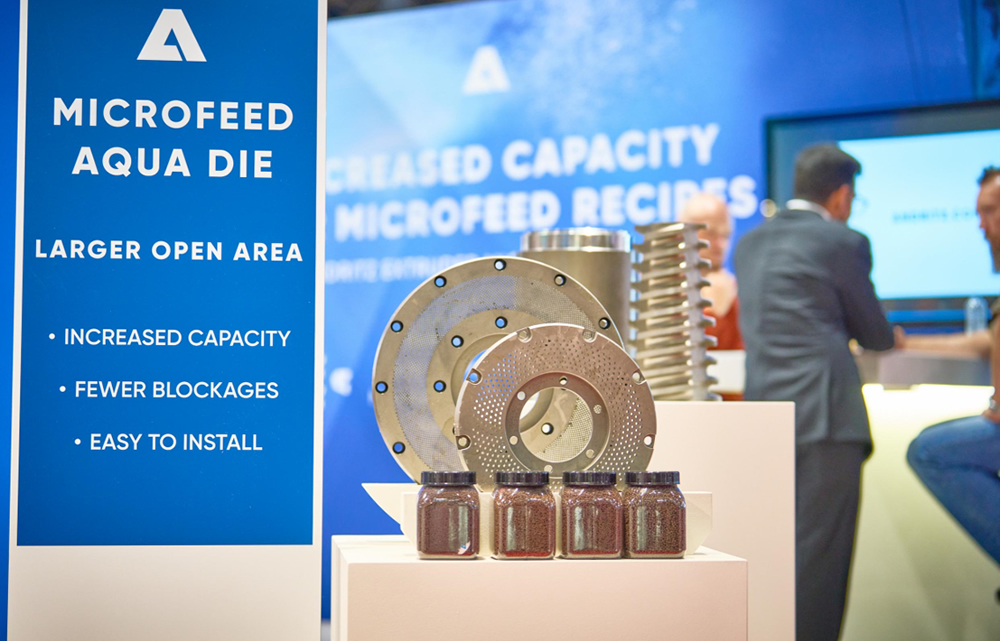
ANDRTIZ's Micro Feed System.
What can you say about the other applications showcased at VICTAM Asia 2022, namely, the 3-Roll Assembly Upgrade for the Paladin 2000 and Metris Vibe?
Lierau: The 3-Roll Assembly Upgrade is a technology that we can apply in our pellet mills. It allows feed mills to be flexible in production. It is not something that is limited to a specific pellet mill.
With a 2-Roll, you need to adjust the raw materials to the recipe that you produce. But 3-Roll can adjust the layer, the thickness and the load on the machine more subtly. It gives feed millers more room to process different types of recipes, taking into account that raw materials are getting more expensive. There is also a lower risk of contamination of the material with the 3-Roll Assembly Upgrade.
Metris Vibe is one technology that I would consider radical in our industry. It is a sensory tool that measures vibration and temperature, indicating whether your machine is running safely and efficiently, or whether an issue is happening.
Metris Vibe allows you to capture data on different rotating equipment in a feed mill. This provides cloud-based information to gain predictive information about the condition of your machine.
Additionally, Metris Vibe is completely independent of a control system, meaning it's 'cyber-secure'.
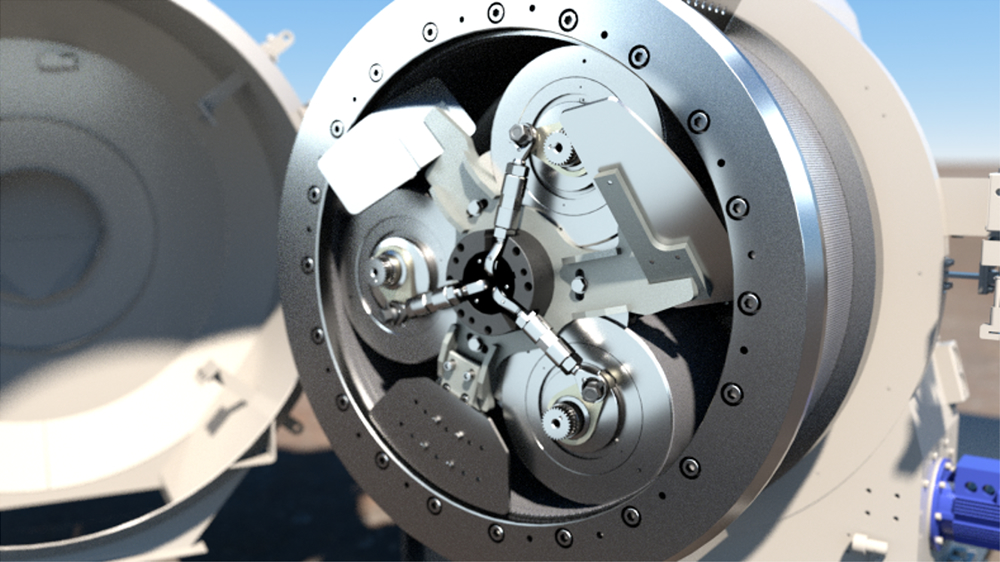
ANDRITZ's Paladin 2000 3-Roll Automatic Roll Adjustment System.
Today's technologies have evolved rapidly, with many technologies becoming more software-based. Can the same be said for the feed milling and livestock production sectors?
Lierau: Looking at the agriculture industry, the digital revolution has indeed taken place there, but just not at the pace seen in other industries.
At ANDRITZ, we truly want to be a digital leader in the (feed milling) industry. Hence, what we try to do at ANDRITZ Feed & Biofuel is to respond to what is necessary for the industry to move towards a more digitalised environment. We are adopting know-how and technologies from other industries and applying them to feed and biofuel.
Metris Vibe is a very small puzzle of a digital solution that we're also offering to clients in the pulp and paper industry. In that industry, there is a strong interlinking of information that is shared between customers and ANDRITZ, allowing us to operate plants on behalf of our clients.
Indeed, we want to bring the (feed milling) industry to such a level where we could run feed mills for our clients so they can focus on what they are doing, that is, marketing their products.
We're evolving from a passive into a more responsive partner that can conduct preventive and predictive maintenance, and even become involved directly with operations. We can capture data and conduct professional data mining to a point where we can indicate to our customers where an issue could happen. This is a technology that came from outside the feed industry, and which we adopted.
With impactful global events happening over the past two years, how has ANDRTIZ adapted to the difficult circumstances?
Lierau: Most would assume the answer would be that we would see a major challenge in energy costs, raw material costs and COVID-19. But we have been dealing with some of these issues for many years.
We've experienced significant growth over two and a half years. Growing by 50% requires people, and I think our biggest challenge was to align our organisation with this growth. Today, we're still hiring, as it is difficult to find available manpower that can help us to take on upcoming projects.
COVID-19 did help us refine our technologies, while also shaping how we communicate with our staff and customers. It had not been expected that Andritz was actually growing in a period that required everyone to think slightly differently about how to do business and survive in the industry.
Asia-Pacific is a fragmented region with matured markets like Australia, and countries like Cambodia and Myanmar just beginning to develop their feed and livestock production sectors. What is the key issue that ANDRITZ sees in the region?
Lierau: It is a question about the available resources that you can put into a feed mill.
We have feed mills that have reached a high level of business development, not only in terms of technology but also in terms of running operations — from plant design to aftermarket solutions. Still, one challenge is helping farmers, who have the intention for further growth, to be competitive in this environment.
For instance, you can run into an issue even with a fantastic pellet mill, and this also comes with a hefty price tag for, especially, a small farm. Thus, we help customers with financing options such as leasing models. We aim to help small farmers realise their vision of what they want to be in the future.
When it comes to resource-rich countries, we can serve these markets with very high-capacity equipment, which would enable them to run extraordinarily high-capacity feed mills. The advantage of a resource-rich country is that you do not need much logistics. Hence, it's the economies of scale that you can take advantage of.
On the other hand, I think we are challenged with determining the scale of equipment in terms of throughput capacity and our current product portfolio.
That said, ANDRITZ still has the largest biomass pellet mill in our portfolio. Furthermore, we can serve all types of customers.
We have a very high capability and know-how in terms of equipment, applying them together in a complete solution. But what is distinctive about ANDRITZ is our capability to service customers, not only for our plants.
ANDRITZ has a very robust process and this goes back to over 186 years of experience and our evolution in technology. When you acquire something from ANDRITZ, it works. This is because we have extremely reliable processes and very knowledgeable people across the globe.
It's not just in Asia or in Europe, but across all continents.
With climate change being a concern in the world and the global call for sustainability, please share how ANDRITZ will continue to evolve to address these challenges in the feed and biofuel sectors.
Lierau: You would be surprised that ANDRITZ began its sustainability initiatives before we even thought about it. And it started with biomass.
In terms of feed milling, we have some lessons learned from the biomass industry. Additionally, we are constantly looking at using highly efficient motors. We are also looking at better insulation and better process engineering that can help reduce power usage and shift away from fossil fuels.
de Roo: (Our approach is) based on the three pillars of environmental, social, and government (ESG), and that that's the framework that every company works with.
As Michael mentioned, sustainability has been on our radar without even realising it for many years. It has been established that ANDRITZ, as a group, has to contribute (to sustainability) with its solutions. We are thus aiming to mitigate the risk of climate change and save on energy consumption in whatever we do.
Are we there yet? We're not. But the fact that sustainability is already in our DNA and this quality needs to be reflected in the products and solutions that we launch in the market.
ANDRITZ also wants to be an attractive employer. It is a place where leaders in ANDRITZ are responsible for taking care of their people and, in turn, taking care of the business.
And as for our customers, we want to say: We understand you and we stand by you.
- Nicholas Yong, eFeedLink


