


INDUSTRY NEWS
World fish production will increase 15% by 2026 compared with the base period (average 2014-2026), and the main driver of this rise will be aquaculture, for which output is expected to be 34% higher in 2026 relative to the base period (average 2014-2026). This is according to the projection of OECD and FAO in their joint agricultural outlook for 2017-2026.
OECD-FAO OUTLOOK
Aquaculture to drive world fish production growth
World fish production is projected to reach 194 million tonnes in 2026, with an overall increase of 26 million tonnes, or 15 percent compared with the base period (average 2014-2026).
According to the OECD-FAO Agricultural Outlook 2017-2026, the main driver of this increase will be aquaculture, for which output is expected to be 34% higher in 2026 relative to the base period (average 2014-2026).
Global aquaculture production is anticipated to exceed the 100 million tonne mark for the first time in 2025 and to reach 102 million tonnes by 2026, as aquaculture is expected to be one of the fastest-growing food sectors despite its average annual growth rate slowing from 5.3% per annum in the previous decade to 2.3% in the period 2017-2026.
According to the outlook report, the bulk of aquaculture production will continue to come from Asian countries, which will account for about 90% of total production by 2026. China will remain the dominant producer, accounting for 63% of total aquaculture production by 2026.
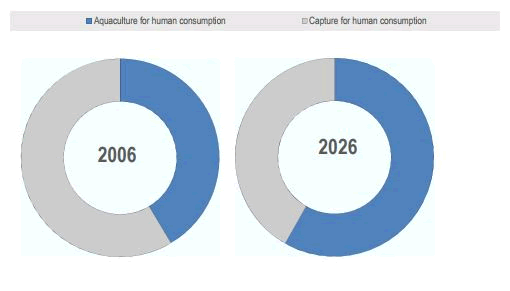
By 2026, aquaculture will account for 53% of total fish production and 58% of total fish produced for direct human consumption (excluding non-food uses).
Of the 177 million tonnes of fish consumed worldwide in 2026, the lowest consumption is expected in Oceania and Latin America.
Asia will consume more than two-thirds of the total, or 127 million tonnes, of which 56 million tonnes will be consumed outside China. Asia is also expected to continue to account for the majority of consumption growth, accounting for 76% of the additional fish consumed by 2026.
Share of aquaculture in total food fish consumption, 2006-2026
Source: OECD/FAO (2017), "OECD-FAO Agricultural Outlook", OECD Agriculture statistics (database)
RESEARCH FINDING
Fishmeal could be source of antibiotic resistance genes…
Antibiotic-resistant bacteria and genes for antibiotic resistance have been showing up in unexpected places including isolated caves and ancient permafrost. This time, a team of scientists has surprisingly found these genes—where they can be exchanged among bacteria and possibly end up in the food chain—in the sediment of marine fish farms even when no antibiotics have been applied.
According to the scientific team's report, which appeared in the American Chemical Society's Environmental Science & Technology journal, one suspected source of these bacteria and genes is fishmeal, which is made of low-value fish and seafood byproducts.
Previous research has found that fish food, which generally incorporates fishmeal, can contain antibiotics. But no study had yet measured the abundance of antibiotic resistance genes in the fishmeal.
As millions of tonnes of fishmeal are used every year with much of it sinking uneaten to the ocean floor, lead researcher Jing Wang and colleagues wanted to see what its impact could be on the mariculture "resistome," or collection of resistance genes.
The researchers analysed commercially available fish meal and found 132 antibiotic resistance genes, some of which could potentially confer resistance to common antibiotics and those of last resort, such as vancomycin.
Lab testing showed that the application of fishmeal to marine farm sediment samples changed the makeup of bacteria species, boosting potential human pathogenic bacteria (Vibrio species), which contribute to foodborne illnesses worldwide. It also increased the abundance and diversity of antibiotic resistance genes in the test sediments.
The results suggest that fishmeal product could itself be a reservoir of these bits of DNA and could promote their distribution globally.
The researchers received funding from the National Basic Research Programme of China.
…But fishmeal makers question finding
IFFO, the international organisation representing member companies in the fishmeal and fish oil industry worldwide, has questioned the result of a published scientific paper indicating there is a potential for fishmeal used in aquaculture feed to be a vector for antibiotic-resistant genes.
According to the research report, which appeared in the American Chemical Society's Environmental Science & Technology journal, antibiotic-resistant bacteria and genes for antibiotic resistance were surprisingly found in the sediment of marine fish farms even when no antibiotics had been applied.
The researchers said that one suspected source of these bacteria and genes was fishmeal, which is made of low-value fish and seafood byproducts.
The study noted that previous research had found that fish food, which generally incorporates fishmeal, can contain antibiotics, adding that no study had yet measured the abundance of antibiotic resistance genes in the fishmeal.
IFFO said in its response posted on its website that the research paper raised several questions including the conduct of sampling of the Peruvian fishmeal, in which the researchers found seven different antibiotic residues.
The Peruvian fishmeal, IFFO said, is normally made entirely from wild-caught Peruvian anchoveta.
"As the sampling was conducted in China and not in Peru, we are seeking clarification of the measures taken to protect samples from contamination", IFFO said.
IFFO also claimed that antibiotic-resistant genes (ARGs) are susceptible to degradation in the environment and that the transfer of genes to other bacteria is a complex process with a number of conditions that must be met for transfer to occur. "It is not clear what risk detectable ARGs represent in the mariculture environment", it said.
IFFO acknowledged the fact that ARGs have been found to be present in apparently isolated locations including permafrost and cave systems. "They may therefore have become somewhat ubiquitous in the environment", it said.
It raised the possibility that ARGs may be present in other marine sediments "The inclusion of a sample control in the paper such as other marine sediments not within the vicinity of a mariculture unit would have helped to identify whether fish farms are actually the source of the ARGs".
IFFO also noted that only very limited other feed ingredients were included in the test. Thus, "it is possible that the presence of nutrients in the sediment (from either fishmeal or other feed ingredients) are encouraging the growth of sediment bacteria which may contain ARGs that do not originate from fishmeal".
Moreover, IFFO observed that fish farms in China "are often notable for their proximity to human populations, and it may well be that any selection pressure on bacterial communities arising from antibiotic use is a result of other sources, such as sewage effluent".

GOOD PROSPECTS
China aqua feed output increases 7.4% in 1st half
China's freshwater aqua feed production rose 7.4% to 1.44 million tonnes in the first half, data from the China Feed Industry Association showed.
In addition, freshwater aqua feed accounted for 10.4% of China's overall feed production in the first six months, while mariculture accounted for 3.7%.
In comparison, feed for pigs and broilers took up 47.2% and 30.8% of feed output, respectively.
GROSS EARNINGS HIGHER
Philippine fisheries output down 3% in Q2
Philippine fisheries output declined 2.93% in the second quarter and contributed 16.84% to total agricultural output.
According to the Philippine Statistics Authority (PSA), the fisheries sector grossed 63.51 billion pesos (US$1.23 billion), or 4.40% higher than last year's gross earnings.
Production expansion and price hikes pushed up the gross receipts from milkfish by 14.35%, tilapia by 12.01% and seaweed by 22.73%.
Gross earnings from tiger prawn declined 5.81%, due to lower volume of production.
DESPITE REQUIRED SAFETY TESTS
Vietnam's post-Aug. 2 pangasius exports to US remain 'stable'
Vietnamese pangasius exports to the US market have so far remained "steady" since Aug. 2, when all products of Siluriformes fish including catfish that are shipped to the US are required to undergo food safety tests, the Vietnam Association of Seafood Exporters and Producers (VASEP) said.
Truong Dinh Hoe, VASEP general secretary, said that during the 18-month transitional period, both sides worked out cooperative approaches to common issues and that the USDA Food Safety and Inspection Service (FSIS) gave close guidance on how to comply with the US requirements.
Mr. Hoe expressed the belief that the Vietnamese pangasius industry has been well developed with substantial and stringent food safety control system. At the same time, he feared that an import discrimination policy from the US government may cause unfavorable and unfair decision against Vietnam.
Under the new US catfish inspection programme, countries that want to continue to export siluriformes fish and fish products to the US must submit a complete "Self-Reporting Tool" and supporting documentation to FSIS by Sept. 1.
As of last year, the US was the largest buyer of Vietnamese pangasius, accounting for 23% of the Sotheast Asian country's total exports, followed by China at 17% and the EU, 16%.
CUT BY HALF
New fish feed factory brings cost of fish feed in Rwanda down
A new fish feed factory that recently started operations has been instrumental in drastically cutting the cost of fish feed in Rwanda by almost half, from about 1,500 Rwandan francs (US$1.80) to RFW800 (95 cents), The New Times reported.
The factory, located at the Kigali Special Economic Zone, has become a relief for farmers, who used to rely on costly fish feeds imported from Israel, Germany, Mauritius and Uganda.
Bart Gasana, managing director of the factory's owner, Aquahort Exports Ltd, told The New Times that the factory guarantees farmers fresh, nutritious and affordable feed.
The factory has so far installed a facility worth $400,000 (about Rwf330 million).
Gasana said the plant's expansion would depend on feed demand from farmers.
The plant is capable of producing about 700 kilogrammes of feed per hour, and is expected to boost fish farming in the country.
GROWING POPULARITY
More aquaculture farms get BAP certifications
Marine Harvest's and Cooke Aquaculture's salmon farms are among the many sites approved by the Best Aquaculture Practices (BAP) certification, a testament to the regime's popularity, according to Steven Hedlund, communications manager of BAP's developer, Global Aquaculture Alliance.
Other sites certified include shrimp farms operated by Vietnam's Stapimex and Thailand's Good Luck Products and Marine Gold Products. Additionally, Fishin' Company (China) and the Colombia Aquaculture Federation's tilapia farms received BAP's acknowledgement.
In some cases, parties in the supply chain have assisted vendors to achieve certification. Such was the scenario for Sunnyvale Seafoods, which helped Stapimex and Good Luck to obtain BAP's stamp of approval.
Hedlund said five other group BAP certifications could follow as he revealed that 106 farms—from Colombia, China, Vietnam and Thailand--are currently going through the certification process.
Group certification is now a vital component of aquaculture production in view of demands for sustainability.
Instead of auditing individual farms, only a portion of a group's farms in close proximity to each other are audited. All these farms have to be under a quality management system (QMS) to be considered a group. A QMS will allow farms to be self-audited against BAP standards.
Hedlund added that with the BAP programme, consumers and the marketplace will have more access to certified products that are quickly and more efficiently certified in a lower cost manner.


