


August 28, 2025
The challenges of India's "unique" dairying model
How competitive and efficient is India's dairy sector?
That's a question being asked, especially with pressure on India from the Donald Trump administration in the United States to open up its market to American dairy products.
One way to assess competitiveness is prices.
Take corn, where the farmgate price in the US is currently about US$4.5 for a bushel (25.4 kg). At ₹87-to-the-dollar, it translates into a price of ₹15.4 (US$0.18) per kg received by the average American corn farmer. This is as against the ₹ 22-23/kg (US$0.25- US$0.26) rate at which corn is wholesaling in Indian mandis and the government's minimum support price of ₹s 24/kg for the cereal grain.
The US corn farmer, in other words, is far more price competitive than his Indian counterpart. Not surprising, given that average yields in the US, at over 11 tonnes per hectare, are more than three times the 3.5 tonnes of India.
But this isn't the case with milk.
The US has a Federal Milk Marketing Order (FMMO) system. Under it, processors ("handlers") have to pay a minimum price for the raw milk they procure from dairy farmers. The price is fixed every month for four uniform "classes" of milk: Class I (for sale as fluid/beverage milk), Class II (for making ice-cream, yogurt, sour cream and other soft dairy products), Class III (for cheese) and Class IV (for butter and milk powder).
The FMMO prices in July 2025 were US$18.82, US$19.31, US$17.32 and US$18.89 per hundredweight (45.36 kg) respectively for the above classes of milk containing 3.5% fat. These, at Rs 87-to-the-dollar, work out to an average of ₹ 35.6 per kg or ₹ 36.7 per litre (one litre of cow milk weighs 1.03 kg).
That's close to the ₹ 34/litre (US$0.39) price that Maharashtra dairies are paying to farmers for cow milk with 3.5% fat and 8.5% solids-not-fat (SNF) content. It makes the farmgate price of milk in India as, if not more, competitive as that in the US.
The competitiveness is more vis-à-vis Europe. The average price for raw milk paid to farmers in the European Union was €53.17 euros (US$61.83) per 100 kg in July, which, at ₹101.5-to-the-euro, comes to about ₹ 55.6 (US$0.63)per litre.
Farmgate prices in New Zealand are now around NZ$76 (US$44.34) per 100 kg or ₹39.9 per litre at₹51-to-the NZD. But this is for milk with 4.2% fat and 9% SNF content. For milk with lower 3.5% fat and 8.5% SNF, the price would be just under ₹ 35 (US$0.40) per litre (Dairies are selling milk fat at roughly ₹ 550/kg (US$6.27) and SNF at ₹ 250/kg (US$2.85); the realisations from the extra 0.7% fat and 0.5% SNF must be deducted to arrive at the equivalent price for 3.5% fat and 8.5% SNF milk).
Milk yields in India are poor by western standards. The average Indian milch cow, according to US Department of Agriculture data, produced 1.64 tonnes of milk in 2024. The corresponding numbers were 4.60 tonnes for New Zealand, 7.33 tonnes for the EU and 10.97 tonnes for the US.
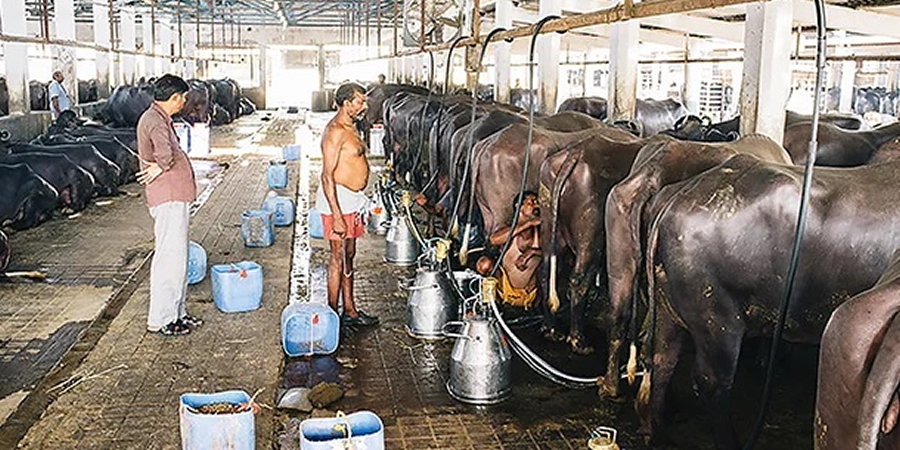
The low yields notwithstanding, the production cost of milk in India isn't that high because dairying is comparatively labour-intensive: Cows have to be fed and milked multiple times daily, besides being bathed regularly along with removal of dung and cleaning of their sheds. In addition, labour is required for planting, harvesting and storing fodder and feed.
Although dairy farms in the West have significantly automated these operations — through milking machines, forage harvesters and balers, feeding robots, sensor-based cattle health monitoring, hot water high-pressure cleaners and bulk coolers — the low cost of labour makes it still cheaper to produce milk in India. Milk has a higher labour cost component relative to corn, soyabean or wheat.
The retail price of whole milk (containing 3.25% fat and 8.25% SNF) averaged US$4.37 per gallon or ₹ 100.4 per litre (one gallon=3.785 litres) last month in the US.
On the other hand, the Gujarat Co-operative Milk Marketing Federation's (GCMMF) toned ‘Amul Taaza' milk (with 3% fat and 8.5% SNF) is retailing at ₹55 (US$0.63) per litre in Gujarat and ₹ 57 (US$0.65) in the national capital region.
Taking a farmgate price of ₹ 31.5 (US$0.36)/litre for toned milk in India and ₹35 (US$0.40)/litre for whole milk in the US, after adjusting for the lower fat percentages, the Indian farmer would be receiving 55-57% of the price paid by the consumer here. That's more than the 35% share of the consumer dollar for the US farmer.
If efficiency is measured by price spreads from the farm to consumer, the Indian dairy sector scores pretty high. GCMMF, in fact, claims its farmers in Gujarat are getting₹44-₹45 (US$0.50 – US$0.51) per litre for cow milk (3.5% fat and 8.5% SNF) and ₹ 65-₹66 (US$0.74 – US$0.75) for buffalo milk (6.5% fat and 9% SNF) — much more than the ₹ 34-₹35 (US$0.39 – US$0.40) and ₹58-59 (US$0.66 -US$0.67)/litre that private dairies are paying. Thus, it is sharing over three-fourths of the consumer rupee with the Gujarat farmer.
All this is due to efficiency in procurement, processing, transport and marketing, enabling a compression of the value chain. A cooperative's aim is to maximise the ratio of the farm value of milk to the retail sale value of products.
India's price competitiveness in milk, as noted, derives primarily from the low cost of labour. That includes unpaid family labour having few employment avenues outside of agriculture.
The dairy farmer basically seeks to recover only paid-out costs (on feed, hired labour, veterinary care and other purchased inputs), while not imputing any value on family labour or owned land. Any money earned over and above pocket-paid expenses constitutes "return".
But this model may not be viable in the long run, with farm labour becoming increasingly scarce and expensive. As the reluctance to work on the farm goes up with rising education, even family labour has an "opportunity cost".
The US, incidentally, had a mere 24,470 dairy farms producing milk from 9.3 million cows in 2022. India has upwards of 50 million farmers engaged in dairying with some 110 million milch cows and buffaloes.
The focus has to be on reducing the cost of milk production so as to maintain the global competitiveness of India's dairy sector, which cannot be based on cheap labour alone.
- The Indian Express


