


August 21, 2023
Kemin's Dr. Taina Silvestre: Keeping perpetual commitment to higher ruminant standards
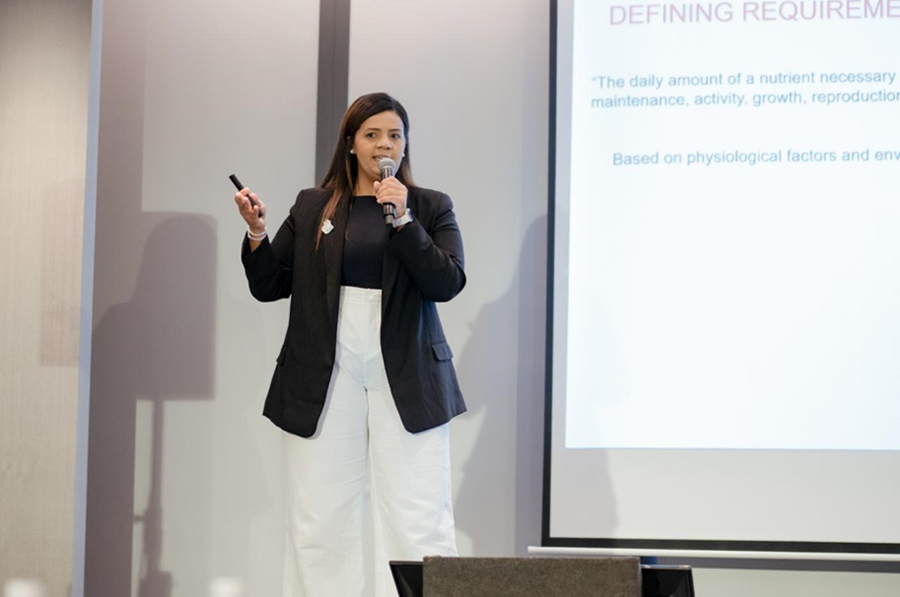
Dr. Taina Silvestre was recently appointed as ruminant technical service manager of Kemin Animal Nutrition & Health (Asia-Pacific).
She dovetails her current responsibilities with a strong commitment to reducing the carbon footprint of milk production. "One strategy to achieve this goal is to formulate diets reducing crude protein concentrations and balancing with rumen-protected amino acids," Dr. Silvestre explains.
She shares with eFeedLink how Kemin improves animal diets and other aspects of its business.
As ruminant technical service manager, what do you perceive as crucial to Kemin Animal Nutrition & Health's business?
Dr. Taina Silvestre: After several years of researching factors driving enteric methane emissions in ruminants, we have figured out that precision feeding can be applied to mitigate greenhouse gas emissions such as methane and nitrous oxide.
Customers are eager to know how to adjust amino acid formulations when rations change and extract more value from feed, for example, utilising less crude protein to give higher productivity and less environmental impact.
At Kemin, we are committed to sustainability and strive to reach net zero greenhouse gas emissions by 2050.
Having taken over your current role from your predecessor, Dr. Elliot Neto, are there any developments that he was a part of and that you would continue efforts in?
Dr. Taina Silvestre: Dr. Elliot Neto was leading a research project on feedlot cattle, and we had just finished that experiment. During the wet season, the availability of high-quality grass is abundant, while in the dry season, the availability of grass is significantly reduced, resulting in low-quality grass.
One strategy to improve animal performance when feeding low-quality grass is enhancing nutrient digestibility and absorption. Our data has shown that beef cattle fed a local grass (with low nutritional quality) and supplemented with LYSOFORTE™ (a bio-surfactant containing lysolecithin) combined with KEMTRACE™ Chromium resulted in improved fiber digestibility and, consequently, greater animal performance.
In addition, body weight loss during transportation to the slaughterhouse was decreased. This combination can be applied as a strategy to mitigate cattle stress during quarantine and transport and for better nutrient utilisation.
You have recently participated in Kemin's Amino Acid Summit 2022 in Danang, Vietnam. What lessons can be extracted from the event that can be applied in the Asia-Pacific?
Dr. Taina Silvestre: Kemin's Amino Acid Summit reunited invitees from 10 countries. As a global company, we partner with subject matter experts from some of the best universities globally to share insightful, relatable and useful information with our guests.
We want customers to know that we work with some of the best people to produce high-quality data. Our research data, for instance, demonstrates that when rumen-protected amino acid nutrition is implemented by applying methionine and lysine, a better animal performance with better nitrogen and feed efficiency is observed apart from the carbon footprint reduction.
Kemin has many technologies to optimise amino acid nutrition and support carbon footprint reduction of milk production in Asia-Pacific. I am excited to forge partnerships with customers and educate them on achieving higher productivity sustainably through our technologies.
What do you foresee for the level of support from Kemin's Customer Laboratory Services (CLS) going forward?
Dr. Taina Silvestre: In terms of technical services, Kemin's Customer Laboratory Services team has more than 20 test kits to identify different production challenges. These kits include Kemin's MYCOSCAN™ test kit for the mycotoxin challenge in ruminants.
Most of our test kits are on-farm tests, and the results are available within minutes, which can help our customers make the right decision quickly.
- Terry Tan, eFeedLink


