


INDUSTRY NEWS
July is seasonally the weakest export month for Norwegian seafood. However, it provided robust figures this year, proving to be the second-highest July month ever for fisheries, raking in NOK1.5 billion 5% higher than last year but 9% lower than the July 2015 record. The take was even higher for aquaculture: NOK5.5 billion, which is also a record for July.
FIRST 7 MONTHS HIGHER IN VOLUME AND VALUE
Usually weak July proves to be strong as Norway seafood exports post robust figures
Norway's seafood exports in July increased 8% to 159,000 tonnes, with 78% of the total coming from aquaculture and the remaining from fisheries, according to the Norwegian Seafood Council.
July seafood export value amounted to NOK7.1 billion (US$862.8 million), up 7% or NOK 2.2 billion from July 2017.
In the seven months through July, Norway exported 1.6 million tonnes of seafood, 11% higher than in the same period last year. Export value was NOK55.2 billion ($6.7 billion), up 4% or NOK 2.2 billion from last year.
July is seasonally the weakest export month. But for the fisheries, July 2018 was the second-highest July month ever, with an export value of NOK1.5 billion. This is 5% higher than last year and 9% lower than the July 2015 record.
For aquaculture, exports totalled a much higher NOK5.5 billion, which is also a record for July.
Salmon exports
Norway's exports of salmon, the most important species for Norwegian seafood exports, totalled
88,000 tonnes worth NOK 5.3 billion ($644.18 million) in July. This is a volume increase of 20% or 15,000 tonnes and a value increase of 7% or NOK344 million compared with July 2017.
During the first seven months, Norway exported 572,000 tonnes of salmon valued at NOK37.8 billion ($4.6 billion). Export volumes increased 9%, while export value increased 4% or NOK1.4 billion from the same period last year.
The average price for whole fresh salmon in July was lower at NOK56.45 ($6.86) per kilogramme compared with NOK64.11 ($7.79) per kg in July last year. Poland and France were the largest salmon markets in July.
In July Norway exported 3,350 tonnes of trout, up 65% or 1,300 tonnes, valued at NOK213 million, up 28% or NOK 47 million compared with July 2017. During the period January to July, Norway exported 24,000 tonnes of trout with an export value of NOK 1.6 billion. This is a volume growth of 30% or 5,600 tonnes and a value increase of 8% or NOK124 million from the same period last year.
Belarus and the US were Norway's largest trout markets in July.
Cod exports
Norway exported 2,600 tonnes of fresh cod, including fillet, which was an increase of 5% or 118 tonnes in July. They were worth NOK83 million, an increase of 10% or NOK8 million compared with July last year. Denmark and Spain were the largest markets for fresh cod in July.
In the first seven months, Norway exported 53,000 tonnes of fresh cod, including fillet, worth NOK1.9 billion. This is a volume decline of 5% or 2,600 tonnes and a value increase of 3% or NOK154 million from last year.
Norway exported 3,900 tonnes of frozen cod, including fillet, valued at NOK155 million in July. This is a volume decline of 43% or 2,980 tonnes and a value decline of 29% or NOK64 million compared with July 2017.
From January to July, Norway exported 43,000 tonnes of frozen cod, including fillet, for NOK1.6 billion. This is a volume decline of 5% or 2,365 tonnes and a value increase of 5% or NOK76 million from the same period last year.
China and the UK were the largest frozen cod markets in July.
King crab and prawn exports
Norway exported 270 tonnes of king crab in July, up 64% or 106 tonnes. They were worth NOK78 million, up 80% or NOK 34 million from the same month last year.
In the seven months through July, Norway exported 946 tonnes of king crabs totalling NOK273 million. This is a volume increase of 9% or 79 tonnes and a value increase of 16% or NOK38 million.
South Korea and the US were the most important king crab markets in July.
Prawns exported in July totalled 670 tonnes worth NOK51 million. This is an increase of 4% or 26 tonnes, while export value increased 6% or NOK2.7 million. During the first seven months Norway exported 5,250 tonnes, an increase of 11% or 515 tonnes. Export value was NOK425 million, up 20% or NOK72 million.
Sweden and Finland were Norway's most important prawns markets in July.
MOSTLY FROM INDIA
US rejects 2 antibiotic-laced, 12 salmonella-contaminated shrimp imports in July
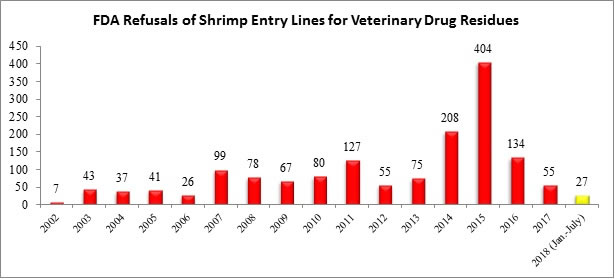
The US refused in July 157 seafood entry lines, of which 2 were of shrimp for reasons related to banned antibiotics and another 12 for salmonella contamination.
This was the lowest number of entry lines refused for antibiotic contamination so far this year, the Southern Shrimp Alliance reports. In the seven months through July, there have been a total of 27 shrimp entry lines refused for reasons related to banned antibiotics.
The two shrimp entry line refusals in July that were related to banned antibiotics were from exporters in India and China.
Further, the Food and Drug Administration reported refusing another 10 shrimp entry lines for salmonella in July, of which eight were from India.
While the total number of shrimp entry lines refused for veterinary drug residues has declined in 2018, the FDA has now reported refusing 60 entry lines of shrimp for salmonella as of July this year, of which it said the vast majority originated from India.
SMALL-SCALE BUSINESSES TO BENEFIT
EU pledges more than €6B for aquaculture and fishing industry
The European Union has allotted a total of €6.14 billion (more than US$7.04 billion) to help fishing and aquaculture businesses move toward a more sustainable future.
Spread over a period of six years, the fund will be channelled through the European Maritime and Fisheries Fund (EMFF), and support small-scale businesses.
Coastal communities will receive more and broader support to set up local partnerships and technology transfers in all blue economy sectors, including aquaculture.
"It will also help unleash the growth potential of a sustainable blue economy towards a more prosperous future for coastal communities. For the first time, it will contribute to strengthening international ocean governance for safer, cleaner and more secure, and sustainably managed seas and oceans. Finally, the Commission is reinforcing the environmental impact of the Fund with a focus on protecting marine ecosystems and an expected contribution of 30% of its budget to climate change mitigation and adaptation, in line with the commitments agreed under the Paris Agreement," the European Commission explained.
Karmenu Vella, European Commissioner for Maritime Affairs and Fisheries, added: "Healthy, well-managed oceans are a pre-condition for long-term investments and job creation in fisheries and the broader blue economy. As a global ocean actor and the world's fifth-largest producer of seafood, the European Union has a strong responsibility to protect, conserve and use the oceans and their resources sustainably. The fund will allow member states and the Commission to live up to that responsibility and invest into sustainable fisheries, food security, a thriving maritime economy, and healthy and productive seas and oceans."
DUE TO CHANGING DEMAND OF CONSUMERS
Dark clouds looming on Guyana's flourishing seafood sector
Guyana, long the poor cousin of the Caribbean region, with a human development index only slightly better than Haiti's, is turning a new chapter in its economic fortunes, and fisheries are playing a significant role.
Though the recent discovery of significant oil and gas deposits in Guyana's waters has attracted much international press, less notice has been taken of Guyana's burgeoning seafood sector, which development agencies have credited with helping to spur the growth of Guyana's GDP and exports over the past 10 years.
A recent joint report by the Food and Agriculture Organisation and the Inter-American Institute for Cooperation on Agriculture showed that the country's fisheries capture production was 47,000 metric tonnes in 2014. Guyana's Bureau of Statistics figures showed that between January and March 2018, Guyana's shrimp and prawn exports were valued at just under US$29 million (EUR24.8 million), while its fish and byproduct exports for the same period were valued at just under $9 million (EUR7.7 million). The bureau indicated that shrimp and prawn exports were the third-largest contributors to Guyana's GDP, second only to gold and bauxite, the country's traditional foreign revenue earners.
"The fishing industry is one of the most important contributing sectors to Guyana's revenue as the country exports more than 60 percent of its catch. This industry is responsible for the livelihood of approximately 15,000 persons and their families", the Guyana Ministry of Agriculture said in a statement on its website. Further, the FAO-IICA Outlook notes that Guyanese consume 35 kilogrammes of fish per capita annually, nearly three times the amount recommended by international health organisations.
Commenting on the contribution of Guyana's fisheries development to its economy, the joint FAO-IICA 2017/18 report, titled "Outlook for Agriculture and Rural Development in the Americas", cites Guyana as one of an important group of countries "that shows sustained growth in the volume of production and in real agricultural income over a 10-year period".
"In Guyana, the country's good performance was due to increases in rice and fisheries production", the report noted.
However, recent developments suggest there are ominous signs ahead for the country's seafood sector that may hamstring its contribution to Guyana's economic growth. BEV Processors Inc., one of the country's leading seafood processors, has announced that it is closing its doors in July 2018. BEV began exporting fish and shrimp products from Guyana 30 years ago, and was the first company in Guyana to export fish in commercial quantities back in the 1980s.
BEV Processors Managing Director Philip Bruce Vieira told SeafoodSource that BEV processes approximately 10 million pounds (4,536 tonnes) of shrimp per year and has a staff of 370. Its main export market has been the US. However, "the demand and pricing for the shrimp we produce have been reduced and the last time we had this situation, we lost a lot of money and at my age, I prefer not to go down that road again," he said via email.
Vieira denied that his business' closure could be attributed to lack of government concessions and support, as widely reported in the media. He said the government had, in fact, been generous to the trawler industry.
Rather, Vieira pointed to demand from his customers in the US for products that have sustainability credentials such as Marine Stewardship Council certification.
"If we are not MSC-certified by the end of 2019, we will lose a lot of our USA customers", Vieira told SeafoodSource.
BEV has been exporting to the US continuously for 34 years and to Europe, Panama and the Caribbean for many years, "earning hundreds of millions of US dollars over the years", Vieira said.
Veira told the Stabroek News in June that he regrets having to shutter his business, but that Guyana would have trouble meeting the changing requirements of international markets.

GOVERNMENT-COMMISSIONED STUDY:
Brexit could substantially harm Scottish seafood sector
The Scottish government cites a new research suggesting that Brexit could cause significant harm to Scotland's seafood industries, including decreased salmon export value, if the UK does not remain in the single market and the customs union.
The study, commissioned by the Scottish government to understand possible impacts on the seafood sector, examined hypothetical scenarios for the UK's exit from the European Union including changes to fishing quota shares and the impact of different types of international trade on the industry.
Among others, the research found that farmed salmon—the UK's most valuable food export—could decrease in export value of between 4 to 6% in the absence of free trade with the EU.
Also, any increase in fishing quotas would be offset by increasing tariff and non-tariff measures once the UK leaves the European single market and customs union.
The research said all of the plausible trade scenarios modelled would leave Scotland—which is one of the largest seafood producers in Europe—worse off than the current situation as a member of the EU.
The plausible scenarios include three of the scenarios wherein the UK ends free trade with the EU, and some level of tariffs and non-tariff measures apply on products exported to the EU. They exclude the scenario with free trade with all countries of the world.
"This report confirms that reduced access to EU markets could significantly harm Scotland's seafood industries, with those parts of our sector reliant on the speedy supply of fresh product to European markets particularly at risk", said Rural Economy Secretary Fergus Ewing.
In 2017 Scotland exported GBP944 million (US$1.25 billion) worth of seafood, up 23% from the previous year.
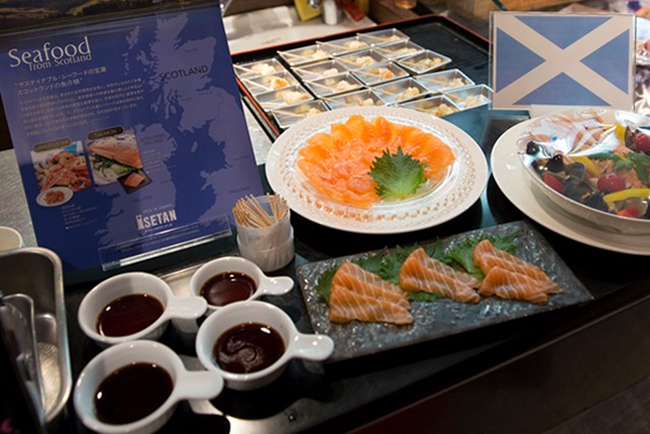
Scottish salmon being promoted at an Isetan store SCOTTISH GOVERNMENT PHOTO
DUE TO UNFAVOURABLE WEATHER
South Korea aquaculture production drops
South Korea's aquaculture output declined by 5.5% in the first half of the year as compared with the same period last year.
Statistics from the Ministry of Oceans and Fisheries showed that production decreased to 1.57 million tonnes, as a result of unfavourable weather conditions and the overall slump in demand.
The ministry explained that due to both attributing factors, there was a reduced harvest of sea mustard and flatfish, among others.
However, in the first half of the year, output figures of several major items, such as abalone and rockfish, were still 22% higher as compared with the average recorded over the past five years.
Additionally, official statistics recorded an 8.7% rise in exports, which totalled up to 44,600 tonnes and a 10.5% rise in revenue, amounting to US$450 million.
US SEAFOOD IMPORTS FROM CHINA $2.7B IN 2017
All Chinese seafood exports to US subject to planned additional 10% tariff
The additional 10% tariff that the US announced it planned to impose on $200 billion worth of imported goods from China includes all of the country's Chinese seafood imports, according to the Southern Shrimp Alliance (SSA).
The proposed list encompasses both aquaculture and wild-caught seafood products, as well as seafood products that are further processed in China, SSA said.
Last year, the US imported around $2.7 billion worth of Chinese seafood.
The US Trade Representative's (USTR) lengthy list of products encompasses 6,031 tariff subheadings, proposed to be subject to the additional 10% tariffs effective this September.
"The list of products released by the USTR appears to include tariff subheadings covering all of this country's imports of Chinese seafood", SSA said in a recent news release.
The USTR explained that the $200 billion worth of goods to be covered by additional tariffs represented less than half of the $505-billion imports from China last year, but were considerably in excess of the $130 billion in US goods exported to China in 2017.
Although China has retaliated against the US' initial action to impose an additional 25% tariff on $34 billion worth of Chinese imports, because of the massive trade deficit between the two countries, China simply does not import enough goods from the US to retaliate against a similar scope of imports.
NO OCCURRENCE OF OVERFISHING
Blue crab population in US' biggest estuary down almost 18% this year
The blue crab population in Chesapeake Bay decreased almost 18% to 372 million this year from 455 million in 2017. This is according to the 2018 Chesapeake Bay Blue Crab Advisory Report released by the Chesapeake Bay Programme. Chesapeake Bay is the largest estuary in the US, encompassing the states of Maryland and Virginia.
The report said that while the number was below the long-term average, no overfishing has occurred.
Moreover, the blue crab population in Chesapeake Bay is not depleted, based on the "exploitation fraction" in 2017. Exploitation fraction refers to the percentage of female crabs (ages 0+) removed by fishing. Exploitation fraction in 2017 was approximately 21%, which is below the target of 25.5% and the threshold of 34%.
According to the report, blue crab commercial harvest dropped slightly in 2017. The three Chesapeake Bay management jurisdictions (Maryland, Virginia and the Potomac River Fisheries Commission) implemented additional commercial harvest restrictions during the second half of 2017 in response to the poor number of age 0 crabs (less than 60 mm or 2.4 inches carapace width).
The 2017 commercial harvest for both males and females from the Bay and its tributaries was estimated at 29.5 million pounds in Maryland, 21.7 million pounds in Virginia and 3 million pounds in the Potomac River.
The number of age 0 crabs was estimated at 167 million in 2018.
The report, which provides scientific analysis of the Bay's blue crab population, is meant to help Bay resource managers set blue crab fishing regulations.
12 CASES OF CONTAMINATION CONFIRMED
Venezuela crab meat potentially 'Vibrio-contaminated', says FDA
The US Food and Drug Administration has warned consumers against eating fresh crab meat imported from Venezuela, as it may be contaminated with Vibrio parahaemolyticus bacteria, which are found in brackish saltwater.
The FDA advised consumers dining out at restaurants or shopping in grocery stores to ask where their crab meat is from. It said this product is commonly found in plastic tubs and may be labeled as "pre-cooked."
The FDA said they were still in the process of determining the source of contaminated fresh crab meat and were ensuring it is removed from the food supply.
As of July 12, the FDA has confirmed 12 cases of Vibrio parahaemolyticus. The states that reported cases associated with this outbreak include Maryland (8), Louisiana (2), Pennsylvania (1) and the District of Columbia (1).
Most people infected with Vibrio parahaemolyticus develop diarrhea, vomiting, abdominal cramps, nausea, fever and stomach pain, the FDA said, adding that diarrhea tends to be watery and occasionally bloody.


