


August 14, 2025
Alltech's Vision for the Future of Feed and Livestock: Innovation, Sustainability, and Growth
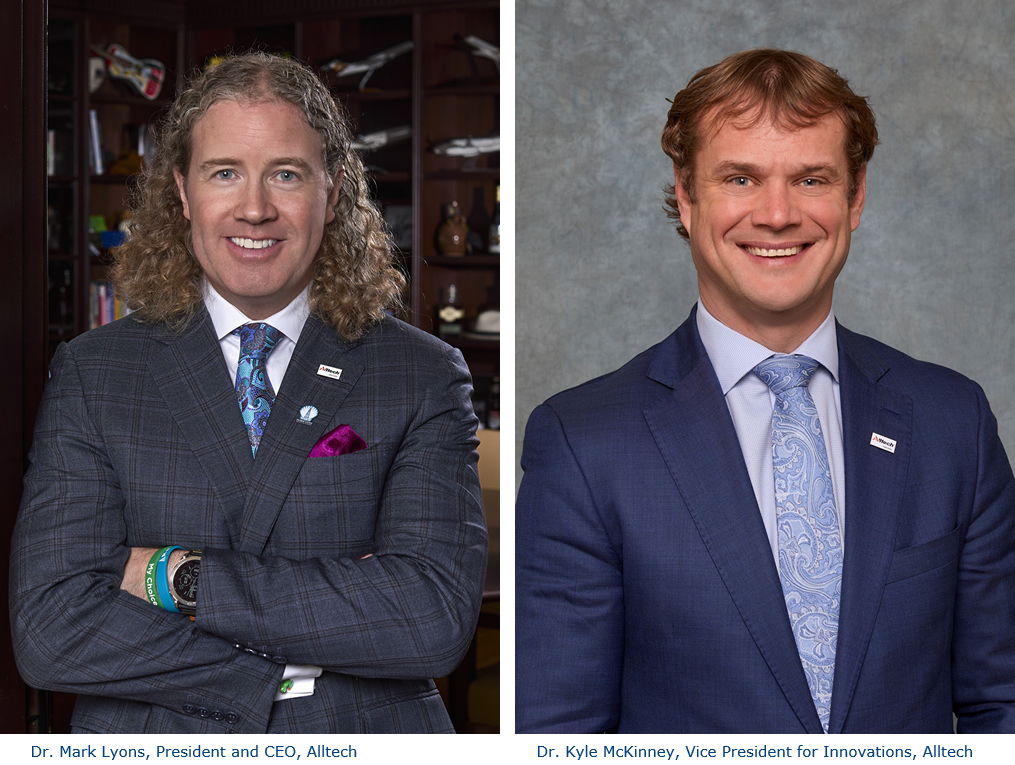
As the global agricultural landscape continues to evolve, the feed and livestock industries are facing a host of challenges. From rising production costs and inflation to the urgent need for sustainability in farming practices, the pressure is on for companies to innovate and adapt.
At the forefront of this transformation is Alltech, renowned for its commitment to improving the productivity and well-being of farmers around the world. With its focus on integrating advanced technology, sustainability, and nutritional innovation, Alltech is working to create a more efficient, environmentally responsible, and profitable future for the livestock sector.
In this in-depth interview with eFeedLink, Dr. Mark Lyons, President and CEO of Alltech, and Dr Kyle McKinney, Vice President of Innovation, explain the company's strategic vision for the future of the feed industry. They share their thoughts on how technological advancements, such as AI and digital tools, are reshaping farming practices, while also exploring how the company is navigating the complexities of climate change, inflation, and evolving market dynamics.
They also discussed Alltech's approach to driving growth in Asia, its commitment to research and development, and the company's ethos of stewardship in agriculture, a philosophy that resonates strongly in the face of modern challenges.
The industry has seen a shift towards more collaboration between companies, even among those once considered competitors. How does Alltech view these partnerships today? Do you find them valuable not only for your company, but also for the broader agriculture sector?
Dr. Mark Lyons: I believe there's been a significant shift in the industry—and in business more broadly.
There was a time when companies aspired to do everything themselves, to excel in every area and sector. But then came a growing focus on core competencies, a concept frequently discussed by business academics. Initially, this seemed to be about focusing internal resources more effectively. But especially over the past few years, and even more so during the pandemic, it became clear just how crucial strong partnerships really are.
Historically, and I think about my father in this context, he probably wouldn't have spent much time engaging with distributors or suppliers. Today, however, we host an annual event in Kentucky specifically for our suppliers. That reflects a major shift—an increased appreciation for the value created across the supply chain when you understand what your partners are doing.
There was also a major turning point for us at Alltech. Over the past 15 years, we've acquired more than 20 companies. Many of these businesses had long-standing relationships with what we once saw as competitors. In some cases, we worried that acquiring a company might upset a customer due to competitive overlap, only to discover that they were already doing business together.
In agriculture, flexibility and responsiveness are essential. Our industry increasingly relies on what I would describe as a matrix of relationships. That's why I make a point of knowing the leaders across the sector—regardless of whether they are considered competitors.
Some of those competitors have now become part of our organisation, and building those relationships post-acquisition remains just as important. Perspectives and business goals evolve, and if you don't have some kind of relationship in place, it's hard to anticipate where those changes might lead—or to spot new opportunities.
At Alltech, we pride ourselves on speed, a flat organisational structure, and staying closely connected to the market. That means understanding the competitive landscape is just as vital as understanding our customers.
What is Alltech's strategic focus in Asia?
Dr. Mark Lyons: Asia represents not just the future of growth—but also very real and immediate growth potential.
We've had a presence in most of the major markets here for 25 to 30 years now. Even before that, we were active through distributors. Asia has always been a key region for Alltech.
I was trying to recall the first time I attended VIV Asia—it must've been when I was in my early 20s. Since then, I've been returning to Thailand almost every year or every other year. In short, we've been present here for a long time.
We now have our own production infrastructure in the region, including five tier 1 facilities and more than 12 tier 2 facilities. This proximity to the market strengthens our ability to respond quickly and meet demand. Asia is undeniably a vital growth market for us.
We're also expanding our teams. Today, our leadership in Asia comprises individuals from the region. That might sound like a given, but for me, it was an essential milestone. I lived in China for six years, so I've experienced firsthand how important local presence and understanding are to building a strong team and fostering genuine customer relationships.
Right now, I believe we have one of the strongest teams not only in Alltech's history but also within the industry overall. Much of the world's population—and consequently, its growth—resides here in Asia.
Our annual global feed survey, published in Alltech's Agri-Food Outlook, found that four of the world's top 10 feed-producing countries are in Asia, and Indonesia is poised to join that list soon. The region is rich in cultural and linguistic diversity, and incomes are steadily rising. Asia will always be a significant domestic market, but it's also increasingly central to global agri-food dynamics.
Alltech has a strong presence in Latin America, and many of our customers there—especially in Brazil—are looking to Asia as a growth frontier. We're in a good position to facilitate connections between these markets while continuing to support local industries here.
Our strategy has been to bring many of our global experts into the region to share insights with customers and colleagues alike—particularly around what we're doing in key markets like the US, Brazil and Canada, where we have a strong foothold. The idea is to explore how similar nutritional strategies and innovations can be applied in Asia.
Dr Kyle McKinney's team is also developing new products and innovations specifically for this region. So, while it's a long answer, I think it reflects just how important Asia is to our global strategy.
Would you say that Asia is currently Alltech's largest market?
That's primarily because of the number of acquisitions we've made in those markets. In Brazil and Canada, for example, we produce premixes and even complete feed. In contrast, we don't produce feed in Asia.
But perhaps we don't need to. There are already very strong domestic companies in the region, and we're able to form meaningful partnerships with them.
Alltech doesn't need to look the same in every market. The culture of the company should remain consistent, but the business strategy can and should adapt to fit each market.
Looking ahead, I believe the potential for growth over the next five years—especially when it comes to Alltech's core technologies—will be strongest in Asia.
Does Alltech tailor its market strategies by region?
Dr. Mark Lyons: Absolutely. Every single market is different. And I would go even further—it's not just about tailoring by country, but by region within a country, or even by specific species segments. Each requires its own distinct approach.
This could be due to differences in sector development, or because of our own internal capabilities—whether that's in production, research, or personnel. But above all, the most important factor is the people.
I've seen cases where two markets may look nearly identical on paper, but one had a really entrepreneurial, dynamic manager—and ten years later, Alltech's presence in that market is ten times bigger than in the other.
So yes, the people always make the biggest difference.
Given the diversity of markets in Asia, is there a specific strategy Alltech follows in the region? Is there an overarching message that guides your approach?
Dr. Mark Lyons: We often talk about the direction the industry is heading, and one term that comes up time and again is "sustainability"—sometimes overused, I'd admit. But for us, we've redefined sustainability through the lens of the producer, the farmer. The core question is: how can we support farmers to become more profitable while also producing food of higher nutritional quality?
And when we do that successfully, we often see a reduction in environmental impact as a result. There are also broader benefits that emerge—improvements for local communities, for example. These are all part of how we interpret sustainability, and they're embedded in our mission, Planet of Plenty.
We launched Working Together for a Planet of Plenty® in 2019, and few regions resonate more with this vision than Asia. You see more people here wearing Sustainable Development Goal pins and having real conversations about these issues. But in Asia, it's also about ensuring food security: having enough food that is affordable, nutritious, and accessible to populations that are growing and evolving rapidly.
At the same time, we must ensure that food is being produced in ways that support the livelihoods of the people producing it. In many parts of Asia, we've seen dramatic urbanisation—I saw this myself during my time in China—and it has deeply affected rural communities, sometimes in difficult ways.
Would you say that producing affordable food and promoting sustainability is the ultimate goal for Alltech?
Dr. Mark Lyons: When people talk about sustainability, their first thought is usually the environment. But the environment is just one of the outcomes. We also need to think about people—about creating sustained livelihoods and offering greater promise for the future.
If we take a step back and look at the West, one of the biggest risks right now is that younger generations don't believe they'll have better lives than their parents. They don't see a more hopeful future. That shouldn't be the case, and I think it's a dangerous path when people start to lose optimism and excitement about what's ahead.
In contrast, we see real energy and enthusiasm in Asia. Young people here are excited about the future. And we need to ensure that this excitement is part of what we're sustaining.
Agriculture isn't necessarily seen as a desirable career. Young people are into tech and IT now. How do you make farming part of their future?
Dr. Mark Lyons: We created a group of next-generation agribusiness leaders—young people whose families owned agriculture businesses. Some of them had been considering careers in finance or tech. I shared my own journey with them—why I chose to stay in the family business and commit to agriculture. And together, we formed a kind of club.
Many of those individuals have since stepped up and are now leading those businesses a decade later. We're now expanding that idea globally through what we call the Alltech Presidents Club. Every October in Kentucky, US, we bring together company presidents—and now we're including the next generation as well.
I see it as part of our responsibility to inspire young people and show them that agriculture is dynamic and full of possibilities. In the Asian context especially, you often find family-run businesses where someone owns a feed mill, runs swine farms, and maybe even launches a trendy restaurant concept in the city.
That's a story that resonates. It connects agriculture with entrepreneurship, food culture, and lifestyle—things young people care about.
Recently, I was speaking with a young man from India—he's the third generation in his family business. He told me he's not interested in the farming side; his father handles that. But he's opening retail stores and working on processed poultry products. In India, only 7% of poultry is currently sold in processed form—the rest comes from wet markets.
But if you fast forward 30 or 40 years, that could easily shift to 30% or even 40%. It's people like him who will drive that transformation. They're identifying opportunities their parents might not have even considered.
We're seeing a rise in digital farming, the Internet of Things, artificial intelligence (AI)—how does Alltech incorporate these technologies into its solutions and services?
Dr. Mark Lyons: We approach this in a few ways. We work closely with agtech companies—some we collaborate with, some we've mentored, and we even have a few of our own initiatives in-house. But for us, it's not so much about heavily investing in these technologies ourselves. Instead, we focus on building the right connections.
We often say, "connect the programmer with the producer." You might come across an exciting piece of technology, but if it doesn't solve the everyday challenges that farmers face, then it won't be adopted. So we're constantly asking: how can we make things simpler and more useful? Dr Kyle McKinney has been very involved in this space.
Dr. Kyle McKinney: We were in California, US, a few months ago, and I'd say there are a couple of important things happening. First, on the topic of attracting the next generation of ag workers—I think the growth of data and AI is actually making agriculture fun again.
You might not have grown up on a farm, but if you're a young engineer or software developer, you can come into this industry, do what you love—developing tech and data tools—and also help feed the world.
Dr. Mark Lyons: You get that sense of purpose. It's more meaningful than just making money—it's like building a video game, but with a bigger impact.
Dr. Kyle McKinney: Exactly. And that's how we attract next-gen talent. At the same time, when we look at new technology—whether we're partnering or evaluating—we always ask: does it serve the farmer? The tech should work for the farmer, not the other way around.
When you attend agtech conferences, whether it's in the US, Asia, or Latin America, you'll see that by 2025, around 75% of the discussion is focused on AI or digital tools. And it's for good reason: tech is helping address sustainability goals, labour shortages, and profitability challenges. There's a lot of momentum right now.
Dr. Mark Lyons: And labour, in particular, is something we've been thinking more about. At one of our internal meetings recently, someone asked, "Is labour an issue in your market?" Only about 20% of hands went up.
But when I spoke with company leaders here—the bosses—they all said labour is a major challenge. So there's a disconnect between what sales teams are seeing on the ground and what leadership is concerned about.
They're not saying they can't hire anyone at all. It's more about the quality of labour. They feel they're paying too much for the skill sets they're getting, or that there's a lack of the right capabilities. That's where technology really comes in.
Dr. Kyle McKinney: Absolutely. There are many angles to look at labour. In poultry or pig systems, for example, health issues can be tough to detect early. But now, we've talked to companies using microphones inside barns. These systems can detect vocal changes in chickens, which may signal illness.
With that kind of tech, AI can flag potential disease early, and farmers can act before it spreads. That reduces the need for someone to physically check every barn, every day.
Is this one way of cutting production costs—through automation?
Dr. Mark Lyons: I think it does help reduce production costs. But the bigger issue is something else. As much as we like to show people taking cute photos with pigs, the reality is that for most animals, humans are actually a threat. The less unnecessary human-animal interaction there is, the lower the risk of disease transmission. And on top of that, animals tend to be calmer.
Ideally, humans should only enter a barn or enclosure with a clear purpose. That's why biosecurity is such a big deal. What's fascinating, though, is that even the most highly trained professionals might miss early signs of illness, things that new technologies can now pick up.
It could be something as subtle as a pig squealing slightly differently or a faint cough—signals that are easy to miss, but AI can catch. That early detection can be a game-changer.
Dr Kyle McKinney: Exactly. The sooner you catch that a pig or chicken might be unwell, the faster you can respond and treat it. And that's where we see things heading in the future.
So it's about accuracy, animal welfare, and reducing medication?
Dr. Kyle McKinney: Yes—reducing medication, for sure. There are multiple benefits to these kinds of technologies, and that's what really draws our attention. If something is only about improving efficiency, it's probably less interesting to us. But if it can improve accuracy, support animal welfare, and reduce reliance on medication—that's where we see real value.
To support your growth in Asia, are you looking more at mergers and acquisitions, or expanding facilities?
Dr. Mark Lyons: Yes, absolutely, both are important. In 2022, we opened our second facility in Vietnam, which was also the country's first organic trace mineral plant. But there's still a lot more needed as we continue to grow in the region. We're definitely open to acquisitions, especially when it makes sense strategically.
Sometimes, it's not just about growth. There are cases where businesses don't have a next generation to take over. I've spoken to many business owners over the years who genuinely care about their people and what they've built. They've spent decades nurturing a company, and the last thing they want is for someone to come in, break it up, or destroy the culture.
That's where Alltech can make a difference. We've got a strong track record of taking care of businesses we acquire, respecting their legacy and integrating them thoughtfully. In Asia, we'll likely see opportunities like that arise.
Of course, the fit has to be right—both in terms of market and philosophy. We're focused on adding value. While we do have feed and premix offerings, our priority isn't market share based on volume. Feed is really a delivery mechanism for our technology—to enhance nutrition and productivity.
So, we're not chasing acquisitions just for scale. Some big feed companies simply wouldn't align with our approach. And even if we did acquire them, they'd probably look very different five years down the road.
In the US, for example, we've developed a focused approach with our monogastric team. Colleagues like Andy Rash, Dr. Roy Drister, and Dr. Curtis Novak are working to understand the needs of the pig and poultry sectors and to deploy the right technologies—whether it's a single Alltech product, a premix, or full feed solution.
That's the kind of value-led thinking we'd want to replicate here, whether through partnerships or acquisitions.
Dr. Kyle McKinney: And we're also really expanding our research and application efforts in Asia. The old model of doing internal R&D in isolation doesn't work anymore—you have to collaborate. Asia is leading the way for us in that regard. We've got over 30 research alliances in the region, mostly with universities, and we're also building out local applications teams. These teams work directly with customers to solve real-world challenges.
Globally, we're growing our innovation efforts, but Asia is definitely a key driver. With all the rapid development in digital and AI, we're making a conscious effort to stay plugged in and continue learning from this dynamic region.
How is Alltech addressing the challenges of high production costs, inflation, and climate change?
Dr. Mark Lyons: Starting with inflation, I think we've already experienced a significant wave, and we may well see another one coming. Tariffs themselves don't cause inflation, but depending on how they're implemented, they can definitely contribute to rising costs.
What happens in times of high costs—especially for key macro ingredients—is that it forces us to be more efficient. And interestingly, that ties in directly with sustainability and climate change. If we're using a kilo of corn or soy more efficiently—improving the feed conversion ratio (FCR) for swine, chickens, or even dairy cattle—we're not just saving money, we're reducing environmental impact.
And that's where technology comes in. Almost every Alltech innovation offers some environmental benefit. That's not always the reason a customer buys it—they're usually looking for a return on investment. But improvements in FCR, better animal health, fewer sick or lost animals ... these all have positive knock-on effects for sustainability.
Think about it: there's nothing more wasteful, environmentally and economically, than losing an animal toward the end of its production cycle. All the feed, housing, effort—gone. That loss impacts not just the environment but also livelihoods, especially for smallholder farmers.
That's why we aim to stay very close to our customers. Not just with our technologies, but also through our supply chain support. We have colleagues here from our global supply chain team who are meeting with both suppliers and customers. Sometimes it's a matter of advising, "There's a better option." That's the kind of partnership we want to offer.
Inflation, ultimately, is something you can either complain about, or adapt to. I use this analogy: two people are camping, and they see a bear. One of them puts on unning shoes. The other says, "You can't outrun a bear," and the first replies, "I just need to outrun you." So in business, it's about staying ahead—doing a better job managing risk and cost than your competitors. Sometimes, that can even lead to better margins than before.
Are there specific technologies you're turning to?
Dr. Kyle McKinney: A lot of it comes down to improving efficiencies, which has always been our focus—even 45 years ago, before the word sustainability was on everyone's lips.
Today, technology like AI and digital tools help us spot disease earlier. With better data, we can now weigh swine in real-time, ensuring they're shipped at the optimal weight. That doesn't just reduce feed waste; it also helps manage labour and logistics more effectively. Taking better care of animals ultimately strengthens the sustainability story. And now, with all this data, we can actually measure that impact.
I do think "sustainability" is being overused as a term. We've even debated coming up with our own word for it—something that's less loaded.
A couple of years ago, I was on a panel at the World Pork Expo in Iowa, US with the owner of a large vet clinic. He made an interesting point: urban folks talk about sustainability, while rural folks use a different word for the same idea—stewardship. Caring for the land, for the animals, passing the farm on to the next generation—that's all sustainability. It's just framed differently.
And I've never met a farmer who doesn't want to look after their land or their livestock. But when you call it sustainability, it can feel overwhelming—like it's going to come with extra paperwork, extra cost, or new regulations. If you reframe it as stewardship and ask, "Do you want to pass your farm on? Do you want to be profitable?"—that changes the tone.
We even made a slide showing that these two words "sustainability" and "stewardship" mean the same things. But language matters.
From our perspective, we won't ask farmers to adopt anything that just adds cost for an environmental benefit. It has to be economically sustainable for them too. If it puts money in their pocket and helps the planet, that's when it works—and that's when it lasts.
How do you foresee the future of the feed and livestock industries—and what role will Alltech play in that future?
Dr. Mark Lyons: What we're really trying to do is help the industry continue on a path it's already been on for decades—one of continuous improvement and efficiency. There's a lot of negative talk out there, especially from the consumer side: that farms are too big, that they're polluting the planet. But if you look at the actual data, the efficiency of modern agriculture is extraordinary. We're producing more with less. That's something to be proud of.
Sometimes I think our industry just needs a bit more confidence—almost permission—to celebrate those achievements. And events like VIV really show how far we've come. It's incredibly international, full of energy, with businesses and technologies from all over. It feels very different from the meetings we attend in Atlanta every year. Asia has a buzz about it. I felt that the first time I came here.
Our role at Alltech is to keep pushing that positive trajectory forward. We take our responsibility seriously. Kyle and I are lucky, we get to travel around the world, connect with people, and share ideas across regions. That's what we're here to do: spark innovation by building bridges.
And I really believe the next few years will be an exciting time. While politicians may dominate the headlines, their actual influence on the industry is limited. Sometimes when they implement changes, the outcomes might not match their intentions—but that doesn't mean the outcomes are bad. In fact, they might even create opportunities: more resilient food systems, localised production, and new types of business partnerships.
At Alltech, we've trained ourselves to spot both challenges and opportunities in the chaos. That's how we help our customers, by navigating uncertainty and finding the silver linings.


