


August 6, 2025
Tyson Foods sees chicken sales soar as beef losses mount despite price hikes
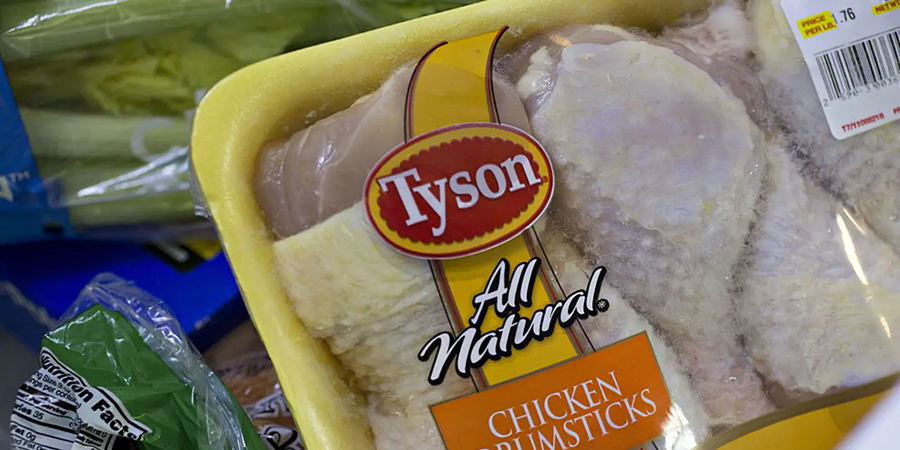
Tyson Foods Inc. saw its stock price increase during early afternoon trading on August 4, after the meat producer raised its sales estimate for the year.
This boost was attributed to strong performance in its chicken and prepared foods divisions, even though the company projected losses amounting to hundreds of millions of dollars in its beef business.
Tyson Foods said it expects sales growth of 2% to 3% in 2025, up from its earlier estimate for flat to 1% growth.
The stock was up 4.6% at last check, just two days after it closed at a 17-month low. If the gains hold, it'll be the stock's largest move up since Nov. 12, when it gained 6.55%, according to Dow Jones Market Data. As of August 1, Tyson shares were down 8.6% in 2025, while the S&P 500 had gained 6.1%.
"The only soft spot in our business is the beef segment," Tyson Foods Chief Executive Donnie King said on the company's quarterly update with analysts. "With cattle availability at record lows, we continue to experience industry market headwinds, but even in this difficult environment, we are improving our fundamentals."
With beef prices up 10% in the quarter compared to last year, and chicken prices up only 1.1%, poultry has been a strong performer for the company, partly because grain prices for feed have been relatively stable.
"The chicken business is running efficiently and consistently, delivering solid growth across the top and bottom line," King said.
Tyson's forecast for sales growth would amount to full-year 2025 revenue of between US$54.38 billion and US$54.91 billion, up from its 2024 total of US$53.31 billion. Both of those estimates exceed the current analyst estimate of US$54.09 billion in sales, according to FactSet.
The company expects its adjusted operating income for its chicken business to increase by US$ 1.3 billion to $1.4 billion for full-year 2025 — stronger than its earlier estimate of US$1 billion to US$1.3 billion.
Tyson expects an adjusted 2025 operating loss for its beef business of US$375 million to US$475 million, which is steeper than its projection from three months ago for a full-year loss of US$200 million to US$400 million.
Its prepared-foods unit, which includes Hillshire Farm products, is expected to deliver adjusted operating income of US$925 million to $US1 billion, and its pork business is seen generating US$175 million to US$200 million in adjusted operating income.
Tyson has been facing tight cattle supplies and challenging market conditions, the company noted.
Its third-quarter profit fell to US$61 million, or 17 cents a share, from US$191 million, or 54 cents a share, in the year-ago quarter.
Adjusted third-quarter earnings of 91 cents a share rose from the year-ago figure of 87 cents a share and beat the analyst estimate of 80 cents a share.
The results include a net loss of $494 million in Tyson's beef business, which includes a US$343 million write-down of the value of assets. Excluding the write-down, the beef business still showed a loss of US$151 million.
Third-quarter sales rose toUS $13.88 billion, from US$13.35 billion, and beat the analyst projection of US$13.54 billion.
Beef sales rose 6.9% to US$5.6 billion, but that was because prices rose 10% to offset a US3.1% decline in volume. Chicken sales grew 3.5% to US$4.22 billion, as volume increased 2.4% and prices rose 1.1%. Sales from prepared foods rose up 3.4%; prices there rose 5.7%, even as volume fell 2.3%.
To combat a shortage in supply, Tyson executives said meat producers are slaughtering fewer heifers in an effort to boost the population.
Beef slaughters fell 16% in the first six months of the year, Tyson said.
"We think herd rebuilding will begin in earnest in 2026 — let's call it 2028 when se see herd rebuild," King said.
While beef remains more scarce. Tyson reported a 10% increase in volume in its branded frozen chicken, which it describes as "value-added." It also reported success with new products such as Tyson Simple Ingredient Nuggets and Mega Dino Nuggets. Tyson said its chicken business grew its share of volume by 1.3%. Its volume for products that it characterises as "value-added" grew at more than 3.5 times the rate of total segment volume for chicken of 2.4%.
- Market Watch


