


July 30, 2026
South Africa likely to see record corn crop
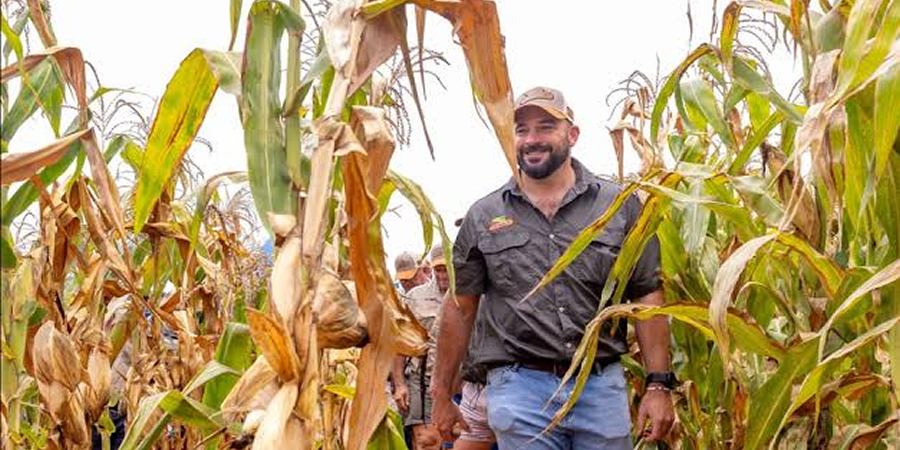
South Africa's farmers are at the back end of harvesting what is widely expected to be a record corn crop.
This is a welcome boost to domestic inventories and the exportable surplus, with major Asian buyers already reported to be queueing up after an absence for much of the previous marketing year.
The corn area has remained relatively steady over the past seven years at approximately three million hectares (Mha), supported by constant advances in seed genetics, agrichemicals, and precision farming techniques that have enabled yield growth on a stable seeded area. Commercial corn yields in South Africa have more than doubled over the past 30 years as the adoption of these innovative production technologies becomes more widespread.
However, this year's harvested area has increased slightly to 3.1Mha according to the latest crop estimates from South Africa's Department of Agriculture, released at the end of June. Commercial plantings of corn in October, November and December of last year were reported at 2.72 Mha, up from 2.67 Mha a year earlier. This is made up of 1.67 Mha of white corn and 1.05Mha of yellow corn.
Subsistence plantings, being small-scale, non-commercial operations where rural households grow corn primarily for direct family and livestock consumption, were pegged at 400,000 hectares, of which 260,000 hectares were white varieties and 140,000 hectares were yellow varieties.
According to the United States Department of Agriculture's Pretoria-based attaché, the production season began favourably in the lead-up to, and during the planting campaign. Crop development was challenged by high temperatures and a month-long dry spell from mid-January, but that gave way to widespread rainfall in February, which got the season back on track. Above-average rainfall continued through March and April in most regions, providing the springboard for another big harvest.
Aided by a slight increase in the average yield compared to last year, 2026 corn production is expected to be a record 18.0 million tonnes (Mt). This is up from 17.3 Mt in 2025 and is around 400,000 t higher than the previous benchmark of 17.6Mt set in 2017.
The commercial white corn output projection of 9.3Mt is the second largest on record, surpassed only by the 2017 harvest of 10Mt. Commercial yellow corn output is expected to finish up at 8 Mt, fractionally lower than the historical peak of 8.2 Mt harvested last year. Subsistence production is forecast to be 700,000t, with white at 400,000 t and yellow the balance.
A convergence of supply-side pressures provides a bearish outlook for domestic corn prices through to the end of 2026. The huge harvest combined with carry-in stocks of 2.9 Mt puts total supply at 20.9 Mt in the current South African marketing year (May to April). This is up from 18.1 Mt a year earlier when the carry-in was less than 700,000 t following a horror harvest in 2024.
The USDA's Foreign Agricultural Service reported that domestic white corn and yellow corn prices had fallen by 33% and 23%, respectively in the 14 months to the end of June 2026. This depressed price environment is expected to discourage any significant expansion in next season's corn area when planting commences later in 2026.
Predominantly driven by population growth, South Africa's domestic corn consumption has been growing consistently over the past decade. That trend is expected to continue in the current marketing year, with demand forecast at 14.2 Mt, up from 13.1 Mt in the 12 months to the end of April.
Domestic use is evenly distributed between the food and feed sectors. Stockfeed sector demand is projected at 7.1 Mt, 14% higher year on year, with around 84% being yellow varieties. Food sector consumption is also forecast at 7.1 Mt, 2.9% higher year-on-year, about 88% of which is expected to be white varieties.
That leaves an exportable surplus of 6.7 Mt in the current marketing year, with the FAS bureau in Pretoria upping its international sales to 3.5 Mt. This is up from 2.05 Mt in the previous corresponding period and is 1 Mt higher than the USDA's estimate in the July global supply-and-demand update.
In the first 10 weeks of the marketing year, exports totalled more than 700,000 t, a sales pace that already exceeds the same period in each of the past two marketing years. Vietnam has emerged as the primary destination, accounting for 64% of shipments. Zimbabwe is currently ranked second with 10%, followed by South Korea with 8%, and Botswana with 6%.
Shipments to Asian destinations are expected to taper off from October as Northern Hemisphere producers begin their harvest and commence new crop exports, increasing global supply and competition. However, corn exports to countries neighbouring South Africa are forecast to remain constant throughout the marketing year.
Zimbabwe in particular has been one of South Africa's most important regional markets in recent years, and that is expected to continue, despite a recovery in production in 2026. In the marketing year that ended on April 30, the top six corn export destinations were all neighbouring countries. Zimbabwe accounted for 39.3%, followed by Botswana with 13.5%, Namibia with 9.8% Mozambique with 9.1%, Eswatini with 7.5% and Lesotho with 5.6%.
With a projected carry-out of 3.2 Mt, South Africa will be building corn stocks in the current marketing year, leaving plenty of room in the balance sheet for additional exports should the Asian demand remain strong and domestic export values competitive against alternate global origins.
- Grain Central


