



INDUSTRY NEWS
China is boosting its aquaculture industry by building its biggest deep-sea intelligent fishery in Qingdao. The facility has three huge steel net cages, each measuring 110 meters by 75 meters, and a support platform. Each net cage will have an output of up to 6,000 tonnes, and be able to accommodate 250,000 cubic meters of water to farm as many as 10 million pompano.
6,000-TONNE OUTPUT PER CAGE
China builds largest deep-sea intelligent fishery
China is building its largest intelligent deep-sea fishery in Qingdao, in China's eastern Shandong province.
The facility comprises three fish farm platforms or steel net cage measuring 110 meters by 75 meters, as well as a support platform, according to local authorities, as reported by Xinhua.
Each net cage is expected to have an output of up to 6,000 tonnes, and will be able to accommodate 250,000 cubic meters of water to farm as many as 10 million pompano.
The report said that the fishery - which would withstand powerful typhoons when submerged in water - is built for Hainan Province, quoting Chen Qing, an official of the project builder Wuchang Shipbuilding Industry Group Co. Ltd, a subsidiary of the China Shipbuilding Industry Corp. Wuchang is the same shipbuilding firm that delivered a large deep-sea semi-submersible fish farm to Norwegian fish farming company SalMar ASA in June last year.
The intelligent fishery requires only nine workers for the support platform, where they can feed, fish, collect dead fish and clean the cage through a remote control.
"It will be a demonstrative project of marine aquaculture. This environmentally friendly project can be promoted to upgrade our marine fisheries and improve the industrial quality," said Wang Lisheng of Hainan's ocean and fisheries department.
0VER 170 US SEAFOOD PRODUCTS
China retaliatory tariff on US seafoods takes effect July 6
China's retaliatory 25% tariff on over 170 US seafood products and some 375 other non-seafood goods was to have taken effect last July 6, the same day that the US supposedly started imposing a 25% tariff on roughly 800 of 1,100 Chinese products.
China's tit-for-tat move came after the US announced on June 15 that it would slap the 25% tariff on a list of $50 billion in Chinese imports. The remaining 300 Chinese products could face tariffs pending a final decision by the US trade office, reports said.
"We will immediately introduce taxation measures of the same scale and with the same intensity," China's commerce ministry was quoted as saying in a statement on the same day the US White House made the announcement on the 25% tariff.
"All the economic and trade achievements previously negotiated by the two parties will become invalid", it added.
Earlier, China and the US tried to resolve their differences, with the former promising in May to buy more goods from the latter to narrow the trade deficit between the two countries.
"We deeply regret that the United States has disregarded the consensus it has formed and flip-flopped, provoking a trade war", a spokesperson for the Chinese foreign ministry said on June 15, according to a report posted on cbsnews.com.
President Donald Trump said the tariffs on China were in response to the country's "unfair trade practices" including requiring US companies to effectively hand over innovations and other competitively sensitive information in exchange for access to the huge Chinese market, according to the report.
TRUMP HOPES TO 'CHANGE CHINA'S BEHAVIOUR'
US 'ready' to support farmers affected by China retaliatory tariff
US President Donald Trump, in imposing tariff hike on a host of Chinese goods including steel and aluminum, hoped to "pressure the Chinese to stop engaging in unfair practices and fully open up its markets to US products, including US technologies", said Agriculture Sonny Perdue in an article published in USA Today newspaper.
Instead, China has retaliated by imposing as well 25% tariff on over 170 US seafood products and some 375 other non-seafood goods starting July 6, the same day that the US starts imposing a 25% tariff on roughly 800 of 1,100 Chinese products.
"There is no denying that the disruption in trade relations with China is unsettling to many in agriculture, but if the President succeeds in changing China's behaviour, America's farmers will reap the benefits", Perdue stated.
The US has accused China of intellectual theft including allegedly trying to steal in 2011 genetically engineered seeds from an Iowa corn field and sending them back to China so they could be reverse-engineered.
"Those seeds, the result of years of research and millions of dollars of American investment, now stand as one of countless pieces of evidence in the case against China for intellectual property theft and unfair trade practices", Perdue said in his strongly worded USA Today article.
Perdue also revealed that the President had instructed him to craft a strategy to support American farmers in the face of retaliatory tariffs. "At the US Department of Agriculture, we have tools at our disposal to support farmers faced with losses that might occur due to downturns in commodities markets", he said, adding that they haven't unveiled the strategy at this point, "as it is not good practice to open our playbook while the opposing team is watching".
Perdue said that if China "does not soon mend its ways, we will quickly begin fulfilling our promise to support producers, who have become casualties of these disputes".
To read the complete article, visit https://usat.ly/2tAvkdp.
SHRIMP INCLUDED
India also imposes retaliatory tariffs on US agri-food products
Now it's India's turn to impose retaliatory tariff on US goods including agricultural products.
In response to the Trump administration's higher tariffs on some Indian goods, the South Asian country said it will increase duties on artemia - a kind of shrimp - as well as Bengal gram or chickpeas and lentils shipped from the US effective Aug. 4.
The increase follows similar retaliatory moves by China, the European Union, Mexico and Turkey, which said it would implement retaliatory tariffs worth $266.5 million against the US.
According to a report by the Nikkei Asian Review, the import duty on chickpeas will be raised to 60%, and on lentils to 30%.
Higher tariffs will also be imposed on artemia, besides other agricultural products and some iron and steel products.
US President Donald Trump had hiked the tariff on Indian steel and aluminum products, which would reportedly result in a $241-million tariff impact on the country.
80M LESS SEAFOOD MEALS SINCE 2016
French consumers losing appetite for seafood
Frenchmen have been falling off from the top seafood-consuming segments since 2016.
According to the 2018 seafood report on France prepared by the Norwegian Seafood Council, France in only two years has had 2,197,702 fewer consumers eating seafood twice or more a week. This means about 80 million less seafood meals or about 10,000 tonnes seafood less each year since 2016.
"This also means that the percentage of French consumers who are not getting enough of the nutrients seafood offer has gone up to 66 %. That is 43 million people", said the report, entitled "A New Era for Seafood in France".
Thus, only 34% of French consumers are high-frequent seafood consumers, or those who eat seafood twice or more a week. France is thus on the lower end of seafood consumption frequency.
In comparison, southern European countries Portugal and Spain have respectively 75% and 67% of their consumers eating seafood twice or more a week, the report said.
Norway is also a seafood-loving country, with two thirds of its population (71%) eating the recommended two portions of seafood every week.
Only Germans have a lower share of high-frequent seafood consumers than France, with a rate of 31%, the report said.
$1.8B FOR YEAR ENDED JUNE 2018
New Zealand seafood export earnings seen to increase 5.5%
New Zealand's seafood export earnings are forecast to reach $1.8 billion for the year ended June 2018, up 5.5% from the previous year, according to the "Situation and Outlook for Primary Industries" report for June 2018.
.
The report, prepared by the Ministry for Primary Industries, says exports are expected to further grow to $2.1 billion in June 2022, averaging 4.1% in annual increase. The forecast growth, the report says, is underpinned by an expected increase in both prices and export volumes, particularly aquaculture growth.
Aquaculture currently makes up 15% of New Zealand's total seafood export volume but generates 23% ($425 million) of the total seafood export revenue. Wild capture fisheries still are the largest component in the country's seafood exports, contributing 85% of the total seafood export volume and 76% of the total seafood export value.
Aquaculture export earnings are forecast to reach $430 million in the year ending June 2018, up 5.9% from June 2017 due to increasing volumes and prices. Aquaculture export earnings are forecast to reach nearly $600 million in 2022. This is an average annual increase of 8%, mainly driven by an expected increase in production and export volumes.
The report says that New Zealand's main aquaculture export markets include the US, Europe, Australia, China, Thailand, Japan and South Korea. The US is the dominant market and has grown significantly since 2010, but slowed down in 2018, while the European and Australian markets have remained stable in the recent years.
The three main species farmed in New Zealand are green shell mussels, which make up 71% of the total aquaculture export revenue; salmon, at 23%; and Pacific oysters, at 6%.
The total annual production is estimated at 110,000 to 120,000 tonnes in recent years. New Zealand is a relatively small aquaculture producer, with just 0.1% of total global aquaculture production.

16.2 MILLION POUNDS
Shrimp landings in Gulf of Mexico at 9-year high for May
Shrimp landings in the Gulf of Mexico in Mary reached the highest volume reported for the month since 2009, at 16.2 million pounds, as per the fisheries statistic division of the US National Oceanic and Atmospheric Administration (NOAA) Fisheries' Southeast Fisheries Science Centre, as reported by the Southern Shrimp Alliance (SSA).
A total of 3.6 million pounds of shrimp was landed in Texas in May, with another 1.5 million pounds landed in Alabama. SSA said that both represent the highest amounts of shrimp landed in the two states for May since it began tracking landings data in 2002.
A total of 10.4 million pounds of shrimp was landed in Louisiana last month, up from 7.9 million pounds in May 2017 and 6.1 million pounds in May of 2016. Last month's landings in Louisiana were the highest for any May since 2013.
The amount of shrimp landed by fishermen during the first five months throughout the Gulf of Mexico, totalled 28.1 million pounds, 9.2% above the prior 16-year historical average of 25.8 million pounds.

25 REFUSALS IN H1
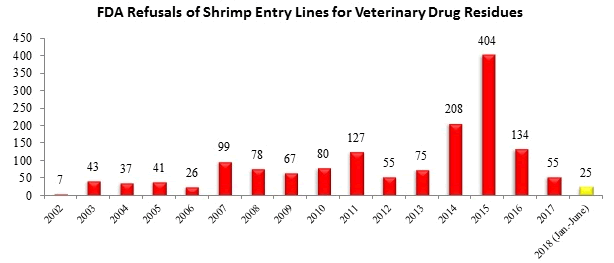
US rejects entry to 5 antibiotic-laced shrimp imports in June
The US in June refused a total of 118 seafood entry line imports, of which five (4.2%) were of shrimp for reasons related to banned antibiotics.
Through the first half of this year, the US Food and Drug Administration (FDA) rejected a total of 25 entry lines of shrimp for reasons related to veterinary drug residues, the Southern Shrimp Alliance reported.
The five shrimp entry line refusals in June were from exporters in India and China.
Dongguan Ateier Import and Export Co. Ltd. of China had three entry lines refused for shrimp contaminated with veterinary drug residues on June 7.
Kader Exports Private Limited of India, on the other hand, had two entry lines refused for shrimp also contaminated with veterinary drug residues on June 13.
BORDER TRADE ALIVE
Reduced tariffs to boost Vietnamese catfish exports to China
Vietnam will be taking advantage of China's reduced tariffs on many kinds of aquatic products from members of the World Trade Organisation by intensifying export of tra fish to that country, the biggest market for this Vietnamese catfish.
The Vietnam Association of Seafood Exporters and Producers (VASEP) on Thursday said the recently reduced tariffs will create favorable conditions for Vietnamese firms to export more fresh and frozen tra fish as well as tra fish fillets to China, Xinhua reported.
VASEP added that the firms could strengthen export of added-value products to the neighboring country because the fish can be used for hundreds of recipes.
.
VASEP said that from January to mid-May, Vietnam earned US$174.2 million from tra fish exports to China and that exports to that country have annually increased between 21% and 35% in the last five years.
According to the Xinhua report, many Vietnamese companies are intensifying tra fish exports to China through border trade as Chinese demand for tra fish for domestic consumption, especially at hotels, restaurants, schools and enterprises, surged recently.
Vietnam exported nearly $4 billion worth of seafood during the first half of this year, posting a year-on-year rise of 11%, said VASEP.


