


July 9, 2026
EFL AG-DATA: Industrialisation and oversupply - Tracing structural shift in Vietnam's swine sector
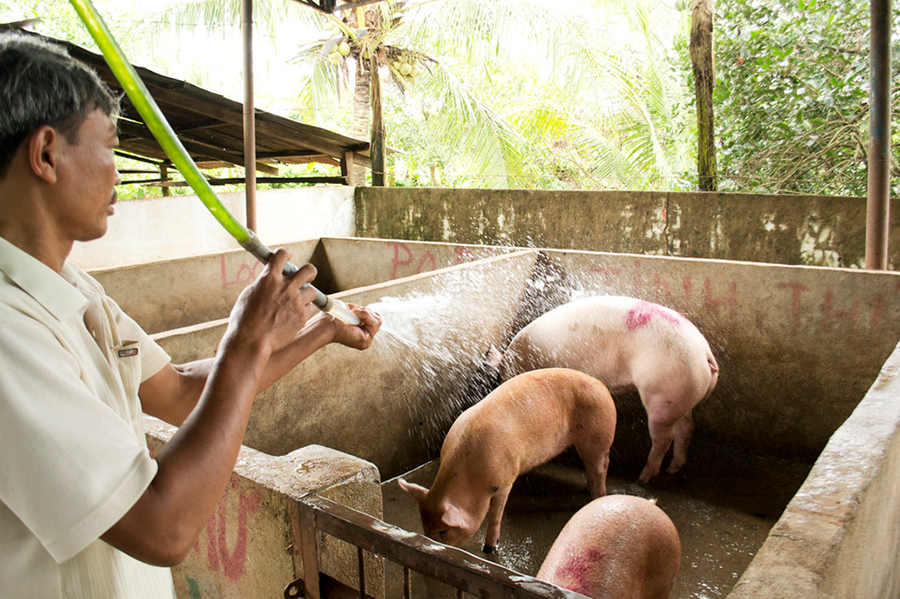
Vietnam's swine-pork industry is operating at a critical historical turning point.
Driven by aggressive corporate consolidation, stringent urban farming bans, and modern tech integration, the sector has rapidly transformed into a global powerhouse, currently ranking fifth by pig herd size and sixth in pork production worldwide.
However, mid-2026 data shows that this rapid modernisation has triggered an impending structural oversupply, echoing recent historic gluts seen in neighboring China. According to market data published by Báo Dân Việt, Vietnam's national pig herd grew roughly 2.8% year-on-year by mid-2026, creating structural oversupply concerns as domestic live pig prices begin to soften.
A look at Vietnam's livestock structure over the last five years reveals an intentional, regulatory-driven overhaul.
Production Share: Traditionally, small-scale household farms were the bedrock of the market, accounting for roughly 50% of the national pork output. Báo Dân Việt reports that large-scale industrial operations now dominate 70% of production, while the household farming share has plummeted by 15% to 20%.
Technology and Biosecurity: The industry has largely transitioned from open-air, vulnerable backyard pens to high-tech, biosecure commercial operations. As highlighted by regional agriculture officials, municipal master plans now mandate that large-scale operators implement Internet of Things (IoT) tracking systems, cold storage chains, and circular biogas waste treatment facilities.
Trade Flow: Rather than relying heavily on external products to stabilise local consumer demand, domestic capacity has grown so robustly that pork imports have begun to fall. Industry trade logs show that in the first four months of 2026, pork imports dropped 3.6% in volume and 21.7% in value year-on-year.
Producers face imminent margin pressures. After holding strong early in the year, live pig prices fell below ₫70,000/kg (US$2.66) in June and have continued sliding to between ₫64,000/kg (US$2.43) and ₫68,000/kg (US$2.59).
Because input and operational costs remain elevated, listed livestock companies are reporting a troubling trend: rising overall revenues paired with falling after-tax profits. This strain is compounded by severe domestic biological threats.
Data from the Ministry of Agriculture and Rural Development (reported via Saigon Giai Phong) reveals that in the first half of 2026, African swine fever (ASF) outbreaks rose by 59.5% year-on-year, causing more than 96,000 pig culls across 28 provinces.
Despite localised disease disruptions, broader industrial growth remains aggressive. Vietnam's domestic live pig prices sit roughly 1.5 times higher than China's bottomed-out market price of approximately ₫35,000/kg (US$1.33). While this price gap acts as a temporary buffer for efficient local enterprises, market analysts warn that it creates a dangerous incentive for overexpansion.
This capacity growth is heavily institutionalised by regional governments. Under 2030 agricultural master plans published by local authorities, cities like Hai Phong are actively targeting regional herds of 710,000 head.
Meanwhile, major agricultural hubs like Nghe An province have formalised targets under Decision No. 2948/QD-UBND to reach 1.3 million pigs producing 225,000 tonnes of live weight annually.
By the end of the decade, traditional smallholder backyard pig farming is expected to be effectively obsolete in primary agricultural zones. Production will be completely consolidated within mega-enterprises.
Báo Dân Việt data points out that just 29 large-scale companies already control 30.5% of the national herd (9.58 million pigs) and command 44.4% of annual domestic shipments. Long-term trajectories indicate that these commercial networks will swallow the remainder of the market, functioning within fully integrated "production-processing-consumption" value chains.
The shift toward industrial dominance is heavily accelerated by municipal mandates. Local governments are aggressively enforcing Livestock Law bans against keeping livestock within urban and residential sectors.
In zones like Hai Phong's Binh Giang commune, Department of Fisheries, Livestock and Veterinary tracking shows traditional smallholder setups contracted by over 90%, forcing remaining operations to entirely relocate into designated agricultural corridors away from residential communities.
To prevent farm liquidations during these relocations, provinces are offering direct financial lifelines. For instance, municipal frameworks like Hai Phong's Resolution 51 provide 100% financial coverage (up to ₫70,000,000, or US$2,662, per facility) to subsidise the cost of achieving VietGAP certification and disease-free accreditations.
While supply expands at home, international demand for Vietnamese pork has taken a sharp hit.
Customs data shows meat exports to Hong Kong—Vietnam's primary destination—collapsed by 41.6% in volume and 24.7% in value (down to 2,100 tonnes worth ₫498 billion, or US$18.93 million) in the first trimester of 2026. This loss of export traction leaves excess supply trapped within the domestic market, further depressing local prices.
The swine sector does not operate in a vacuum; its growth is heavily shaped by parallel livestock expansions tracked by the Ministry of Agriculture.
Poultry populations climbed 3.1% year-on-year by mid-2026, outstripping the pig herd's growth rate. This surge generated 1.3 million tonnes of poultry meat, creating a highly competitive, affordable protein alternative for domestic consumers that limits how much pork the local market can absorb.
Furthermore, this cross-industry growth places a heavy logistical strain on national infrastructure. The poultry sector is enduring its own biological crisis; records published by Saigon Giai Phong indicate that avian influenza outbreaks multiplied 3.8 times in early 2026, resulting in nearly 240,000 bird culls.
Simultaneously, provincial master plans are aggressively funding non-swine commodities—such as Nghe An's push for 555,000 head of beef cattle and ₫3,000 billion (US$114 million) in shrimp aquaculture.
As these sectors scale simultaneously, swine enterprises face intense competition for shared resources, including feed mill production allocations, national veterinary oversight, specialised cold-chain logistics, and premium land permits within high-tech agricultural zones.
- EFL AG-DATA


