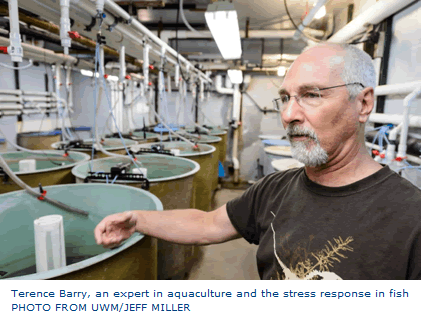
Did you know that fish, like humans, also feel stressed? Stressed-out fish, however, shorten their survival. A research group at the University of Wisconsin-Madison (UWM) accidentally discovered that an oil from a gland that chickens use to condition their feathers can keep fish alive.
The accidental finding started when animal science professor Mark Cook was exploring underused products from animal agriculture. Curious about the oil, or preen, gland, he and post-doctoral researcher Jake Olson noticed that the gland secreted an anti-inflammatory compound. Since a previous test showed that a different anti-inflammatory had accelerated fish growth, Cook and Olson contacted Terry Barry, a university expert in aquaculture, said.
"We did a quick study with fathead minnows, and they had better growth and survival", Barry, an expert on fish stress responses, was quoted as saying in a feature article written by David Tenebaum for UWM. "But when we tried rainbow trout and yellow perch, we did not see the growth acceleration".
A different result came out, however–substantially improved survival. "Every time they got stressed because the oxygen level had dropped or water temperature suddenly changed, fish fed a derivative of the preen-gland oil survived, but the others did not", Barry continued.
The researchers decided to call the oil cosajaba, which Olson describes as water-proof, a wax. Preen gland secretions play a mysterious role in birds, according to Olson. "A lot of research has built up suggesting it (gland) has a pheromone function and plays a role in mating. It may be antimicrobial or help in ultraviolet protection, in addition to waterproofing the feathers."
The researchers are finding out how unusual fatty acids in cosajaba oil dampen the stress response. Yet, they still have to determine how long the oil should be fed and when to start feeding it.
Stress has been found to be a major contributor to annual losses of about $250 million to Atlantic salmon farms in Norway. The stressors include events like vaccination, netting and the transition from fresh to salt water that precedes rapid growth in Atlantic salmon, according to the UWM article.
While the preen gland is discarded as waste from about 9 billion broiler chickens slaughtered in the US each year, Barry wonders whether cosajaba oil can be mass-produced.