


June 20, 2023
Purdue University: Drone imagery analysis to help increase soybean yield in wake of climate change
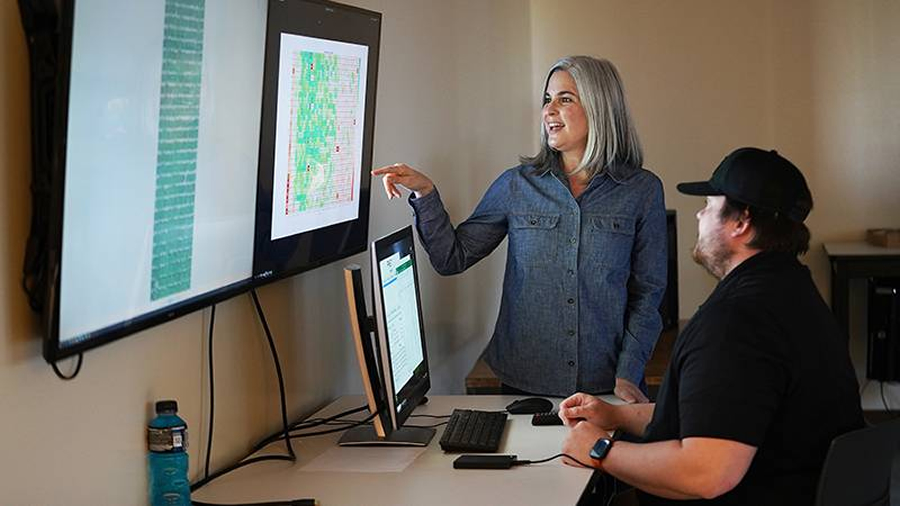
Professors from Purdue University have worked in recent years to predict soybean biomass from drone imagery in Indiana, the United States.
"We're now expanding that capability to all the public soybean breeding programmes in the region," said Katy Rainey, professor of agronomy, who also directs the Purdue Soybean Center. Soon, she and Keith Cherkauer, professor of agricultural and biological engineering, will begin receiving drone imagery collected on a panel of 1,200 soybean varieties that breeders have planted in 11 US states across the country's north-central region.
"Here at Purdue, we'll do all the processing and modification of the images to predict biomass," Rainey said. The effort is part of the SOYGEN3 (Science Optimized Yield Gains across ENvironments) project. Consisting of eight universities, including Purdue, SOYGEN3 has more than US$900,000 in funding from the North Central Soybean Research Program.
"The overarching goal in this experiment is to develop methods and models for selecting soybeans that will be high yielding in future extreme environments under climate-change scenarios," Rainey said. "We know that the future environments we're going to grow soybean in are different from the ones we have now because climate is changing. We're getting more extreme weather as well from climate change."
The project exploits software, called Plot Phenix, which rapidly converts aerial crop photographs into useful information for plant breeding, crop modeling and precision agriculture. Rainey, Cherkauer and Purdue PhD alumnus Anthony Hearst, who is also chief executive officer of Progeny Drone Inc., patented Plot Phenix in 2022.
"I'm interested in water use, the effects of environments and the ability to measure and simulate soybean across large areas," said Cherkauer, who also directs the Indiana Water Resources Research Center. "Having locations that are farther apart increases the likelihood that we will have a range of environmental conditions."
Minnesota soybean breeders and farmers plant different genetic stock than those in Indiana, for example, which requires more heat-resistant varieties. But even areas that share the same annual average precipitation could experience dramatically different years.
"We could have drought here in Indiana, and eastern Kansas could be having a normal year," Cherkauer said. "Having access to so many locations that could be experiencing average weather conditions and drier conditions allows us to stretch the image analysis and the models we're building beyond what we do right now."
Eastern Kansas gets about the same precipitation as Indiana, Illinois and Missouri. But western Kansas receives about half as much precipitation. It resembles central-western Nebraska, the Dakotas and western Minnesota in that regard.
"Indiana is almost entirely rain-fed except for seed production and production in the sandy soils. Illinois is going to be similar. As you get into Iowa, they're starting to see a bit more irrigation," Cherkauer explained.
Cherkauer is a co-founder of GRYFN, a Purdue-affiliated company that has provided a new drone for the project with funding from the departments of Agronomy and Agricultural and Biological Engineering and the College of Agriculture. Calibration flights for the new platform have already begun at Purdue's Agronomy Center for Research and Education, a 1,600-acre farm facility located seven miles northwest of campus.
The SOYGEN3 collaboration will fly drones that collect imagery in red, green and blue (RGB, or true color, the type captured by regular cameras).
"SOYGEN3 is about starting with relatively inexpensive cameras and hardware systems at a variety of locations," Cherkauer said. But the Purdue drone also will carry multispectral and thermal cameras, yielding better data sets that could lead to recommendations for their SOYGEN3 partners.
Such data could help the US maintain its position as the world's leading soybean producer. Revenues in 2022 topped US$66 billion. This includes more than US$34 billion in exports, according to the United States Department of Agriculture's Foreign Agricultural Service.
"It's a unique crop because it is very important to future protein food security," said Rainey. Yet soybean uses are mostly industrial, meaning that people consume only a small percentage of its production.
"You might occasionally eat a traditional soy food like tofu or edamame. But for the most part, 95% of soybeans globally are fed to chickens and pigs and are the basis of that food chain."
To maintain soybean's burgeoning production, researchers will need a more finessed understanding of how weather and climate affect yield in a range of environments involving genetic variation. Breeders would then be able to select soybean varieties more strategically.
"The genetic variation is key because the most obvious way that breeders or breeding organisations in the private sector would use the data that we produce would be in what's known as genomic prediction," Rainey explained.
Given enough data over the entire soybean genome, genomic prediction allows breeders to create a statistical model that predicts yield for 10,000 untested lines.
"But the genomic prediction models need to be calibrated to environments and have more information in them than what's currently in there," Rainey said. Also needed is a model that includes biomass predictions. Such models are based on drone imagery and genetics.
"In my lab, we work on combining that information. We're just about the only ones to do that across the public and the private sector in soybean," she said.
- Purdue University


