


June 17, 2020
Nor-Feed: Plant extracts in feed to replace synthetic coccidiostats
Press release


 Coccidiosis is a poultry disease caused by species of the genus Eimeria, resulting in increased susceptibility to diseases and infections, which can lead to delay in growth and death. In a context of high prices for vaccines, the emergence of the risk of resistance to ionophores and chemicals and changes in consumption patterns, natural products appear as an alternative to synthetic coccidiostats. In this context, Nor-Feed offers a feed additive based on a standardized extract of saponin-rich plants.
 Synergistic action of saponin-rich plants in Norponin® XO2 (Trigonella foenum-graecum and Yucca schidigera) in the fight against coccidiosis.
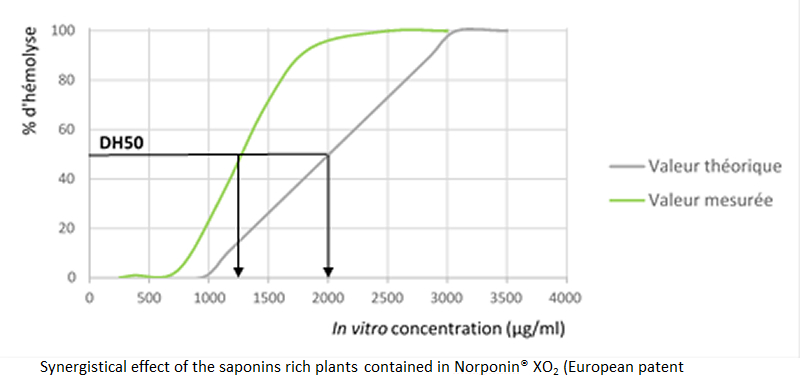
Saponins are secondary metabolites contained in certain plants, composed of a hydrophilic part (glycosides) and a hydrophobic part (sapogenins). This bipolarity is of outmost importance to explain their activity against coccidia. Saponins bind to sterols present in the membranes of coccidia. The interactions between the glycosidic parts of the saponins and the membrane sterols cause a destabilization of the coccidia membranes. These bonds create pores in the membranes of the coccidia which allows a flow of water, causing an osmotic gap and the explosion of coccidia. Nor-Feed has developed an in vitro test based on a hemolytic model (European patent pending), as a tool for selecting raw materials and formulation, highlighting the synergy of plant extracts used in Norponin XO2 against coccidiosis. For this, the haemolytic capacity of Norponin XO2 was determined (measured value) and compared to its theoretical haemolytic capacity, based on the values of the saponin-rich plants contained in Norponin XO2 taken separately.
Use of Norponin XO2 as an alternative to ionophores and synthetic substances in the fight against coccidiosis in broilers
Synthetic anticoccidials and ionophores have been widely used in poultry for many years in order to control coccidiosis, with the result that the risk of resistance of Eimeria to chemical solutions is emerging. In addition, the continued use of chemical solutions can lead to the presence of residues in the meat. In addition, this risk is one of the main points of attention of European consumers. As a result, natural solutions appear to be a new alternative in controlling coccidiosis to ensure animal performance.
In this context, in order to validate the effectiveness of its natural extract, Nor-Feed has carried out numerous trials, including 7 with an experimental infestation. This article therefore presents an experimental infestation trial and a field trial in a broiler integration.
In this context, in order to validate the effectiveness of its natural extract, Nor-Feed has carried out numerous trials, including 7 with an experimental infestation. This article therefore presents an experimental infestation trial and a field trial in a broiler integration.
 • Trial under experimental infestation conditions
The test was conducted with the private Antenor Orrego University on 75 broilers (males, Cobb 500) divided into 3 groups, in 15 different boxes (5 chickens per box, 5 boxes per group):
Synergistical Effect of saponins rich plants contained in Norponin XO2
- Negative Control group : standard diet
- Positive Control group : standard diet + synthetical coccidiostat (Clopidol 25% at 50 g/T of finished feed from D1 till
- Norponin XO2 group : standard diet + Norponin XO2 at 250 g/T of finished feed from D1 till slaughter.
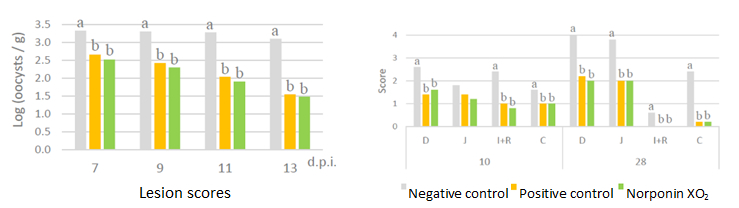
From day 14, an oral inoculum was provided with Coccivac-D (Merck) at 15 times the vaccination dose. On days 7, 9, 11 and 13 post inoculation (d.p.i), feces oocysts were counted on 5 chickens per group. On days 10 and 28, Eimeria-induced lesion scores were analyzed on the intestinal tract, duodenum (D), jejunum (J), ileum (I + R), caecum (C).
The number of oocysts in the feces was significantly (P <0.05) greater in the negative control group compared to the other groups. This is consistent with significantly lower lesion scores for both Norponin XO2 and positive controls (P <0.05). This highlighted that the Norponin XO2 solution is at least as effective as a coccidiostatic synthesis / ionophore program in reducing the risk of coccidiosis.
• Field trial in a broiler integration
The trial was conducted with Cobb chickens from birth to slaughter on a commercial farm in Turkey. The animals were divided into two groups. In the first, a synthetic ionophore / coccidiostatic program was provided (625 g / T Nicarbazine + Narasin from birth and up to 21 days, 700g / T Narasin from day 22 to day 38, followed by a period without anticoccidials from day 39 to slaughter, the positive control). In the second group of animals, 250 g / T of Norponin XO2 was brought from birth to slaughter. For this test, two repetitions took place within the same farm :
- 110 000 broilers : 50 000 with Norponin XO2 and 60 000 in the positive control group
- 109 760 broilers : 50 240 with Norponin XO2 et 59 520 in the positive control group
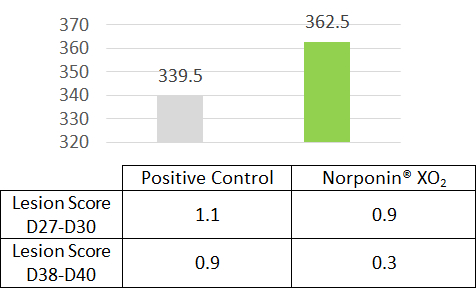
The lesion scores of the intestines (based on the sum of Eimeria maxima, acervulina and tenella) at 27-30 days and 38-40 days were analyzed according to the Johnson Reid method by performing an autopsy of 5 chickens in each group on each periods studied. The zootechnical performances (EPEF) were calculated for each group.

The analysis demonstrated that the use of Norponin XO2 from birth to slaughter is at least as effective as a Nicarbazin + Narasin / Narasin program alone on improving animal performance (EPEF). From an infestation point of view, the level of intestinal lesions related to the presence of coccidiosis was higher in the positive control group than in the Norponin XO2 group. Thus Norponin XO2 from birth to slaughter is at least as effective as Nicarbazin + Narasin / Narasin alone on the control of Eimeria and on improving the zootechnical performance
The use of Norponin XO2 is an effective natural alternative to conventional ionophore and chemical programs in the control of coccidiosis, providing a solution in line with market issues.


