


CORPORATE NEWS
'MARKET SYNERGIES'
INVE seals tilapia distribution deal with Manit Farm

INVE has signed an agreement that will result in a range of its tilapia products being distributed by one of Thailand's largest quality tilapia fry and feed providers, Manit Farm.
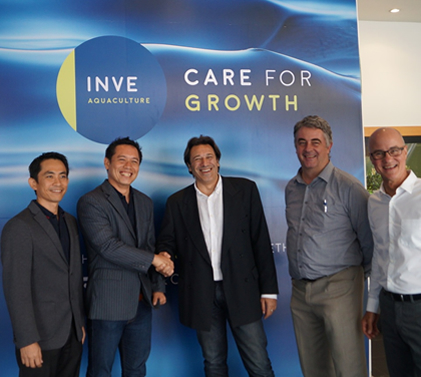
The collaboration is built on the synergy between Manit Farm and INVE—part of the Benchmark Group and a supplier of products that improve biosecurity and microbial management—both in the farms' water supplies and in the gastro-intestinal tracts of the fish themselves.
"The deal will allow Manit to distribute a range of INVE products including a biocide, Sanocare CID; a water treatment product, Secure POND; and a feed probiotic, Secure YIELD," said Mario Hoffmann, key account manager at INVE.
Global production of tilapia is expected to reach 6 million tonnes in 2018 and, according to the Thai Department of Fisheries, 197,000 tonnes of these will be produced in Thailand. Due to the comparatively low cost and the relative ease of producing tilapia, the sector is seen as an important source of protein to feed a growing human population. Both INVE and Manit Farm are committed to promoting aquaculture in Thailand.
"We believe in market synergies among complementary competences and we care for the sustainable growth of the tilapia market in Thailand," explained Stelios Leontios, INVE's commercial director.
Sustainable growth will be achieved if tilapia production is professionalised and modernised, integrating the recent developments in genetics, biosecurity, nutrition and management tools—goals that Manit Farm, which has been in the tilapia hatchery business for over 25 years, is keen to achieve.
"In 2007, we established our Tilapia Genetics Center, in collaboration with Benchmark's Akvaforsk Genetics, focusing on the selection of different strains of tilapia. As a result, Manit Farm now provides Superblack Nile tilapia fry and Superred red tilapia fry, as well as a range of quality feed under both the Manit Farm and OHO brands," said Khun Amorn Luengnaruemitchai, managing director of Manit Farm.
INVE, one of the pioneering firms in world aquaculture, has more than 32 years' experience in developing products and solutions for hatcheries and farms worldwide. Through its market and technical knowledge, the company has developed products for nutrition, health and the environment for a range of species.
"The combination of fry genetics, biosecurity measures, and specific management protocols—through product and strong technical support—will allow farmers to cost-efficiently produce quality fish," said Olivier Decamp, INVE's farm and feedmill product manager.
The agreement will increase the market penetration for INVE's tilapia products in the Thai market, by capitalising on Manit Farm's existing distribution and services network, which already counts more than 1,000 tilapia farmers across the country as customers.
It will also help the company to promote one of its main goals.
"This partnership will allow INVE Aquaculture to reinforce one of its main ambitions: to care for the growth of aquaculture by being the preferred knowledge partner for aquaculture businesses worldwide," Commercial Director Leontios added.
REGIONAL CHALLENGES NOTED
Cermaq releases QI sustainability report

Cermaq has released the results of its first-quarter sustainability report, which showed strong performance on the social indicators in all regions it operates. On the other hand, the performance on fish health and environment reflects the local operational challenges in each region.
The fish survival rate measured as 12 months rolling rate was highest in Norway with 94.8% and between 92% and 93% in Canada and Chile (for Atlantic salmon). In Canada the treatment for sea lice (in feed) was at the same level as the previous year; in Chile there was an increase in bath treatment, whereas there were no bath treatments in Norway (including hydrogenperoxide).
The use of cleaner fish has proven effective in the Norwegian operations and Cermaq is engaged in research into local cleaner fish in Canada. Through an industry-wide initiative in Chile, a native Cleaner fish species (Malapterus reticulatus) has been identified and Cermaq Chile will start breeding trials.
Cermaq is testing the effect of Imvixa at its research site in Chile. Imvixa is a new oral treatment against sea lice which has been approved in Chile. At this point it seems to have a significant effect on Caligus sea lice, results showed.
At present, Cermaq has 25 salmon farms duly certified by the Aquaculture Stewardship Council.
Cermaq is one of the world's leading companies in farming of salmon and trout, with operations in Norway, Chile and Canada. Cermaq is a fully owned subsidiary of Mitsubishi Corporation with head office in Oslo, Norway.
FOR PROMOTION OF SUSTAINABILITY
Thai Union awarded leadership trophy by Greenpeace

World seafood giant Thai Union Group PCL was cited by Greenpeace in early June as a leader for positive change in the seafood industry for its SeaChange project.
Last year, Thai Union launched SeaChange, a strategic approach to sustainability designed to transform the way the seafood industry operates worldwide.
SeaChange is an integrated plan of initiatives organised into four programs (safe and legal labor, responsible operations, responsible sourcing, and people and communities) to drive meaningful improvements across the entire global seafood industry.
SeaChange's objectives can be summarised in three overarching objectives: 1.) To ensure the
seas are sustainable now and for future generations; 2.) To ensure that its workers are safe, legally employed and empowered; and 3.) To ensure vessels it buys are legal and operate responsibly.
Thai Union regards SeaChange as "a journey which covers every aspect of the business: from how to look after the oceans to how to manage waste; from the responsibility the company takes for workers to building brighter futures for its communities".
"Thai Union absolutely accepted the mantle of leadership—knowing our suppliers and ensuring we purchase from responsible organizations and well-managed vessels is critical to helping us achieve our mission to be the seafood industry's leading agent of positive change," said Dr. Darian McBain, PhD., Thai Union's global director for sustainable development. "Thai Union engages in a wide-ranging set of initiatives in our pursuit to reduce the risks and the likelihood of illegal, unreported and unregulated fishing entering our supply chain."
McBain commended Greenpeace on its efforts and offered Tara Buakamsri, Thailand country director for Greenpeace Southeast Asia, a "Super Whale" trophy—Thai Union's highest recognition award—for doing its job well.
"I would like to thank Greenpeace for recognition of Thai Union's leadership in sustainability and Thai Union looks forward to working collaboratively moving forward," she said.
To learn more about SeaChange, visit http://seachangesustainability.org/.
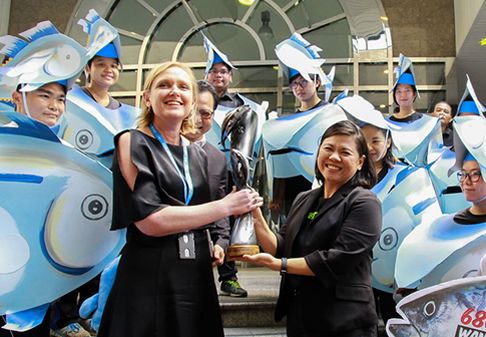
Darian McBain (left), PhD., Thai Union's global director for sustainable development,
accepts a leadership award from Khun Anchalee Pipattanawattanakul (right), Oceans
Campaigner for Greenpeace Southeast Asia, and Khun Tara Buakamsri (rear), Thailand
Country Director for Greenpeace Southeast Asia, for the company's promotion of
sustainability, reaffirming Thai Union's role as a leader for positive change in the seafood
industry. THAI UNION PHOTO

Norway's Marine Harvest gets licenses for 4 'Egg' salmon farms
Norwegian seafood giant Marine Harvest has been granted by the Norwegian Directorate of Fisheries development licenses to operate four salmon farms using the Egg concept of production.
The Egg method allows Marine Harvest to farm salmon at depths where sea lice cannot survive. The production facility is a 44-meter-high supertanker-like structure that is shaped like an egg.
Marine Harvest, the world's largest producer of Atlantic salmon, said it applied for 14 Egg facilities on Feb. 10 last year but that 10 had been rejected.
It said it will appeal the decision rejecting the "remaining 10 development licenses for the Egg concept".
Nevertheless, Marine Harvest expressed pleasure that "the authority (Norwegian Directorate of Fisheries) shares the view that 'the Egg' represents a potential new production solution within salmon farming which may contribute to further develop the salmon farming industry".

The Egg salmon farming concept HAUGE AQUA PHOTO
'EXPANSION OF PLEDGE TO AQUACULTURE'
Calysta, Cargill break ground on new feed plant in US

NouriTech™ and its lead investors, Calysta Inc. and Cargill, were joined by state and local officials in breaking ground for a 37-acre aquaculture feed production facility in Memphis, Tennessee, USA.
The plant will be home to the world's largest gas fermentation operation that will produce Calysta's FeedKind® protein, a nourishing and sustainable feed ingredient for fish, as well as livestock and pets, using its proprietary technology.
"(The) groundbreaking is an important milestone for this project and our Cargill Memphis campus as it demonstrates our ongoing commitment to Tennessee, Shelby County and Memphis. It also expands our pledge to aquaculture as an increasingly important source of food," said Cargill Managing Director Mike Wagner.
"FeedKind protein is a new sustainable feed ingredient that is critical to helping meet sharply rising global demand for food," said Alan Shaw, Calysta president and CEO. "We are delighted to partner with Cargill and the Memphis community to launch construction of our first commercial scale manufacturing plant. This is the next step in bringing this important product to markets throughout the world."
Upon completion, NouriTech will occupy 37 acres of Cargill's 69-acre property on President's Island, employ around 160 full-time team members and produce some 200,000 tonnes of FeedKind annually.
The first phase of construction is expected to be completed in 2018, with the plant on line in 2019. The second phase of construction will be completed by 2020.
State and community representatives spoke at the ceremony, including Tennessee Economic and Community Development Commissioner Bob Rolfe; Shelby County Mayor Mark H. Luttrell, Jr.; Memphis Mayor Jim Strickland; and Greater Memphis Chamber President Phil Trenary.
"It is great to see NouriTech break ground on its new Memphis facility," said Rolfe. "The company announced plans in November 2016 to locate its new manufacturing facility in Shelby County and create many news jobs, and it is exciting to see NouriTech start the process of building this new facility. I look forward to seeing NouriTech continue to succeed in Tennessee and in the city of Memphis."
"We're delighted about NouriTech's decision to expand its mission in our community. It's a thriving company that now has a new name and a new logo that will be known to people throughout the world," said Luttrell, Jr.
Strickland, for his part, said, "We're proud to have played a unique role in enabling NouriTech to create new jobs here in Memphis. I'm proud this innovative venture decided that Memphis was the best place for it to grow, and I'm so glad to have another example of the momentum we're seeing in our city".
Trenary echoed Strickland saying, "Memphis has established itself as a major center for advanced manufacturing, and we welcome the NouriTech brand to this community, bringing new jobs and investment to Memphis".
NouriTech's 37-acre site will feature a one-story administration building that will house technicians, engineers, supervisory and management staff; 20 fermenters, each similar in size to a football field end zone; two fermenters, which is expected to be installed in the first phase of construction and up to an additional 18 in the second phase; several dryers, each approximately the height of a six-story building; one dryer, to be built and used for the first phase of construction, with remaining dryers to be built in Phase 2; several kilometres of piping; and various processing, filtration and product handling and loading equipment.
The team responsible for making the NouriTech vision a reality includes Black & Veatch, a leading engineering, consulting and construction company, and various equipment and technology providers.
POSITIONING IN LATIN AMERICA
BioMar acquires Ecuadorian shrimp feed producer

As part of the company's expansion strategy, BioMar Group has acquired 70% of Ecuadorian shrimp feed producer Alimentsa.
The acquisition will position BioMar among the leading shrimp feed producers in Latin America.
Since last year, the company has been servicing Latin American shrimp farmers from the factory in Costa Rica with focus on sustainability and feed efficiency.
With the acquisition of Alimentsa, BioMar will create a foothold in Ecuador which is one of the world's leading shrimp-producing countries with a volume of more than 450,000 tonnes of shrimp. The country is generally recognised for its shrimp products with an emphasis on high quality and sustainability by both end-consumers and retailers.
"It is our ambition to become a major player within high-end shrimp feed. With the acquisition of Alimentsa, we can immediately deliver an attractive value proposition to the shrimp farmers in Latin America and we believe that in the future,together with Alimentsa and customers, we can develop new product solutions based upon shared interest in innovation, cooperation, sustainability and performance", said Carlos Diaz, CEO of BioMar Group.
"During our due-diligence process, we have confirmed that the acquisition will enable us to build a strong relationship with Latin American shrimp farmers. Alimentsa is recognised for high-end feed and a professional technical service. That is very much in line with our focus in BioMar", he added.
The acquisition represents an investment of US$119 million.
BioMar Group estimates that the market will prove to be very attractive with growth rates of 8-12%. Shrimp production in Ecuador is characterised by optimal conditions that allows up to three production cycles per year.
Furthermore, the farming densities in Ecuador are quite low compared with other markets allowing much better and sustainable sanitary conditions. In addition, Alimentsa holds a market share of around 12-15%.
"We foresee a solid business potential in Ecuador, but first and foremost, we believe that the combination of a strong local company with recognised products and deep insights into the market together with a global company with the size and innovation muscle as we have in BioMar Group will enable us to meet the future requirements of the market as well as the end-consumers. We are very confident in the local management and the organisation", Diaz said.
"We believe in being 100% devoted to aquaculture and we have clearly stated that we strive to be innovators dedicated to an efficient and sustainable global aquaculture", he added.
'VERY IMPORTANT MILESTONE'

Skretting, the world's leading producer and supplier of high-quality feed for farmed fish and shrimp, launched the Skretting brand in Honduras and Nicaragua in late May to support the growing need for sustainable shrimp feeds in those two important aquaculture markets, as well as throughout Central America.
Earlier in August 206, Skretting successfully launched its brand in Ecuador and Peru.
"The arrival of Skretting in Honduras and Nicaragua is a very important milestone for Central America's aquaculture industry. Skretting wholeheartedly believes that given the right support and the confidence to grow, this is a region that can make an increasingly valuable contribution to the global growth of sustainable aquaculture production", said Alex Obach, managing director of Skretting Aquaculture Research Centre (ARC), during the launch.
"ARC Providing high-quality shrimp and fish with high-quality diets will be one of the most important contributors to this future, and this investment by Skretting demonstrates our commitment to ensuring that Honduras, Nicaragua and Central America as a whole are given the tools to fulfil their considerable potential", he added.
Since the establishment of Skretting in Ecuador and Peru, shrimp farming operations in both markets and across Latin America have advanced from the support provided by the company's worldwide R&D knowledge.
In particular, many of the region's shrimp producers continue to be shown at special events and seminars that aligning the appropriate high-specification nutrition with precise feed management procedures could bring a new golden era for the region's shrimp farming sector.
Crucially, shrimp farmers have been learning the importance of correct feeding in the first stages of the life cycle, and how to optimise growth based on the genetics of their shrimp stocks.
Skretting said that its entry into Honduras and Nicaragua will expand upon Skretting's existing feed supply relationships with several farming operations.
Skretting's Aquaculture Research Centre has more than 120 researchers from 27 countries and has been conducting research on nutrition, aquatic animal health and farming for more than 25 years. This unit continues to analyse countless aspects of shrimp and fish feed management, with a strong emphasis on confirming the best nutrient composition of its feeds.


