


June 15, 2026
Vietnam's egg farmers suffer heavy losses as prices sink to multi-year lows
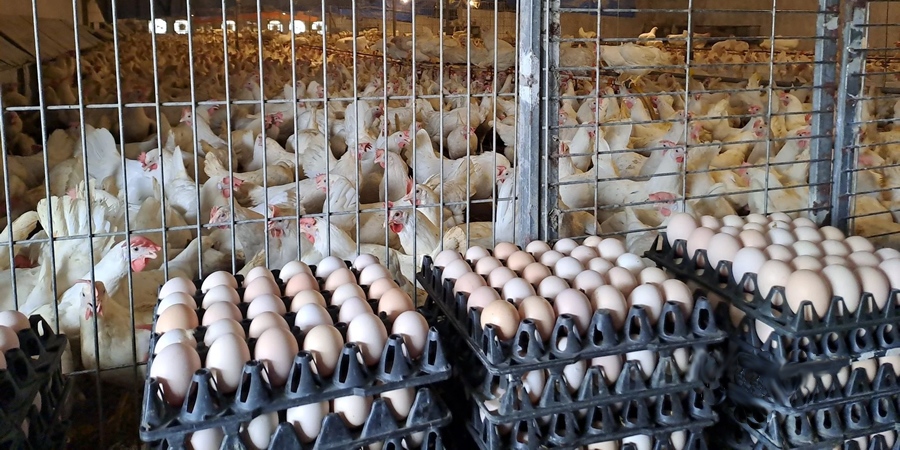
Egg producers across Vietnam's southeastern region are struggling with severe financial losses as farm-gate egg prices remain at their lowest levels in years.
In Phu Giao Commune, Ho Chi Minh City, Ha Ngoc Thanh, owner of an industrial egg-laying chicken farm, said egg prices have fallen sharply since March 2026.
Eggs are currently sold at the farm for only ₫1,200 (US$0.04) to ₫1,500 (US$0.05) per egg, down more than ₫1,500 (US$0.05) compared with the same period last year.
At the same time, rising feed and input costs have pushed production expenses to around ₫1,600 (US$0.06) per egg, leaving many farmers operating at a loss.
A survey of major poultry-producing areas, including Dong Nai City, Tay Ninh Province and Ho Chi Minh City, found that industrial egg prices have remained depressed for several months. As a result, farmers are losing several hundred đồng on every egg sold.
For large-scale operations, monthly losses can amount to hundreds of millions of Vietnamese đồng.
A poultry farm owner in Phu Vinh Commune, Dong Nai City, said egg prices had fallen sharply, but production could not simply be halted because hens still needed to be fed and cared for.
Despite the sharp decline in farm-gate prices, consumers continue to pay significantly higher prices at retail outlets, highlighting the pressure poultry farmers face within the supply chain.
A survey conducted on June 14 found that eggs were trading at ₫24,000 (US$0.91) to ₫30,000 (US$1.13) per dozen at major retail chains, equivalent to ₫2,400 (US$0.09) to ₫3,000 (US$0.11) per egg. Premium and fortified egg products were priced between ₫35,000 (US$1.32) and ₫45,000 (US$1.70) per carton of 10 eggs.
Vice Chairman of the Dong Nai Livestock Association, Nguyen Kim Doan, said the prolonged decline in egg prices since the beginning of 2026 has placed many poultry farmers in a difficult position.
A poultry farm in Phu Giao Commune, Ho Chi Minh City, where white-feathered chickens are bred for commercial production.
According to Mr Nguyen, large eggs are currently sold for only ₫1,000 (US$0.03) to ₫1,200 (US$0.04) per egg, while smaller eggs fetch around ₫800 (US$0.03). Production costs, however, range from ₫1,400 (US$0.05) to ₫1,600 (US$0.06) per egg, meaning farmers are losing approximately ₫400 (US$0.02) on every egg sold.
Compared with the same period last year, egg prices have fallen to roughly 60% of their previous level, representing a steep and sustained decline.
Nguyen attributed the downturn primarily to oversupply.
In 2025, favourable market conditions pushed egg prices to between ₫2,000 (US$0.07) and ₫2,200 (US$0.08) per egg, encouraging many companies and farmers to expand their flocks. However, consumption failed to keep pace with rising output, resulting in a significant market surplus.
Workers process and package eggs at QL Vietnam Agroresources Company Limited in Tay Ninh Province.
Exports have also played a vital role. Last year, strong demand from Cambodian importers helped support domestic prices. More recently, however, several Vietnamese companies have invested in poultry farms in Cambodia, reducing the country's need to import eggs from Vietnam and contributing to excess supply in the domestic market.
Another factor has been the conversion of some former pig farms into egg-laying chicken operations, particularly in Dong Nai City, further boosting supply and intensifying downward pressure on prices.
- SGGPO


