



INDUSTRY NEWS
Brazil has finally opened its market to Russian fish and fish products, initially approving exports from three fish processors. It said it was open to approving more Russian fish product exporters, subject to veterinary and phytosanitary control.
SUBJECT TO VETERINARY CONTROL
Brazil opens market for Russian fish, fish products
Brazil is set to open its market to Russian fish and fish products, as it officially approved in late May exports from three fish-processing establishments.
According to Rosselkhoznadzor, or the Russian Federal Service for Veterinary and Phytosanitary Surveillance, a meeting between representatives of the Rosselkhoznadzor and the Brazilian Ministry of Agriculture was held on May 22-23, during which they discussed issues of exporting Russian products to Brazil, subject to veterinary and phytosanitary control.
"The Brazilian party confirmed that the approved establishments can start exporting these (fish) products to Brazil", Rosselkhoznadzor said in a news release posted on its website.
The Rosselkhoznadzor, in turn, requested that it extend the list of Russian fish product exporters in the future. The Brazilian party said it was open to such a possibility.
The meeting also discussed Russian grain export to the Brazilian market, particularly the difficulties experienced when exporting wheat to Brazil. The Russian party suggested the amendment of the Brazilian phytosanitary requirements, such as the exclusion of several quarantine objects and allowing the presence of Canada thistle in Russian wheat consignments intended for export to Brazil.
To settle the issue of Russian wheat export to the Brazilian market, the Rosselkhoznadzor plans to arrange talks between technical experts in the near future.
SPREADING TO ASIA
FAO issues own special alert on tilapia disease TiLV
After the Network of Aquaculture Centres in Asia-Pacific (NACA) issued its disease advisory covering tilapia in early May, the UN Food and Agriculture Organisation (FAO) came out on Friday, May 26, with its own special alert on the spreading TiLV, or Tilapia Lake Virus, a highly contagious disease affecting one of the world's most important fish for human consumption.
According to FAO's Global Information and Early Warnings System (GIEWS), TiLV has so far been confirmed in Colombia, Ecuador, Egypt, Israel and Thailand, Xinhua reported.
Disease outbreaks among cultured tilapias have occurred in Thailand, putting at risk the US$7.5-billion global industry, especially in the top tilapia-producing countries in the Asia-Pacific region including China, the Philippines, Thailand, Indonesia, Laos and Bangladesh.
An international team of researchers have found that TilV has been responsible for the 85% decrease in the annual yields of the world's second-most farmed fish in Israel since 2009.
FAO said that tilapia-producing countries should be vigilant, and should follow aquatic animal-health code protocols of the World Organisation for Animal Health (OIE) when trading tilapia.
It added that they should initiate an active surveillance programme to determine the presence or absence of TiLV and the geographic extent of the infection, and identify risk factors that may help contain it.
According to the UN agency, TiLV surveillance was being conducted in China, India and Indonesia, and is planned to start in the Philippines.
The top 10 tilapia-producing countries include China, Egypt, Philippines, Thailand, Indonesia, Laos, Costa Rica, Ecuador, Colombia and Honduras.
The US is the biggest importer of tilapia, consuming 225,000 tonnes of the fish yearly.
RANKED 12th, COULD BE ON TOP 5
Sorry state of Philippine aquaculture deplored
The Philippine government's lack of support for fisheries and aquaculture was highlighted at the 2nd National Aquaculture Summit, which was held simultaneously with the Livestock Philippines Expo and Aquaculture Philippines on May 24-26.
The Philippines is currently ranked No. 12 globally in production volume, but because of its vast
coastal and inland resources it can potentially be among the top 5 global producers.
In his talk on the first day of the summit on Wednesday, Dr. Gilberto Llanto, president of the Philippine Institute for Development Studies, pointed out that the budget allotted for aquaculture represented only a very small portion of the total budget for agriculture, adding that too much emphasis is being put on rice production.
"Fisheries and aquaculture play second fiddle to the DA (Department of Agriculture) centralised commodity programs, such as rice and corn", he said.
In fact, he said, some 1.6 million small fishers who have a high incidence of poverty, may potentially benefit from improved aquaculture.
Llanto also disclosed that as of September 2015, only half of 80 aquaculture facilities nationwide are fully functioning.
Among others, Llanto said that private-public sector partnership/collaboration is imperative to improve the industry's condition.

VIETNAM'S UPS AND DOWNS
Aquaculture output up 3.3% in May…
Vietnam's aquaculture output in May increased 3.3% year-on-year to 370,000 tonnes, data from the Ministry of Agriculture and Rural Development (MARD) showed, according to a Vietnam News Agency report.
The total output for the first five months this year was 1.235 million tonnes, up 2.4% year-on-year.
During the five-month period, the total output of tra fish in the Mekong Delta provinces hit 465,900 tonnes, up 11.1% from the same period last year, while the aquaculture area was estimated at 3,092 hectares, falling 6.2%.
The sharpest increase of tra fish output was recorded in Can Tho city, by 50.1%, followed by An Giang, by 11.9%, and Dong Thap, 3.2%.
The price of tra fish slightly dropped in May to around 24,000 to 26,000 Vietnamese dong (US$1.05-$1.14) per kilogramme. The price of tra fish foy also fell, ranging from VND27,000- VND 50,000 ($1.20-$2.20) per kg.
The total shrimp output in the first five months topped 144,000 tonnes, up 46.2%. Shrimp prices ranged between VND 85,000 and VND340,000 ($3.70-$15) per kg.
The shrimp raising area was estimated at 597,000 hectares, up 6.8% from the same period last year.
In the five months through May, fish catch topped 1.327 million tonnes, up 5.2% year-on-year, of which 1.264 million tonnes were caught at sea, up 5.5%. The total output included 311,000 tonnes caught in May, according to MARD.
…Exports of aquatic products up 10.4% in first 5 months…
Exports of aquatic products raked in US$618 million for Vietnam in May, pushing the total amount in the first five months to $2.8 billion, or a year-on-year rise of 10.4%
The Ministry of Agriculture and Rural Development (MARD) said the US, Japan, China and South Korea were the leading importers of Vietnamese aquatic products, accounting for 53.5% of the country's export value, according to a report by Việt Nam News.
Vietnam also imported $87 million worth of aquatic products in May, raising the five-month figure to $508 million, up 28% year-on-year, the report added.
MARD explained that the hike in imports was due to the increased purchase of fish by processing facilities that export their products, particularly to the Chinese market.
…Shrimp exports stagnant in 1st quarter…
Following a 6.7% growth recorded in 2016, Vietnam's shrimp exports in the first quarter didn't budge, slightly decreasing 0.1% compared with the same period last year. They were valued at US$618 million.
The Vietnam Association of Seafood Exporters and Producers (VASEP) attributed the stagnant growth to a sharp rise in raw shrimp price and anti-dumping tax levied by the US.
Nevertheless, the demand in Japan was high, as the appreciation of the Japanese yen made shrimp-exporting companies shift to this market. Recovering exports to other markets such as the EU and South Korea also offset declines in the US, China and Australia.
Exports of whiteleg shrimp retained the largest share of Vietnamese shrimp exports in the first quarter, at 63.3%, while those of black tiger shrimp had 27.3% share and of marine shrimp, 9.4%.
Whiteleg shrimp exports hit US$391.7 million, increasing 10.6%, while exports of black tiger shrimp touched $168.7 million, declining by 21% from the first quarter of 2016. Shipments of marine shrimp reached $57.9 million, up 12.3% year-on-year.
Vietnam exported shrimp to 68 markets, up from 64 markets in the same quarter in 2016.
The top 10 main importing markets were Japan (with a share of 21.9% of total exports), the EU (19.2%), the US (18.1%), China (15.1%), South Korea (10%), Canada, Australia, ASEAN, Taiwan and Switzerland, in that order. They all accounted for 95.4% of Vietnam's total shrimp exports.
Among the top importers, Japan, the EU and South Korea recorded positive growths, with shipments to South Korea showing the highest rise of 30.8%. Exports to the US and China declined. Particularly, sales to the US dropped by 26.3%.
Raw shrimp output in 2017 is projected to increase slightly to 660,000 metric tonnes (worth around $3.4 billion or up 9% year-on-year) over a farming area of 700 hectares.
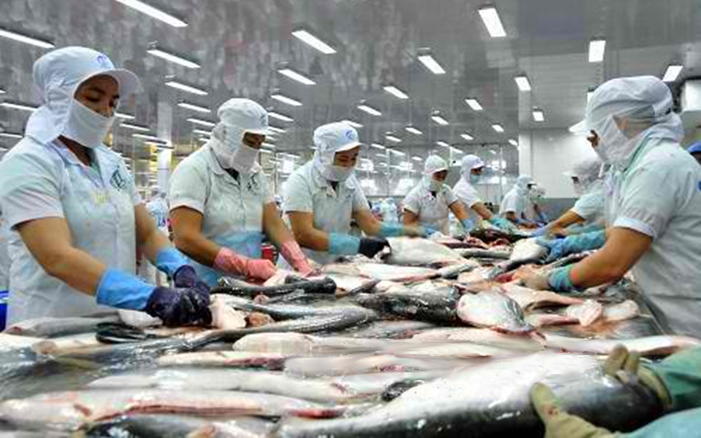
Tra fish processing facility in Vietnam PHOTO FROM VIET NAM NEWS
…Lobsters die en masse in Phu Yen province
Mass deaths of lobsters have been reported in the coastal province of Phu Yen in Vietnam with farmers losing hundreds of billions of dong (tens of millions of US dollars), according to a report by Dtinews.
The phenomenon was explained as the result of weather change.
One farmer, named Tran Thi No, was reported to have lost nearly 800 lobsters raised in 10 cages at her farm.
At a farm near Phuoc Ly beach, Nguyen Thanh Quang also lost over 1,000 lobsters in 15 cages in just over a week, Dtinews reported on Monday, May 29.
According to Song Cau District People's Committee, there are over 1,100 lobster farms in the area with over 13,300 cages. Thus, the total losses from this mass deaths can run up to hundreds of billions of dong.
The vice director of the Song Cau District's Animal Husbandry Department, Nguyen Huu Dai, said the lobster deaths were caused by a sudden weather change, when heavy rains occurred after a long heat wave.
"The rains suddenly changed the saline level and caused a lack of oxygen in water," Dai was quoted as saying.
"Another reason is that lobsters are densely raised, which resulted in water pollution", he added.
In Xuan Phuong ward, many farmers collected and sold dead lobsters.
"We can only sell those that have just died and look still fresh," farmer Pham Canh said, according to the Dtinews report.
He said the usual price of lobster per kilogramme was VND1.5 million (US$66), but that the dead lobsters could only be sold for a third of that. "We're facing a loss of about VND5 million (US$221) for each cage", he lamented.
FRAGMENTED MONITORING NOTED
GAA helps Chile to better manage harmful algal blooms
The Global Aquaculture Alliance (GAA), a leading standards-setting organisation for farmed seafood, has released a new report that identifies measures to enhance the management of harmful algal blooms (HABs).
The 19-page algal blooms management report, which GAA published on Tuesday, May 30, concluded that while there was much capacity and experience among those studying and monitoring HABs in Chile, fragmentation in monitoring and outreach was apparent.
The report suggested that the Chilean economic development agency CORFO and Chile's minister of the economy establish a committee of scientists and regulators to review existing HAB programmes and recommend how they can be better coordinated and managed.
Early last year, a series of HAB outbreaks hit the coastal waters of southern Chile, affecting finfish (particularly salmon) and shellfish farmers. The outbreaks resulted in losses of farmed and wild finfish, as well as widespread paralytic shellfish poisoning.
A GAA-led team of experts met with Chilean government officials, researchers, and salmon and shellfish aquaculture leaders in August to gain better understanding of the situation.
The GAA report emphasises the timeliness of HAB detection through use of new technologies, and supplementing the work already being done in Chile. Tracking HABs, it said, involves enhanced maintenance of buoys that can identify and count algal cells and transmit results via the internet for near real-time use and satellite-based remote-sensing systems coupled with the application of physical-biological numerical models.
While some types of data are very adequately applied, the report noted that the algal nutrient measurements needed to understand and model the concentrations, sources and fates of the natural and human-sourced nitrogen, phosphorus and silica found near aquaculture facilities in the Chilean Inland Sea were limited.
The algal blooms management recommendations also include further examination of mitigation methods to control HABs near salmon farms including testing of methods that have been successful in other countries.
18-MONTH COLLABORATION
GAA, IFFO partner to improve fishmeal supplies in Southeast Asia
The Global Aquaculture Alliance (GAA) and IFFO (Marine Ingredients Organisation) are working together to fund a project that will improve the understanding of Southeast Asian fisheries supplying raw material for fishmeal production.
The study will look at the issues from the perspective of social, economic and environmental sustainability factors. The aim is to identify improvements that can be prioritised and targeted to enable increasingly responsible supplies of fishmeal. This will support change in fisheries management in the region, thus driving the adoption of certification in the supply chain, and ultimately supporting the development of best practices in aquaculture.
A variety of relevant and critical stakeholders including NGOs, governments, feed companies and standards holders will be invited to participate.
Duncan Leadbitter (Fish Matter Pty) will head the project on behalf of the two organisations.
The project will begin in July 2017 and is expected to run for 18 months.


