CORPORATE NEWS
VIA ALIMENTSA
BioMar strengthens position in Ecuador
Less than a year after acquiring the majority stake in Alimentsa, BioMar has accelerated the development of the Ecuadorian shrimp feed producer in terms of capacity as well as human capabilities.
"We have continued to build on the legacy of Alimentsa", said Danny Velez, who took over as general manager shortly after the acquisition. He stressed the importance of ensuring continuity while fortifying the company in a highly competitive market.
Velez said that sales volume has continued increasing since the acquisition by the Danish fish and shrimp feed company, adding that Alimentsa is in the middle of a series of new investments including a fifth production line in order to secure sufficient capacity next year. It is a relatively small investment as the new line fits into our present facilities, and thereby we expect it to be ready already early next year", Velez said.
Velez said that their new feed trial and development facility announced in November is also progressing according to schedule and will be operational later this year.
Further investments are planned for the near future to fulfill the strategic ambitions of the company. Velez sees the current price drop for shrimp as a temporary correction that should not impede investment.
"Overall global shrimp consumption continues to increase, and in terms of quality and sustainability Ecuador has the upper hand. China is the largest market for shrimp, but the local production in China is facing new tough environmental restrictions and this will limit the supply. At the same time the Chinese consumers become more and more demanding, so I strongly believe that the market will return to equilibrium soon", he said.
BioMar's investment programme in Ecuador is accompanied by a strengthening of the organisation in Alimentsa. "We want our customers to see the tangible benefits of becoming a part of BioMar, so especially product development and technical customer support are being reinforced. However, also other areas of the company are being strengthened while we integrate Alimentsa into BioMar", Velez said.
As a consequence, the Technical Director for BioMar Central America, John Tinsley, relocated to Guayaquil in May, joining Alimentsa's R&D Manager Laurence Massaut in a first step to build a highly competent team for feed trials and product development around the new Aquaculture Technology Centre.
In addition, Andres Rivadulla has joined Alimentsa as finance manager from the multinational plastic giant BIC and a number of new positions are being filled out.

FOR THE PRICE OF A$25M
Nissui wants stake in Seafarms
Nissui of Japan has entered into an agreement with Seafarms Group Ltd. (SFG) to acquire 14.99% of its outstanding shares for A$25 million (around 2.1 billion yen or US$18.7 million).
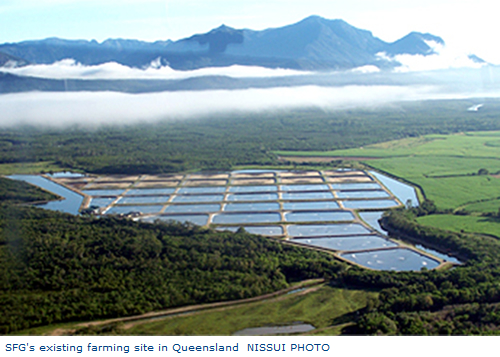
SFG's existing prawn farming operations in Queensland, Australia, produces more than one-third of total domestic production of farmed prawn in Australia, where the required environmental standards create high barriers to entry.
The marine products company decided to invest in SFG after it was satisfied that SFG's proposed new large-scale prawn farming project in Northern Territory of Australia, known as Project Sea Dragon, would obtain the necessary government approvals for the development. It is also of strategic significance for Nissui to secure a differentiated farmed prawn business base and products.
Project Sea Dragon Pty Ltd (PSD), a 100% subsidiary of SFG, plans to start building the black tiger prawn farming site this year and bring the product to the market by 2021. At the first year of harvest, PSD targets to produce 10,000 tonnes of quality fresh prawns.
Through this equity participation, Nissui will market the black tiger prawn products from PSD exclusively in Japan, Australia and New Zealand, on top of potential global distribution through the Nissui Global Links network.
Nissui Group will also distribute in Japan and Oceania region around 2,000 tonnes per annum of black tiger and other prawns sourced from SFG's existing Queensland prawn farming operations, including products from its complete farming cycle.
Despite a declining trend in the Japanese prawn market, expanding US, Europe and China market supports substantial demand for farmed prawns. Vannamei shrimp holds 80% of global farmed prawn market, while once-dominant black tiger prawn holds 20%.
Nissui pursues "Sophistication of Aquaculture Business" as one of the major themes in its marine products business and has already started a feasibility study of on-shore farming of vannamei shrimp for eating raw in Japan. It now invests in the development of farming businesses in the world consistent with its new mid-term plan "MVIP+2020", starting from 2018.
Nissui will develop the prawn business to be a core business in the same way as its salmon/trout and white fish businesses.
'THE SMALLER THE BETTER'
CPF pioneers Best Small Farm project in Philippines
Charoen Pokphand Food PCL has pioneered the Best Small Farm (BSF) project in the Philippines to help Filipino white shrimp (vannamei) growers achieve high productivity while keeping costs low and ensuring food safety, the Philippine Daily Inquirer (PDI) reports.
The BSF's main objective is to improve biosecurity in the farm and reduce the risk of disease contamination, which is the main threat in growing shrimp.
Eliminating the risk factors of diseases, according to CPF, involves the 3C concept (clean fry, clean water and clean pond bottom), which helps ensure the successful farming of shrimp.
Under the BSF project, the standard size of the pond is reduced from the usual one hectare to just 0.16-0.25 hectares as the smaller size makes it easier to manage the farm and keep potentially deadly diseases at bay. At the same time, harvesting and pond preparation become more efficient, leading to a higher pond crop turnover.
CPF has put up a Best Small Farm pond demo in the CPF Farm in Zambales province. This pond demo has harvested 8,500 kilos of shrimp from just 1,600 square meters. This gives the pond a productivity of 53 tonnes per hectare with a feed conversion ratio (FCR) of 1.30.
CPF Philippines has been producing shrimp feed at its factory in Samal, Bataan, since 2013.
'CHANGE PRESENTS OPPORTUNITIES'
Thai Union shares visions for food business
The Thai Union Group PCL has shared its visions toward global food trends at the Thailand Food Innovation Forum 2018 held last May 21-22.
The company's CEO, CEO Thiraphong Chansiri, said Thai Union sees five major trends affecting business amid changing market environments. They are currency fluctuations; emerging disruptive technologies; global growth engine slowdown; geopolitical risk; and global free trade at risk.
"Change is certain; however, it also presents opportunities", he said. "More importantly, we need to build our ability to deal with these uncertainties".
Meanwhile, Dr. Tunyawat Kasemsuwan, Thai Union's group director for global innovation, noted that consumers are more concerned today about food safety and purity, and manufacturers need to focus on addressing consumer needs with transparency in ingredients, processes and supply chain.
Moreover, food byproducts are an excellent source of ingredients for nutraceuticals, and possess many components that are excellent for human health.
At the two-day event, Thai Union presented its award-winning Yellowfin Tuna Slices to visitors, one of the new innovative products developed by Thai Union's Global Innovation Incubator.

WANTS BRAND RECOGNISED
Trident Seafoods changes marketing strategy in China

Trident Seafoods, the US' largest seafood company, is changing its marketing strategy in China by selling Alaska seafood directly to Chinese consumers, Xinhua reported, citing an online report by Alaska's Energy Desk.
Trident Seafoods has been selling fish in China for 20 years only as a commodity so that many Chinese consumers don't know the company's products as a brand, it was reported.
The company now wants to bring wild Alaska seafood directly to Chinese consumers via stores or markets to make its own brand known.
Jeff Welbourn, senior director of the Chinese Business Office for Trident Seafoods, recently talked with Chinese business partners about getting their products into some new markets, Xinhua reported.
Trident Seafoods is tapping the 300 million active users of Chinese e-commerce giant JD.com, in whose website Chinese consumers can get their order of wild seafood from Alaska.
Per capita consumption of seafood in China is around 40 kilogrammes of seafood per year, he said. This is around twice the per capita global consumption in 2017.
US$200M PLANT ON SCHEDULE
Veramaris tops off algal oil production facility in Nebraska
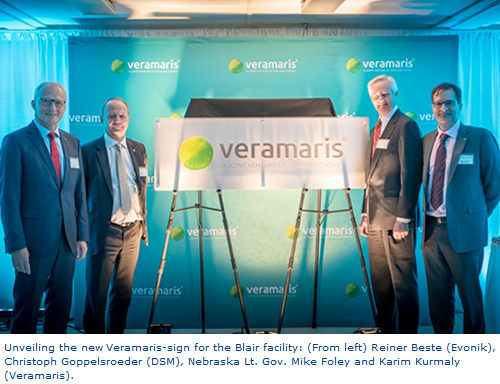
Veramaris, a DSM and Evonik joint venture, celebrated a major milestone in the construction of its new production site in Blair, Nebraska. Graced by the presence of Nebraska Lieutenant Governor Mike Foley, a topping-out ceremony was held on June 4 in Blair, Nebraska.
The construction of the US$200-million facility is on schedule, and commercial quantities of algal oil will be ready for delivery in mid-2019. Pilot-scale quantities are already being supplied to selected feed producers and farmers for market development.
"Our algal oil is the response to the industry's call for a sustainable source of the omega-3 fatty acids EPA and DHA. The known provenance of all the raw materials used in our process makes the product fully traceable," Veramaris CEO Karim Kurmaly said.
The initial annual production capacity of the Nebraska plant will meet roughly 15% of the total current annual demand for EPA and DHA by the global salmon aquaculture industry.
Veramaris said it uses locally sourced sugar in its fermentation process. The algae strain, Schizochytrium, which is applied, has the advantage of producing the essential omega-3 fatty acids EPA and DHA and the resulting oil has a concentration exceeding 50%. The production site will be entirely waste-free.
Veramaris also said its highly concentrated algal oil will, for the first time, enable the animal nutrition industry to keep up with the increasing demand for these two essential omega-3 fatty acids without any reliance on fish oil obtained from wild fish stocks.
"The raw material for this disruptive Veramaris technology comes from the heart of American agriculture - from Nebraska. Nebraska corn helps conserve marine life in the ocean. This is a wonderful story and I wish Veramaris all the best in making aquaculture more sustainable," Foley said.
Until recently, the omega-3 fatty acids EPA and DHA added to animal feed have been almost exclusively from marine sources. Currently, a total of 16 million tonnes of wild fish are caught for the production of fish oil and fishmeal. With the help of natural marine algae, Veramaris contributes to closing the supply-demand gap for omega-3 EPA and DHA, while helping to conserve marine life and biodiversity in the oceans.
The existing Evonik site in Blair was chosen for the production of the omega-3 fatty acids EPA and DHA to take advantage of Evonik's decades of operational experience for large-scale biotechnology operations. The company has been operating a facility there for the fermentative production of Biolys® - the amino acid L-lysine - for almost 20 years.