


June 11, 2025
Australian cattle group "bitterly disappointed" as court reduces live export ban compensation
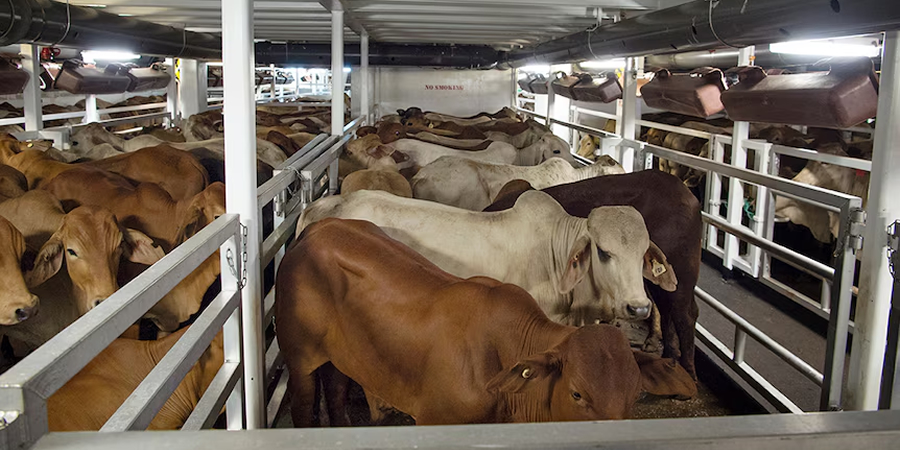
Cattle producers in Australia's Northern Territory say they are "bitterly disappointed" after the Federal Court minimised the extent of their claimed losses stemming from the 2011 live cattle export ban.
Fourteen years on from the ban that started it all, and five years after winning their class action against the federal government, hundreds of claimants had been seeking A$510 million (US$332.66 million) in compensation, plus costs and interest, from the Commonwealth.
The group includes cattlemen, trucking companies, livestock agents and shippers whose lives and businesses were up-ended after the ABC's Four Corners aired evidence of animal cruelty in Indonesian abattoirs, prompting the then-Labor government to issue a temporary ban on the live export trade.
Late last week, the Federal Court's Justice Thawley concluded that exports to Indonesia were already in "steep decline" leading up to Australia's temporary ban.
"Indonesia had pursued a beef self-sufficiency policy for many years, but it was pursued with renewed vigour under the new programme, which began in January 2010," he said.
"The court has concluded that the decision to set the quotas at the levels they were set were not affected in any material way by the ban. No more cattle would have been exported in 2012 or 2013 than were in fact exported if the ban had not been made," concludes Thawley.
Northern Territory cattle producers are still digesting the judgement, but have pushed back against the court's conclusion that the temporary ban played a limited role in the subsequent decline in exports to Indonesia.
"We're bitterly disappointed about the ruling," said David Connolly, former president of the Northern Territory Cattlemen's Association, and someone who has been closely involved in the class action.
"We deal one-on-one with the people who import our cattle … we know how the customer reacted, but it's very difficult to prove that in court."
Three years after a federal court ruled a live cattle export ban unlawful, farmers say they are yet to see a dollar and have accused the federal government of intentionally delaying compensation.
The court is yet to determine how much compensation is due to the industry, and the parties will confer by June 18, with court orders to follow.
"I don't know what that number might look like – it might look like A$300 million (US$195.68 million), A$400 million (US$260.93 million), or A$500 million (US$326.16 million), but that's something to be determined down the track," Connolly said.
"We'll take some advice, we'll read the Justice's rulings, but we'll certainly consider an appeal."
On May 30, 2011, ABC's Four Corners broadcast shocking footage from inside Indonesian slaughterhouses. It showed Australian cattle being kicked, struggling while retrained by ropes, and being slaughtered without having been stunned.
In response, and under political pressure, then-agriculture minister Joe Ludwig announced a ban on June 7, prohibiting the export of live cattle to Indonesia – Australia's largest market.
Overnight, a roughly A$400 million (US$260.88 million) industry was shut down, and hundreds of thousands of cattle were stranded in Australia.
Since the ban and subsequent legal fallout, there has been increased focus on transparency and animal wellbeing on ships.
The ban only lasted six weeks, but the industry claimed it cost hundreds of millions of dollars and devastated businesses.
Their criticism was that the government had completely failed to consult with the industry and Indonesia over the animal cruelty concerns.
The Labor government initiated an independent review and industry support packages, but in 2014 a 300-strong class action began, seeking US$510 million (US$332.66 million) in compensation for lost income as a result of the ban.
The lead plaintiff was the Brett Cattle Company.
"We suffered immense financial hardship because of the ban, so much stress, it was overwhelming at times," Emily Brett told the ABC in 2020.
In June 2020, the Federal Court's Justice Steven Rares found that former agriculture minister Joe Ludwig acted with misfeasance, in banning cattle exports in 2011.
Justice Rares said the blanket ban had been "invalid and capricious".
"I am comfortably satisfied, based on the whole of the evidence, that the minister was recklessly indifferent as to first, the availability of his power to make the ban order in its absolutely prohibitory terms without providing any power of exception and, secondly, as to the injury which the order, when effectual, was calculated to produce," he said.
"Accordingly, the minister committed misfeasance in public office when he made the ban order on June 7, 2011."
The current Labor government offered "a very substantial settlement offer of US$215 million (US$140.25 million)" within months of taking office in 2022, but no settlement was reached.
The Brett family was later awarded nearly A$3 million (US$1.95 million) in compensation, but the hundreds of other claimants have had to wait.
Former NT Cattlemen's Association chief executive Will Evans said the process has been "disgraceful".
"We're bringing all guns blazing and will take [the government] for every cent we can," he told the ABC earlier this year.
Furious cattle producers are heading back to court to win compensation that hundreds of claimants have still not received since a successful class action against the Commonwealth's 2011 live export ban to Indonesia.
Since the Four Corners episode aired in 2011, an Exporter Supply Chain Assurance System (ESCAS) has been introduced, and after a slump, the live export trade with Indonesia has recovered.
In 2024, live cattle exports grew by 13% to 766,044 head, the second consecutive year of growth. Indonesia now accounts for 70 % of Australia's live cattle exports.
Industry peak bodies say the trade, both directly and indirectly, contributes billions to the Australian economy and employs more than 6,500 people.
Australia has been putting farm animals on boats and sending them out to sea since the 1830s.
One senate report from the 1980s reviewing the trade of live sheep to the Middle East captures the ongoing ethical tension of the live export trade.
"If a decision were to be made on the future of the trade purely on animal welfare grounds, there is enough evidence to stop the trade," the report said.
"The trade is, in many respects, inimical to good animal welfare, and it is not in the interests of the animal to be transported to the Middle East for slaughter."
But the committee "agreed that the animal welfare aspects of the trade cannot be divorced from economic and other considerations".
"After consideration of all factors, the committee acknowledges the reality of the situation that any short-term cessation or disruption to the trade would cause considerable dislocation both in Australia and in the Middle East."
- Australia Broadcasting Corporation (ABC) News


