


June 8, 2026
Indonesia needs 1.4 million more dairy cows for self-sufficiency as government links MBG nutrition programme to farm expansion
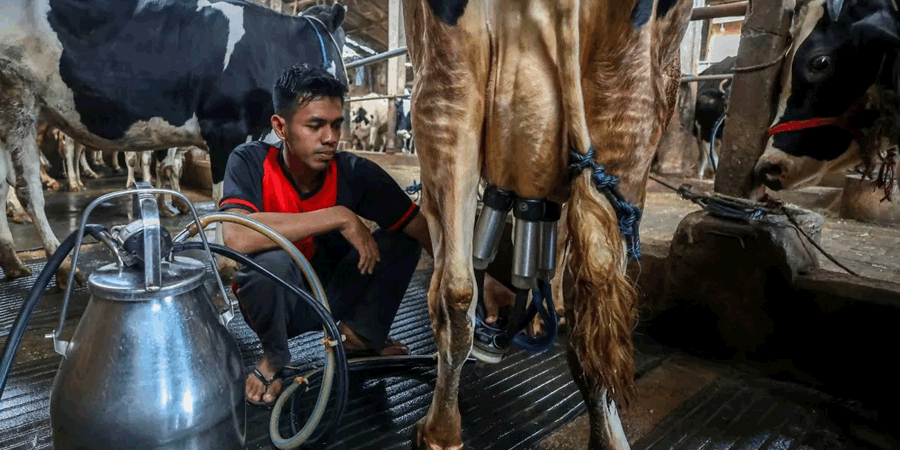
With domestic production meeting only 25% of national demand and per-cow yields averaging 12.5 litres per day, the agriculture ministry is using the Free Nutritious Meals programme as a demand anchor for smallholder dairy development outside Java.
Indonesia requires an additional 1.4 million dairy cows to achieve milk self-sufficiency, according to Makmun, Director of Livestock Product Downstreaming at the Agriculture Ministry, who told a National Milk Day press conference in Jakarta on 2 June that the national herd of around 540,657 head would need to reach approximately 2 million to meet domestic demand.
Domestic milk production currently covers only about 25% of national consumption, with the remainder supplied through imports. Per-cow productivity averages 12.5 litres per day against a ministry target of above 20 litres, and ultimately 25 litres. Makmun said the required herd size could be reduced if productivity improves, and that the government is working to raise output through better feed quality, animal health management and genetic improvement. Nearly 15,000 pregnant dairy cows were imported by the government and private sector last year as part of herd expansion efforts.
To create a more reliable domestic demand base, the ministry has introduced a concept called Dapur Susu Indonesia (Dasi), which integrates small-scale milk processing facilities with kitchens serving the government's Free Nutritious Meals (MBG) programme. Under the scheme, milk collected from local farms would be processed and supplied directly to nearby MBG kitchens. Makmun said a prototype facility requiring less than Rp 5 billion (approximately US$305,000) in investment has been developed, capable of supplying five to ten MBG kitchen units from a supporting farm of 100 to 200 cows.
The initiative is intended to give smallholder farmers, who own more than 90% of Indonesia's dairy herd, a more direct route to market without competing against large commercial processors. Makmun said the MBG programme has effectively provided both a development pathway and a guaranteed off-taker for small-scale producers.
The government is targeting dairy farm expansion beyond Java, identifying Sumatra, Kalimantan, Sulawesi, Bali, Nusa Tenggara and eastern Indonesia as priority regions. Advances in technology enabling milk production in lowland areas, including developments in Subang and Brebes, are seen as reducing the traditional constraint of highland dependency.
Tjatur Lestijaman, General Manager of Research and Development at Indolakto, said growing MBG-driven demand had already prompted the dairy processing industry to expand production capacity. "New investment is necessary," he said.
Annual per-capita milk consumption in Indonesia stands at between 16.3 and 16.6 kilograms, well below the FAO benchmark of 30 kilograms per capita for low-consumption countries.
- The Jakarta Post / Xinhua


