


June 8, 2026
Thai Shrimp Association urges government to rescue industry as disease costs erode competitiveness
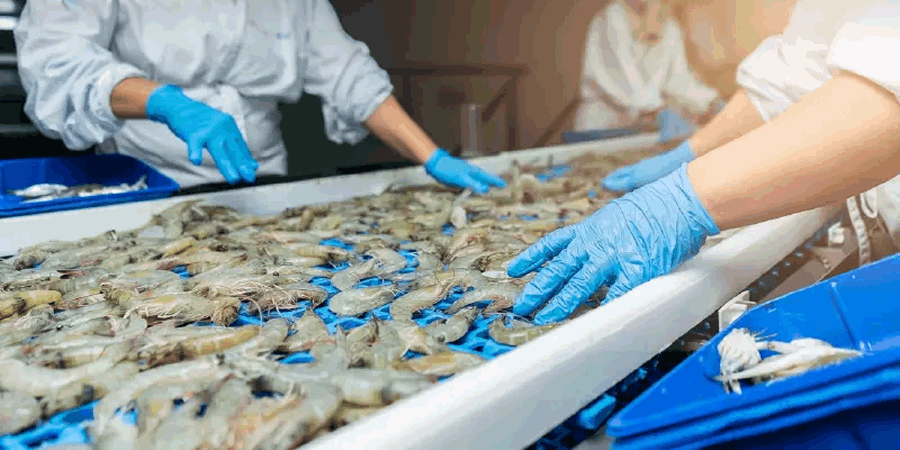
Disease-driven production costs have left Thai shrimp roughly US$1 per pound more expensive than rivals from Ecuador and India, threatening a sector that once generated over 100 billion baht in annual export earnings.
The Thai Shrimp Association has called on the government to take urgent action to revive the country's shrimp industry, warning that endemic disease pressure, slowing exports and lost market share to lower-cost competitors are undermining a sector that at its peak generated more than 100 billion baht (approximately US$2.8 billion) in annual export revenue.
Ekapoj Yodpinit, president of the Thai Shrimp Association, said Thai shrimp is now approximately US$1 per pound more expensive than competing product from Ecuador and India, rendering it uncompetitive on price in key markets despite its reputation for quality and food safety. Exports to the United States and Japan had already begun to slow in the first half of this year, he added.
Ekapoj attributed the cost gap not solely to currency movements but to the compounding burden of four persistent diseases: white spot syndrome, white faeces syndrome, early mortality syndrome (EMS) and yellow head disease. These conditions suppress survival rates and production efficiency, driving up unit costs. Ecuador, by contrast, has continued to improve farm-level productivity with comparatively less disease disruption, he noted.
The combined effect has prompted buyers with over 30 years of purchasing history with Thai suppliers to begin redirecting orders to Ecuador, India and Vietnam.
The association has submitted an 11-point reform plan to the government, with a proposed budget of 5.5 billion baht (approximately US$153 million), covering disease prevention, production efficiency improvements and structural industry reforms.
On trade access, the association urged the government to accelerate free trade agreement negotiations with the European Union and to resolve the closure of shrimp export routes to Malaysia. It also called for active promotion of Thai shrimp in Chinese markets and measures to stimulate domestic consumption, including through the government's "Thais Help Thais Plus" programme, to support farmers amid the export slowdown.


