


May 31, 2023
Cargill: Focus on innovation, sustainability and a customer-centric approach
Cargill has been investing heavily in research and development, new digital solutions and talent development to stay ahead in the ever-evolving livestock and feed industry.
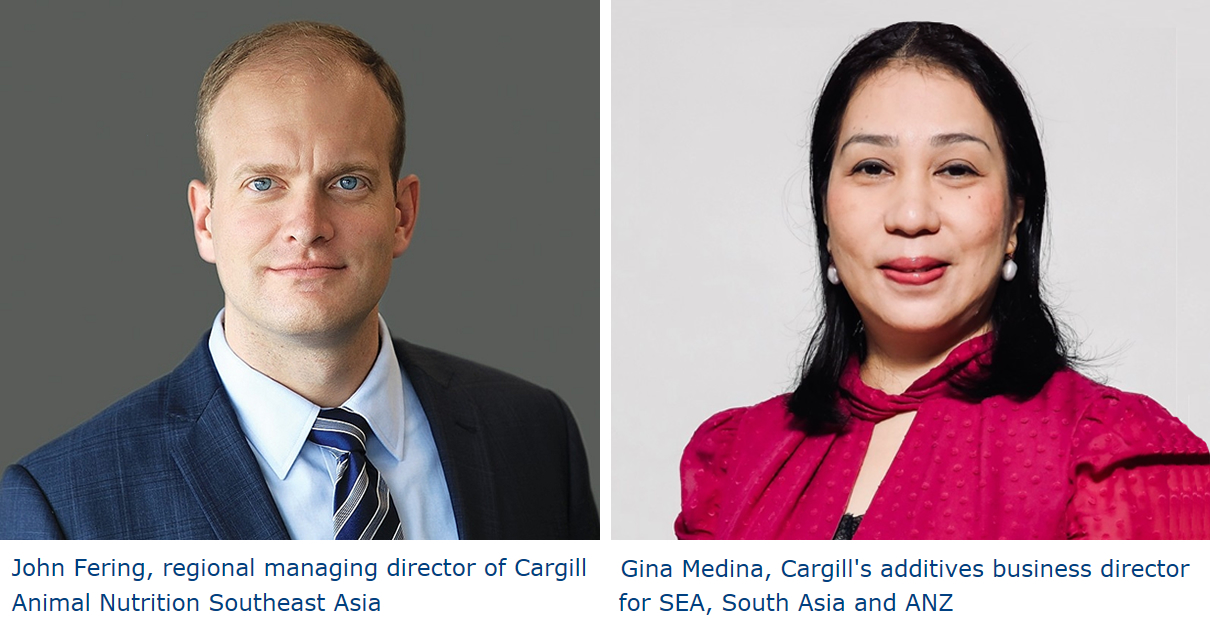
At this year's VIV Asia show in Bangkok, Thailand, eFeedLink speaks to John Fering, regional managing director for Cargill Animal Nutrition Southeast Asia, and Gina Medina, additives business director for SEA, South Asia and ANZ, as they share insights on Cargill's innovative solutions, sustainable practices and customer-centric approach.
Both Fering and Medina also shed light on Cargill's efforts to provide customers with the best technology, resources and talent to help them succeed in a challenging industry.
Additionally, they highlight the company's focus on precise nutrition, digital solutions and alternatives to antibiotics for animal health.
In the past four years, Cargill's animal health and nutrition business witnessed double- and triple-digit growth across Southeast Asia. Please tell us about the key factors behind this uptrend.
John Fering: Three years ago, we reorganised our animal nutrition division to bring together our Provimi and Cargill Feed and Nutrition businesses. Since then, our focus has been on customer and innovation driven growth. We aim to we provide leading nutrition and strong technical services to our customers.
Cargill differentiates with a strong culture of innovation and customer focus on practical, applied solutions on the farm. We have incorporated this culture into our feed platform to ensure deep market access for our feed business, supported by practical applications.
Innovation has been our number one driver and bringing relevant technology has been particularly important during the pandemic. We've seen uncertainty and volatility, not just due to COVID-19, but also because African swine fever (ASF) has been a major disruptor in the region.
During those difficult times, we observed many of our customers turning to companies like Cargill for the breadth of our knowledge and expertise. Our goal is to provide a global perspective translated into locally relevant solutions and equip our customers to deal with uncertainty and volatility. This has been one of our biggest drivers.
Cargill has noted "a gap in production yields seen across the Southeast Asia region compared to the global average." Please elaborate on what these production yields refer to and the challenges that the organisation sees as impediments to the growth of the livestock and feed industry in the region.
John Fering: We see significant opportunities for the region, both for feed and livestock producers. If we look at the data points and the performance yield of our farmers within this region, there is a notable gap between what we typically produce in Southeast Asia and the global average for PSY (pigs per sow per year) or FCR (feed conversion ratio) in the case of pork.
For Cargill, it comes back to our goal of bringing innovation and best practices from other parts of the world to help our local producers narrow that gap.
Firstly, we address the variability and volatility of our feed inputs by bringing technology to understand the right nutrient profile and design optimum value diets. Genetics is another big challenge and opportunity, and we see more advanced genetics being adopted. We also focus on environmental, farm facility and management practices to bring practical and relevant practices in animal husbandry to help customers make optimum production decisions. We help by bringing a holistic approach across each dimension of animal husbandry.
Animal health is the single biggest disruptor, especially considering the density of livestock production in this region and the limited geographic area available to raise animals. We work with producers to implement fundamental biosecurity practices and to manage basics of animal health to ensure a strong production platform.
We serve customers by translating global perspectives into locally relevant solutions.
Gina Medina: We are also emphasising our digital solutions to help farmers and our business partners improve productivity, particularly in nutrition and farm operations. This will help increase efficiency and productivity and ultimately, reduce costs.
In Southeast Asia, there has been a tendency to lower the protein-based value of feed due to costs. This is especially evident in businesses related to animal feed and nutrition. How does Cargill assist customers in addressing this issue?
John Fering: Food inflation has been a very real issue in Southeast Asia where we see changes in consumer purchasing patterns due to affordability. The high cost of macro commodities impacts protein affordability. Our main customers in this region are independent farmers, and our goal is to protect their livelihoods and the long-term profitability of their businesses.
While we cannot directly influence protein demand, we aim to help farmers use technology to produce more efficiently and make different trade-offs between input costs and production outputs, to arrive at the best decision for their businesses. Our priority is to support our customers through market cycles to enjoy favorable business returns over time.
Applying precision nutrition technology is essential to eliminate nutrient waste and eliminate excess costs in diet design and feed formulation. Improving livestock yield through better animal husbandry practices is also important to ensure the access to high quality, affordable protein, for consumers.
Please describe further how Cargill is helping Southeast Asian livestock and feed industry players deal with antibiotic use, sustainability and high costs of feed ingredients.
Gina Medina: During VIV Asia 2023, we have witnessed that feed additives are recognised as valuable and effective solution to address animal feed related challenges. To support this, we are proud to launch Microverse and showcase our commitment to becoming the best science-based and nutrition-focused business in the world.
We aim to achieve this goal by pooling together the resources and capabilities available at Cargill. Our ultimate ambition is to establish ourselves as the largest feed additive business in the industry.
Additionally, we are combining technologies from not only Cargill but also our other animal nutrition brands. With the wider feed additive portfolio that we now have, Cargill can offer a broader range of alternatives to antibiotics, which are safer and more sustainable for animal production.
Cargill is a multinational corporation with a presence in various regions across the world. Besides providing products and solutions to livestock producers in each region, how are you communicating the importance of sustainable production to them?
John Fering: Sustainability is truly at the heart of our business. If we take a fundamental look at our nutrition business, it's about achieving the highest yield and output with the least inputs. Agriculture is a vital part of the sustainability conversation. This is not a promotion for feed additives, but rather a recognition of the role of technology and innovative tools to support decision-making and waste reduction.
We continue to see numerous opportunities in our nutrition business. A prime example is our feed additives that target the microbiome. Our commitment to deeply understanding this subject with science-based technology is because we recognise that enhancing an animal's microbiome leads to more efficient and healthy growth, directly impacting sustainability.
Another opportunity is digital tools or what we call "digital farming." By eliminating delays in farm management interventions through data-driven decision-making, we help customers increase yields. This can be achieved through our digital monitoring tools for livestock. By utilising this technology to accelerate decision-making and ensure timely intervention, we can generate the same yield and productivity with fewer inputs.
Cargill revealed that its growth in Southeast Asia is driven by helping independent farmers see productivity gains. Do you see the consolidation of farms and production plants as, ultimately, the way forward for the region?
Gina Medina: We definitely see a trend toward the consolidation of integrators and a decrease in the backyard segment. The rationale for this shift is to enhance efficiency and productivity and to achieve this, we are able to provide more advanced tools like digital solutions, precise nutrition and efficient additives.
Precision nutrition is a core aspect of Cargill's strategy. We are working diligently to improve sustainability, which is closely tied to optimising nutrient utilisation, reducing feed costs and implementing digital solutions.
Furthermore, it is also important to select or utilise efficient additives that can contribute to precise nutrition for a farm.
John Fering: Another practical element of this trend is the significant amount of capital required to modernise production, as well as the investment in facilities, land and genetics to support modern agricultural production.
We are witnessing demographic shifts, as people move away from rural and agrarian societies into other types of careers and work. This phenomenon is especially prevalent in livestock production in the Southeast Asian region.
However, we still see room for many different players growing with different business models. We do not anticipate the Southeast Asia livestock industry will reach the same level of intensive, integrated production in all species as other regions, given the difference in market conditions and consumer expectations
We serve the needs of diverse customer segments through different business teams designed to meet their specific requirements. For example, Gina's additives team mainly works with large and sophisticated integrators and feed mills, while our feed business focuses on feed dealers and commercial farms.
At Cargill, we aim to transfer technology and make it accessible to all producers, regardless of their business model. We believe that backyard farms are still quite resilient, especially in the longer term, and we are fortunate to have different business models and teams to serve their needs.
To modernise the livestock and feed industry and serve diverse customer needs, Cargill is now directing its efforts toward innovations, investments and infrastructures. Please tell us more about these developments.
John Fering: I would name three areas. Firstly, I believe that our investments in R&D within the region are essential. Historically, we relied on the US and Europe for our core research and development. However, we have added R&D facilities in the region in the past two years. For example, we have a partnership in China that is home to our largest sow nutrition research unit. Bringing our innovation closer to the region is crucial in addressing local nuances, preferences and environment in our decision-making process.
Secondly, feed additives and digital tools have played a significant role to boost our customer's profitability. We have mentioned our digital farming tools to support decision-making and leading technology to bring the best additive solutions to our customers.
Thirdly, and perhaps most importantly, is the work we are doing on our people. Upskilling our talent with advanced technical skills to be applied in real operating environments is critical. Investing in our people with industry-leading practitioners and technical experts is necessary to move from theory to application.
The agriculture industry is increasingly utilising digital or precision farming techniques. However, when feed mills invest in such technologies, there may be a challenge in integrating their platforms with Cargill's. How can you ensure that they work together seamlessly with Cargill's current systems?
John: Our crown jewel is our technology. The innovation cycles and digital fluency of our industry is gaining momentum. Core themes focus on sustainability and digital technology to raise industry production standards.
Our Cargill Nutrition System can be introduced to any major feed mill using their NIR (near-infrared spectroscopy) and feed formulation systems. Using this technology, producers can design diets and feeding programmes that achieve the best yields for best cost.
Beyond precision nutrition, the industry is aggressively moving away from antibiotics towards more natural and safe technology to support animal health. This being driven by government regulations and consumer expectations, and there's a lot of opportunity in this space, which we find exciting.
Please state Cargill's key goals for its activities in Southeast Asia in 2023.
John Fering: It's about helping our customers be successful. We believe that our success at Cargill is linked to the success of our customers.
The industry has experienced volatility and challenges, and we strive to be a dependable and reliable partner by providing the best technology, people and resources to help our customers achieve their objectives with confidence in Cargill's support.
Gina Medina: In short, we are committed to be a total solutions provider and partner of choice to our customers.
- Nicholas Yong, eFeedLink


