



In modern egg production, profitability does not depend solely on the number of eggs produced. Parameters linked to egg quality, both from a physical and nutritional point of view, are becoming increasingly relevant. The weight of the egg, the quality of the albumen, the colour of the yolk or the content of fatty acids and vitamins are today attributes of great interest to the industry and to an increasingly demanding consumer.
However, maintaining these quality parameters consistently throughout the production cycle is not always easy. During its production cycle, the hen faces situations of stress or phases of high physiological demand that can compromise its ability to simultaneously sustain egg production and quality. In these cases, it is not always enough to formulate a diet correctly: it is also necessary to encourage the bird to use the available energy and nutrients more efficiently.
In this context, there is a growing interest in nutritional strategies aimed not only at meeting requirements, but also at optimizing the animal's metabolic efficiency. Among them, SOLERGY proposes an approach based on the support of energy and liver metabolism, with a potentially relevant effect on egg quality.
Egg quality: much more than a physical parameter
The quality of the egg is usually immediately associated with visible aspects such as the colour of the yolk, the consistency of the shell or the size. However, behind these attributes there is a complex network of metabolic processes that depend directly on the physiological state of the hen.
Egg formation requires intense activity of synthesis, transport and deposition of nutrients. To do this, the hen must mobilize lipids, proteins, pigments, vitamins and minerals efficiently, coordinating multiple metabolic pathways in a short space of time. When this machinery works optimally, the result is an egg with better internal quality, higher nutritional value and, consequently, higher commercial value.
On the other hand, when metabolic efficiency decreases, either due to age, stress or high production load, it is common to observe a progressive deterioration of certain parameters, such as albumen quality, loss of yolk colour or reduction in the nutritional value of the egg. Therefore, improving egg quality is not only about adjusting the formulation, but also about supporting the bird's metabolism so that it can transform the nutrients ingested into production and quality.
SOLERGY: A strategy based on functional energy
SOLERGY is a nutritional solution based on a synergistic combination of gluconeogenic and phytogenic compounds, designed to support functional energy availability and improve metabolic efficiency in laying hens.
Unlike conventional energy sources, SOLERGY does not simply contribute energy to the diet. Its value lies in its capacity to support the animal's physiological response by promoting hepatic energy metabolism, improving the use of nutrients and helping the bird to maintain productive performance under demanding conditions.
This approach is especially relevant in laying hens, where liver function and energy metabolism are closely linked to laying persistence, egg quality and overall productive efficiency. By supporting a more efficient metabolic response, SOLERGY contributes to maintaining performance while offering nutritionists a practical tool for energy optimization in feed formulation.
The liver, a key organ in egg quality
In layers, the liver plays a central role in productive physiology. It is one of the most metabolically active organs and is responsible for essential functions such as:
– the synthesis of lipids destined for the yolk,
– and the regulation of the energy balance of the bird.
Therefore, when liver function suffers, so does egg quality. In this sense, any nutritional strategy aimed at improving metabolic efficiency and maintaining adequate liver functionality can have a positive impact on both production parameters and egg quality.
The studies carried out with SOLERGY in avian cell models provide an interesting physiological basis for understanding its mode of action. An increase in ATP production, an improvement in the ATP/ADP ratio and a greater accumulation of glycogen in hepatocytes were observed, which points to a more efficient metabolic response and better energy availability at the cellular level. In addition, the product showed a protective effect against oxidative damage, an aspect especially relevant in birds subjected to high production demands.
Practical evidence in laying hens
The value of a nutritional tool is truly confirmed when its effects are translated into measurable results in the field. In this sense, SOLERGY has been evaluated in a trial carried out with Hy-Line W-36 hens between 44 and 58 weeks of age, within a system aimed at the production of eggs of high nutritional quality.
In this study, the birds received either a control diet or the same diet supplemented with 1 kg/t of SOLERGY, added to the base formulation.
During this trial, the results showed consistent improvements in several egg quality parameters:
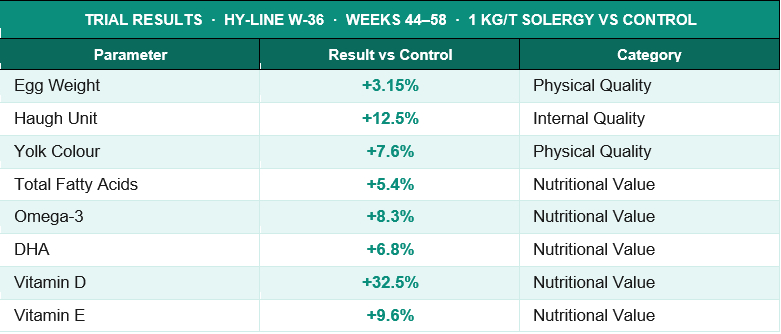
From a technical point of view, these results are especially relevant because they show a simultaneous improvement in the physical characteristics, internal quality and nutritional value of the egg.
What these results mean in practice
One of the most interesting data from the trial is the increase in Haugh units, one of the most widely used indicators to assess albumen quality. An improvement of 12.5% suggests a clear improvement in the internal structure of the egg, with direct implications for freshness and technological quality.
2. Better commercial presentation of eggs
The increase in egg weight and the improvement in the color of the yolk are parameters closely related to the perception of quality by both the consumer and the industry.
3. Increased nutritional value
The increase in omega-3s, DHA, vitamin E, and vitamin D suggests an increased ability of the bird to transfer nutrients to the egg. This is especially interesting in systems aimed at producing eggs with high added value or with a differentiated nutritional profile.
4. Increased stability throughout the cycle
Another noteworthy aspect of the trial is that the positive effect of SOLERGY was maintained throughout the evaluation period, suggesting sustained metabolic support in phases where egg quality tends to deteriorate progressively with age.
When the right formulation is not enough
On many farms, diets are correctly formulated and theoretically cover the nutritional requirements of the bird. However, in field conditions, this does not always guarantee that the hen expresses its full productive potential while maintaining high egg quality.
This is especially observed in:
– flocks of middle or advanced age,
– systems aimed at obtaining eggs with added nutritional value.
In these scenarios, the problem is not always a direct nutritional deficiency, but a limitation in the bird's metabolic capacity to efficiently take advantage of the nutrients ingested. For this reason, the concept of functional energy is becoming increasingly important: it is not only how much energy is contained in the diet that matters, but how much of that energy can actually be transformed into quality and performance.
From this perspective, SOLERGY provides an interesting approach because it acts on the metabolism of the bird, helping to sustain liver function, energy efficiency and nutrient deposition capacity in the egg.
Conclusion
The quality of the egg reflects, to a large extent, the metabolic efficiency of the hen. When the bird manages energy better, maintains its metabolic balance and transfers nutrients more efficiently to the egg, the result is an improvement in its physical, internal and nutritional quality.
In this context, SOLERGY represents a nutritional tool with a particularly interesting approach for laying hens, since its action goes beyond the conventional energy supply and is aimed at the metabolic support of the bird.
The available results show consistent improvements in key parameters such as egg weight, Haugh units, yolk colour, lipid profile, and vitamin content. All this reinforces the idea that strategies aimed at improving metabolic efficiency can be a useful way to sustain egg quality, especially in phases of the cycle in which it tends to deteriorate.
In a market that is increasingly oriented towards differentiation and quality, these types of solutions can help the industry move towards more efficient, stable and value-added oriented production systems.


