


May 22, 2017
Jamón Ibérico rising! Spain becomes a major world pork market player
A net exporter to EU countries since 2004, high productivity, low costs and a unique product enabled Spain's swine sector to diversify into non-traditional Asian markets.
By ERIC J. BROOKS
An eFeedLink Hot Topic
The last three years have seen European pork exports outmuscle their world market competitors, particularly in the Far East. None had done so more than Spain. Though a net pork exporter only since 2004, the country is on track to become a top world market supplier of both high-end and mass market pork. With 2016 pork exports of 2 million tonnes (800,000 exported outside the EU), Spain has overtaken Denmark (1.97 million tonnes, 595,000 tonnes outside the EU) as the largest European pork supplier
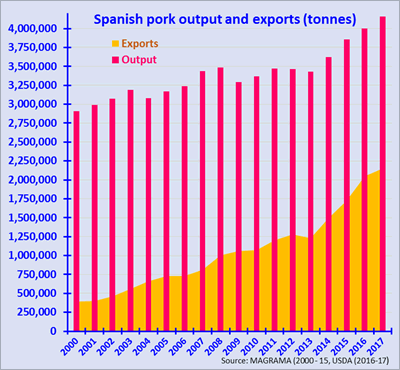 Unlike America or Brazil and much like Canada, Spanish swine farms are heavily export dependent, selling 50% of their output outside the country. Although only 800,000 tonnes of the 2 million tonnes of exports or 4 million tonnes of 2016 output is exported outside the integrated EU market, that still makes it the world's sixth largest pork exporter, trailing third ranked Canada (1.33 million tonnes) Denmark (1.3 million tonnes outside the EU), Germany (1.2 million tonnes outside the EU), and Brazil (0.83 million tonnes).
 Just like Canadian pork relies on the US market, Spain's pork sector still heavily depends on its fellow EU countries –but that's where the comparison ends. Unlike Canada (which cannot break its NAFTA market dependence), Spain is now breaking into fast growing developing markets in a big way. That is one big reason why Spanish production and hog inventories are booming while its Canadian rivals remain stagnant.
The past year saw Spain overtake Germany as the country with Europe's largest hog herd, though due to higher carcass yields, the latter still produces more pork. In fact while the overall EU hog herd is in decline, Spanish farms are expanding aggressively. After levelling out in the early part of this decade to comply with new EU animal welfare legislation, Spanish hog herds expanded aggressively.
Based on Eurostat data, from a bottom of 25.2 million head in 2013, they increased 1.2% to 25.0 million head at the start of 2014. Amid rising export demand, they then rose 6.2% to total 26.56 million head at the start of 2015, then another 6.8% to open 2016 at 28.37 million head.
Over the past year, with the rise in sow inventories levelling off though thanks to export demand, still came in above expectations. Instead of increasing 2% as initially anticipated, the herd grew by 3.1%, opening 2017 at 29.232 milion head. Approximately 26 million of this total is accounted for by modern efficient hog breeds and another 3 millioni by traditional, far less efficient but tastier native Black Iberian pigs.
 All this growth is however, export driven. From 2000 through 2017 inclusive, Spanish pork production increased at a modest 2.1% annual rate, but exports rose by a far faster 10.6% rate over these same seventeen years. Moreover, America the leading exporter saw its shipments grow rapidly and then stopped doing, as did Canada, Denmark and Brazil. By comparison, Spanish pork exports have risen at annual rates ranging from 10.4% to 13.2% in all the five year periods since 2000.
From 390,000 tonnes in 2000, they rose at an 11.7% annual rate, nearly tripling to 1.060 million tonnes by the end of 2009. They then increased at a healthy 7.2% annual rate over the next five years, totaling 1.5 million tonnes by 2014. At this time, France was Spanish pork's biggest foreign customer, followed by Italy and Portugal.
What happened next was surprising: Russia's embargo of Spanish pork in late 2014 underscored its overdependence on the European market, which (based on USDA figures) absorbed 78% of exports in 2013. The Russian embargo entailed the loss of approximately 60,000 tonnes of exports and intensified competition from several hundred thousand tonnes of rival European pork that once went to Russia. All EU exporters redirected their former Russian shipments into East Asia, but none one did so more successfully than Spain.
One year before Russia imposed its embargo, over 85% of Spanish pork exports went to either EU countries or Russia. Despite the embargo, 2015 saw exports rise a sharp 14.9% to 1.723 million tonnes –and the proportion shipped to European countries fall to 69%. The number of pork processing plants approved for exporting to China rose from ten in 2013 to 20 by the end of 2015 and 28 by the end of last year.
Powered by booming Asian demand, 2016 saw Spanish pork exports rise an even faster 16% to 2 million tonnes –and the proportion shipped to EU countries fall to 60%. From 172,500 tonnes in 2015, pork exports to China jumped 96% and totaled 338,000 tonnes in 2016. This was more than the volume of Spanish pork exported to France, Italy or Portugal.
Amid booming Chinese import demand, Spanish pork exports to China overtook those of America and Denmark. Only Germany sold more pork to China than Spain and export momentum remains on the latter's side. At US$500 million, its pork exports to China exceeded that of all EU countries by value except France.
Spanish swine's overseas success is based on a solid foundation of strong supply growth, unique high quality pork and competitive production costs. After rising 6.5%, from a USDA estimated 3.618 in 2014 to 3.853 million tonnes in 2015, Spain's pork output increased 5%, to just under 4.1 million tonnes in 2016. Although domestic consumption growth is tailing off, rising export demand is expected to make for a 4% rise in 2017's pork production, to 4.17 million tonnes.
Within this success story, one of Spanish swine sector's leading strengths is that its two equally competitive hog lines enable it to simultaneously cater to both mainstream pork consumers and specialized, high-end customers. Production of both traditional and native breeds is vertically integrated. Most of this vertical integration has taken place over the last twenty years.
Taking advantage of Spain's natural hog production advantages, they have brought Spanish swine production costs from the tenth lowest in Europe twenty years ago to fifth lowest by 2007. The country has enjoyed the lowest European hog farming costs since 2012 and looks set to do so for a long time to come.
Complimented by low feed prices and some of western Europe's lowest farm wages, this gives Spain the EU's lowest production costs, even undercutting leading producers like Denmark. Thanks to low land prices, expansion of existing facilities enjoys significantly lower construction and labour costs than other parts of Western Europe.
Approximately 90% of hog inventories are accounted for by modern white pig lines similar in breed and productivity to those found in America. This however, is complimented by a smaller, high cost but highly profitable line of traditional Black Iberian pigs.
The distinctive, nutty and gamey flavored pork they produce are the basis for world famous Jamón Ibérico (Iberian ham). Raised mostly in central and southwestern Spain, black Iberian piglets are first fattened on a diet of barley and corn for several weeks. Thereafter, they forage for themselves in pastureland and oak groves, eating grass, acorns and various roots until they are ready for market.
Their diet is governed by Spanish law, as is the requirement for such hogs to have at least 50% black Iberian pig ancestry. Jamón Ibérico made from such hogs is first salted and left to dry for two weeks. Thereafter it is rinsed and left to dry for four to six weeks. Depending on the quality of Jamón Ibérico produced, it is then cured for anywhere from one to four years.
On one hand, overall productivity is pulled down by Iberian hogs. Aside from their lower feed coversion ratios and longer growth times. Dragged down by Iberian pigs, the average hog feed conversion ratio is around 2.5, compared to the 2.8 to 3.0 range found in rival exporters such as Germany, America, Canada and Denmark. Moreover, Iberian sows produce 13 piglets a year, versus 27+ for modern, white pig breeds. That means that Spanish sows on average produce 24 piglets/year, compared to 29 piglets/year in rival EU exporters Germany and Denmark.
On the other hand, aside from fetching higher unit pork revenues and unit profits, black Iberian pigs coincide with the cultural preferences of Chinese and Japanese buyers, both of whom traditionally prize pork derived from black pig breeds. Not surprisingly, an April 2017 USDA report confirms that, "Spanish traders successfully used Jamón Ibérico to open markets in Asia, first to this gourmet product, and then to Spanish pork from white pigs."
Bloated by the high unit costs of its Iberian hog herd, the average production cost of Spanish pork is an AHDB estimated £1.05/kg, below the unit cost of pork from its German (£1.15)/kg or Danish (£1.08/kg) exporting rivals. Because it compares very well with an average EU pork production cost of 1.18/kg, a rising proportion of Europe's pork is produced in Spain.
In fact, Spanish pork derived from the 90% of its herd accounted for by modern, white pigs is nearly on an equal price footing with Canadian and US pork. In fact, due to its lower transport costs to East Asia, Spanish pork is roughly equal in price to US pork in price in Far Eastern markets while being considered of superior quality.
Going forward, Spanish herds, because Spanish sow numbers, pork production and productivity are all on a longterm trend to continue expanding faster than that of rival EU producers, so are its exports. With its combination of low costs, high productivity, high meat quality and unique, differentiating pork taste, Spain's swine sector will increasingly stand apart from that of its European rivals.
All rights reserved. No part of the report may be reproduced without permission from eFeedLink.


