


May 14, 2025
A winning formula: Johannes Fuite on Olus' vision for the future of livestock farming
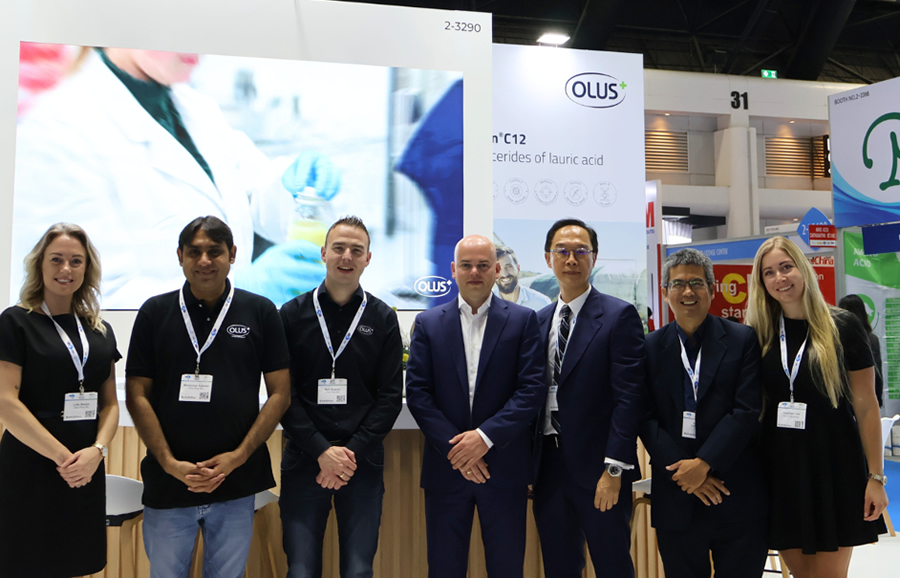
From left to right: Lotte Waaijer (Marketing), Muhammed Suleman (Sales Manager, Middle East), Nick Slagman (Sales Manager, Poultry), Johannes Fuite (CEO), BK Chew (APAC Director), Hai Diep (Sales Manager, Southeast Asia), and Fleuranse Fuite (Regulatory affairs).
Based in the Netherlands, Olus is a dynamic and innovative player in the animal feed industry, carving a unique path with its commitment to excellence, sustainability, and customer-focused solutions.
Founded by a passionate team, Olus focuses on producing cutting-edge, high-quality products that aim to make a meaningful impact on the livestock farming sector.
In this exclusive interview, Johannes Fuite, the Managing Director of Olus, shares insights on how the company is positioning itself for success in a rapidly evolving market, particularly in the Asia-Pacific region, and how they plan to lead the charge in innovation and customer satisfaction.
Can you tell us about the origins of Olus and how your company's innovative approach to animal feed solutions has evolved over the years?
Johannes Fuite: We are a Dutch family-owned company with a background of over 100 years in the animal feed industry. In the Netherlands, my family also owns a feed mill, a processing plant, and a spray-drying tower. Our operations began with the need to reduce antibiotic use, which led me to develop a product aimed at reducing antibiotics in the industry.
I experimented with various products, including essential oils and acids. In the end, I developed a solution that addresses necrotic enteritis, combining protection against coccidiosis and clostridium in one product. Traditionally, these issues were treated with antiparasitic products like Amprolium or Diclazuril. However, even with these treatments, clostridium would resurface, requiring additional antibiotic treatments. My solution controls both coccidiosis and clostridium in one product.
The product prevents the penetration of oocysts into the gut wall, preventing further infection. The ingredients also control the growth of clostridium. With this dual-action product, we offer three key benefits: cost-effectiveness, convenience for farmers, and improved feed intake stimulation, helping chickens grow better.
When I founded the company, I initially sold the product to veterinary clinics. Since then, we've developed additional ingredients, such as hydrolysed lecithin, glycerides of acids like monopropionin, monobutyrin, and monolaurin. We also offer liquid products for drinking water to control bacteria. But despite our expansion, we've always aimed to keep our business nimble and agile, much like a speedboat.
Why a speedboat? Because we want to be fast, flexible, and sharp. We aim to create products that offer a "1 plus 1 equals 3" solution—better than anything the competition offers.
While some companies choose to grow through acquisitions, our focus lies in creativity and innovation. We are dedicated to developing products that go beyond existing solutions, using active ingredients and unique combinations that bring real value to end users.
For example, we recently launched Elan® Control C12, a product combining monopropionin, monobutyrin, and C8, C10, C12 and essential oils. This product is competitively priced against butyric acid and lauric acid but provides a broader range of active ingredients, giving the end user a more effective solution at a competitive price.
By offering such innovations, we differentiate ourselves in the market. We also keep our product portfolio compact, allowing us to act quickly. For instance, we can produce all products in just three to five working days, and we aim to respond to emails within 24 hours. This level of speed and service is what sets us apart—hence, the speedboat analogy.
We only produce products that offer genuine added value and do not waste time or resources on ineffective solutions. This approach makes us unique in the market, especially as we expand into APAC. We see significant growth potential here, not just for expansion's sake but because the opportunities are incredible.
Since arriving in Asia, I've genuinely fallen in love with the region. People are friendly, and the atmosphere is full of opportunities. While each region has its own way of working, I've found the collaborative spirit in Asia particularly energising. It's been a great experience, and I look forward to growing our presence here.
We believe that with the right people, a strong network, and our innovative approach, we can build a successful business here. That's why we are committed to investing in Asia and working with the best people in the market.
Would you say that Asia is now your primary focus for growth and expansion?
Johannes Fuite: Yes, absolutely. I can confidently say that Asia will be the fastest-growing market for the company in the coming years—100%.
We've spent the last 12 years conducting extensive research and development in the Netherlands, and now we're in a position to implement our innovations here, especially with the help of partners like BK and Hai, as well as their network. With these resources, we can apply our "1 plus 1 equals 3" philosophy to create something truly impactful.
On your company profile, you've mentioned that Olus aims to be the best partner rather than the largest company in the industry. With that in mind, what makes your products and operations stand out from traditional competitors, and how do you maintain a competitive edge in such a fast-evolving market?
Johannes Fuite: You're absolutely right—many of the traditional companies in our industry can become complacent. As they grow, they tend to slow down due to bureaucracy, and communication becomes less efficient because more people are involved in the decision-making process.
At Olus, we aim to stay nimble. We've intentionally kept our operations simple, enabling us to act quickly and efficiently. We believe that by remaining streamlined, we can offer a more responsive service. For example, we've designed a fully automated factory that requires only a small number of staff. Automation allows us to operate at lower costs and maintain high efficiency.
Our ability to stay competitive is rooted in both our innovative product development and our investment in automation. Last year alone, we invested nearly €15 million to expand our production lines to be fully automated, ensuring that we can keep costs down and offer affordable products while maintaining the highest standards of quality.
In terms of product innovation, we focus on creating solutions that outperform our competitors—products where "one plus one equals three." We aim to deliver superior products at competitive prices. On the operational side, we focus on speed, innovation, and excellent customer service. Our team is made up of professional individuals who are passionate about bringing value to the market.
By keeping our processes agile and our overhead low, we can be proactive and stay ahead of the curve. While traditional companies may become bogged down by bureaucracy, we remain fast and focused on providing our customers with the best solutions.
In this regard, I see Asia as a huge opportunity for us. We've done extensive research in Europe and are now implementing those insights here through trials and new partnerships. Our team is professional, our factory is state-of-the-art, and we're seeing a great response from potential partners at industry exhibitions.
Antibiotic use remains widespread in the farming industry, despite various countries, particularly in Europe, implementing bans. How do you approach this challenge, especially when some farms continue to use antibiotics despite these restrictions?
Johannes Fuite: In my opinion, if you manage your production well, the use of antibiotics can be controlled and made safer. When antibiotics are used, especially those not intended for human use, I don't see a significant risk of contamination or resistance in humans. For example, coccidiostats, which are used to prevent coccidiosis, aren't used in humans, so they don't pose the same concerns.
However, if you use antibiotics that are also prescribed for humans, there are greater risks. The danger of resistance is real, and if we don't address this, it could lead to severe consequences for public health, with more people suffering from infections that are difficult to treat. That's why we focus on minimising antibiotic use whenever possible.
For farmers, the key is good management. If you have solid production practices, proper hygiene, and healthy animals, you can greatly reduce the need for antibiotics. Basic factors such as nutrition, hygiene, and using quality materials for animal care should be prioritised. If you get those fundamentals right, you can avoid relying on antibiotics in most cases.
Using antibiotics solely to enhance growth or improve performance is entirely the wrong approach. However, when antibiotics are necessary to treat genuinely sick animals, I believe they should be used strictly for that purpose and kept to a minimum. In cases of major outbreaks, such as with E. coli, antibiotics can be used temporarily to control the situation. This is important for both animal welfare and the farmers, as it ensures a healthier flock and can prevent further harm.
While I advocate for the strict use of antibiotics when needed, I also encourage the use of alternative products, like those we produce, to promote animal health. These solutions can help reduce the reliance on antibiotics and contribute to overall better farming practices. If you use the right solution with the right dosage for the right issues, you can manage almost all illnesses without using antibiotics and destroying the gut microbiome.
Could you elaborate on how your product compares to traditional antibiotics in terms of effectiveness?
Johannes Fuite: We have conducted numerous trials and studies to validate our product's effectiveness. One recent trial in South Korea, in collaboration with our partner over there and the university, focused on testing our product against gram-positive bacteria like Streptococcus and Staphylococcus, as well as E. coli and Salmonella. In this trial, our product outperformed antibiotics when it came to controlling gram-positive bacteria.
The key difference is in how our product interacts with the gut. Antibiotics, while effective, can damage the gut wall and disrupt the microflora, leading to negative side effects. Our product, however, doesn't break down the villi in the gut, meaning it maintains the integrity of the digestive system while still being effective against harmful bacteria. In many cases, we see better performance with our solution when compared to antibiotics, even with the same Minimum Inhibitory Concentration (MIC).
That said, we must acknowledge that many companies offer a broad range of products, and some farmers may feel hesitant to switch from antibiotics to alternatives. That's where we come in. Our role is to guide farmers and provide expert advice on how to use our products effectively. We need professional, knowledgeable people in the field who can ensure our products are applied correctly so that farmers can trust the results. If we do this right, I believe we can significantly reduce the need for antibiotics.
With the growing trend of digital farming, the Internet of Things (IoT), and artificial intelligence (AI), is Olus Plus incorporating these technologies into its services and solutions?
Johannes Fuite: Yes, we are certainly keeping an eye on the tools available in the market. For example, we use tools to streamline our internal processes and make tasks simpler, such as using AI-driven solutions like chatbots to improve efficiency. However, I believe we're still in the early stages of a technological revolution in this field. Before we fully invest, we're waiting for these technologies to become more refined and finalised.
Do you see Olus embracing these technologies in the future?
Johannes Fuite: Absolutely, if it can help us improve our service and ensure that our products are applied correctly, we would be eager to incorporate these technologies. The goal is to optimise the process so that people can always rely on the results when using our products. If technology can support that, we're 100% on board.
You've mentioned that Asia is your favorite market. How do you tailor your market approach in different regions? Do you adapt your strategies based on the region?
Johannes Fuite: Yes, we have different strategies for different regions.
In Asia, relationships play a crucial role in business. People place a high value on personal connections, and I believe that when you do good for others, it will come back to you. That's why we take the time to build strong, trust-based relationships.
In Europe, the business culture tends to focus more on product specifications and pricing. This approach brings its own efficiencies and strengths. Personal relationships are certainly valued, but often play a more supporting rather than leading role in the decision-making process.
I think this cultural difference is one of the reasons I personally enjoy working in Asia. People are incredibly caring and take the time to look after each other, which makes doing business here feel more personal and rewarding. It may take longer to build those relationships, but it's definitely worth the effort.
With inflation, rising feed, and production costs, how is Olus addressing these challenges? We often hear terms like sustainability and cost-efficiency, but what does that really mean in practice for your company?
Johannes Fuite: We've made significant investments in a new plant where we've adopted alternative production methods that break away from traditional practices. For instance, in traditional production, you'd need to spray-cool products using a spray-cool tower, which is energy-intensive. We've found a more efficient way to do this, using less energy, which ultimately reduces costs while still delivering the same high-quality results for the animals.
On top of that, we're continually investing in technology that makes our operations more sustainable. However, it's important to keep in mind that sustainability isn't just about reducing environmental impact—it's also about ensuring animal welfare. Sometimes, highly sustainable methods don't always result in better outcomes for the animals, so we need to strike the right balance.
Ultimately, it's about using common sense to find the optimal solution every day. In the Netherlands, for example, we've invested heavily in sustainable production, ensuring that we remain efficient without wasting raw materials just for the sake of being "green." We focus on making sure that sustainability, animal welfare, and production efficiency all come together in the best possible way.
How do you foresee the future of feed and livestock farming? And with Olus being relatively new compared to other established companies in the market, how do you plan to compete and make your mark in this space?
Johannes Fuite: We're in a unique position, and that's something we're very proud of. Our goal is not to be a "me-too" product or to settle for being second best. We want to be the leader in innovation, service excellence, and competitive pricing.
While we don't aim to be the cheapest, we're committed to offering the best products. By combining these three factors—innovation, service, and competitiveness—we believe we're well-positioned to succeed, especially in the Asian market. We want to work with great people, build strong relationships with our customers, and offer innovative products that stand out from the "me-too" options out there.
Our ELAN® brand will be defined by our uniqueness and the tangible benefits that our customers receive from using our products every day. If we can't deliver on that promise, we won't sell it.
We have a winning mentality, and we believe that winning customers want to work with winners.
- Gemma C. Delmo and Nicholas Yong, eFeedLink


