


April 11, 2013
China Dairy Symposium tackles dairy challenges through innovation

According to some US dairy experts, adapting to the latest feed technologies may be the key to success for China in keeping up with its milk production.
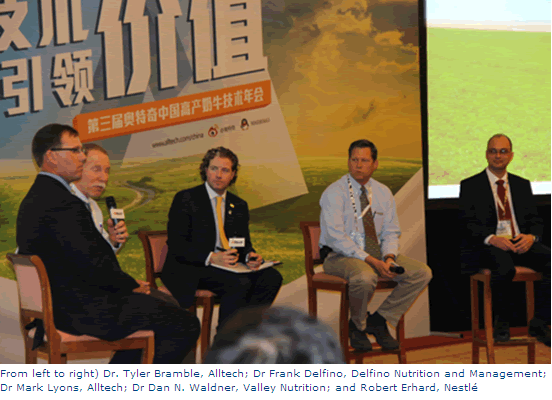
More than 240 global dairy industry leaders attended this year's China Dairy Symposium, hosted by Alltech, where they discussed how the Chinese dairy market's main challenge for the next 10 years will come from an increasing demand for milk, which will continue to outpace domestic supply.
At the same time, they must meet the demands of more conscious consumers looking for high quality, safe dairy products. By 2030, 70% of people in China will live in cities; milk and egg consumption compared to today will rise by more than 50% and consumers will demand healthier, safer and more nutritious food products.
"Milk consumption in Chinese urban areas is 4.5 times higher than in rural areas. With the increasing urban population and the rapidly growing middle class, milk consumption is expected to further grow," said Dr Mark Lyons, vice president of corporate affairs at Alltech. "Chinese dairy farmers will need to significantly increase their production efficiency to cope with this demand."
Steve Maddox, chairman for the US Dairy Promotion and Research Board, believes that the biggest challenge for dairy farmers is reducing feed costs, which can make up 65% of total production costs, while increasing milk production at the same time. During the panel, Maddox shared a testimonial about a California farmer who reformulated diets by lowering the nutrient content and adding alternative feed stuff such as Optigen®, a sustained release, non-protein nitrogen source, in order to decrease the total cost of the ration.
Dr Tyler Bramble, a dairy specialist from California introduced another California herd that had success. A 4,250-cow dairy that used DEMPTM, a dietary escape microbial protein product, in a reformulated diet, showed a relevant savings of US$0.0006 per head per day. The farmer saw an increase in milk production from 76.1 to 79.7 pounds and an increase in milk fat from 3.57% to 3.60% while keeping milk protein constant at 3.1%.
Mary Beth de Ondarza, dairy nutritionist at Paradox Nutrition, identified two key factors for farm profitability and efficiency: maximising efficiency and nutrient digestion. Maintenance of a healthy rumen for maximum nutrient digestion and a high level of microbial protein yield are vital for optimal feed efficiency. Issues such as sub-clinical ruminal acidosis need to be handled by paying attention to the total dietary starch and sugars, the speed of starch digestion, dietary fiber, as well as the amount of chewable fiber in the diet. De Ondarza explained that increasing rumen microbial protein synthesis increases milk production by the use of carbohydrates and degradable protein.
Joep Driessen, general manager at CowSignals, held a session about practical ways to improve young stock rearing. "Calving needs to be clean and quiet. Cows should be milked within two hours of calving to get the best quality colostrum. These six to eight liters of milk could be the key in preventing the calf from developing diarrhea and pneumonia," Driessen said.
Driessen also stressed the importance of feeding the cow three meals after calving in order to maintain higher milk production. He advised farmers to measure animals' growth, inseminate early and secure a fresh, warm microclimate for the animal.
Finally, Robert Erhard, director of Corporate Fresh Milk and Agricultural Service, Nestlé, Greater China Region, introduced Nestlé's recent US$396 million investment in building the Dairy Farming Institute, a world-class dairy training centre in Shuangcheng, Heilongjiang province. With this unique project, Nestlé is aiming to become China's reference for dairy farming management and partner with companies such as Alltech, who will provide a worldwide network of dairy experts and will hold educational services about nutrition to students, visitors and farmers.
"Our target now is 32,500 kg of milk," said Lyons. To make this goal a reality, he urged the audience to adapt new technologies such as the use of alternative feed ingredients, algae and mycotoxin management in order to significantly increase animal performance and profitability while reducing the cost of feed.


