


Evonik: Dietary Tributyrin Speocare T60 Improves Gut Health & Performance in Poultry
Evonik: Dietary Tributyrin Speocare® T60 Improves Gut Health & Performance in Poultry

Gut health challenge is one of the major factors affecting production performance and profitability in the Asian poultry industry.
The causative factors resulting in gut disturbance may be due to hot and humid climatic conditions, high-density poultry production systems, high levels of disease occurrence, and a shift towards antibiotic growth promoter-free poultry production. Poultry producers have been looking for suitable alternatives to antibiotic growth promoters (AGPs) to overcome gut health challenges.
Among the gut health solutions, organic acids, such as butyric acid, have been demonstrated to play a potential role in the modulation of gut microbiota and integrity in broilers. Most importantly, butyric acid serves as a primary source of energy for enterocytes in the gastrointestinal tract of poultry.
Development of tributyrin
The major limitation of butyric acid supplementation in poultry diets includes an unpleasant smell and rapid absorption in the upper gastrointestinal tract. To overcome these drawbacks, tributyrin was developed, which is a triglyceride containing three molecules of butyric acid bound to glycerol.
Tributyrin has emerged as a feed additive with significant potential to improve gut health in poultry. The short-chain fatty acid butyric acid, in a triglyceride form, has been shown to exert a positive effect on the intestinal barrier function and microbial balance within the gut.
Mechanism of action
The mechanism by which tributyrin functions involves its hydrolysis in the small intestine, releasing butyric acid and monobutyrin. Butyric acid serves as an energy source for enterocytes, the absorptive cells lining the gut. This process not only provides nourishment to these cells but also strengthens the gut barrier, preventing the translocation of harmful bacteria and their toxins.
On the other hand, monobutyrin exhibits a strong antimicrobial effect, specifically against Salmonella spp. and E. Coli.
Application benefits in broilers
Previous studies have demonstrated that the inclusion of tributyrin in broiler diets leads to improved bird performance and reduced mortality rates. The additive has been associated with improved feed conversion ratio and a decrease in the prevalence of wet litter.
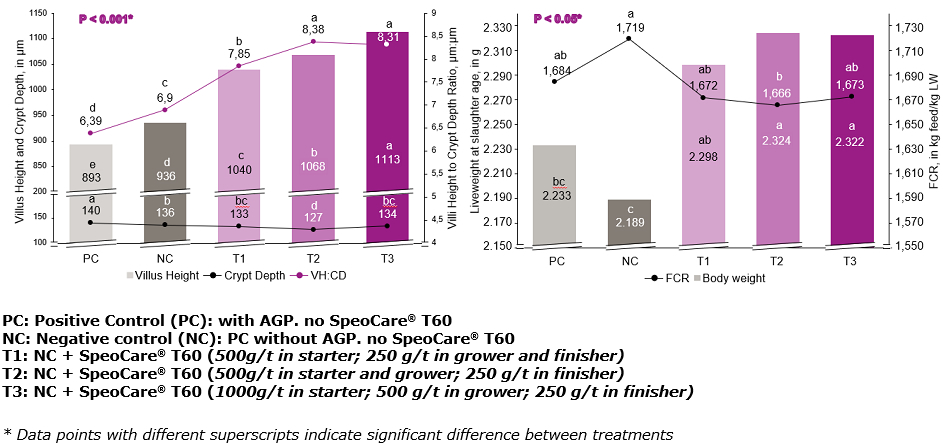
Furthermore, tributyrin has been found to modulate gut microbiota, promoting the growth of beneficial bacteria while inhibiting pathogenic species. A recent study from India demonstrated that tributyrin (SpeoCare® T60) supplementation at different inclusion levels improved gut morphology and production performance compared to control-fed broilers (Fig 1). The optimal performance was achieved at a TB-supplemented dosage of 500 g/MT in starter and 250 g/MT in grower and finisher broilers.
Tributyrin supplementation solved dirty egg problem in laying hens
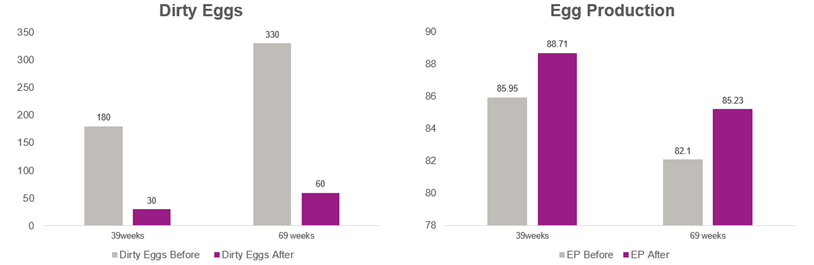
The farm challenge concerns the incidence of the dirty egg problem for the last five-month period at 61 (older flock) and 31 weeks (young flock) of age, laying hens, and low egg production. To address this problem, the layer farmer has been advised to use tributyrin (SpeoCare® T60) supplementation at the rate of 500 gm per MT in laying diets.
After a 28-day feeding period, the dirty egg problem significantly reduced from six trays to one tray/day in the young flock and reduced from 11 trays to 1-2 trays/day in the old flock (Fig 2). Egg production increased by 2.76% in the young flock and 3.13% in the old flock. This case study clearly supports the claims that dietary tributyrin improves intestinal barrier function and microbial balance within the gut. Thus, dietary tributyrin supplementation improves gut health and function and, consequently, this favors improved egg production and quality in commercial layers.
In summary, tributyrin (Speocare T60) supplementation enhances gut integrity and bird health, which consequently improves nutrient absorption and digestibility, leading to improved performance and profitability.
For more of the article, please click here.


