


April 1, 2024
Fish facility to drive production of Cambodia's aquaculture industry
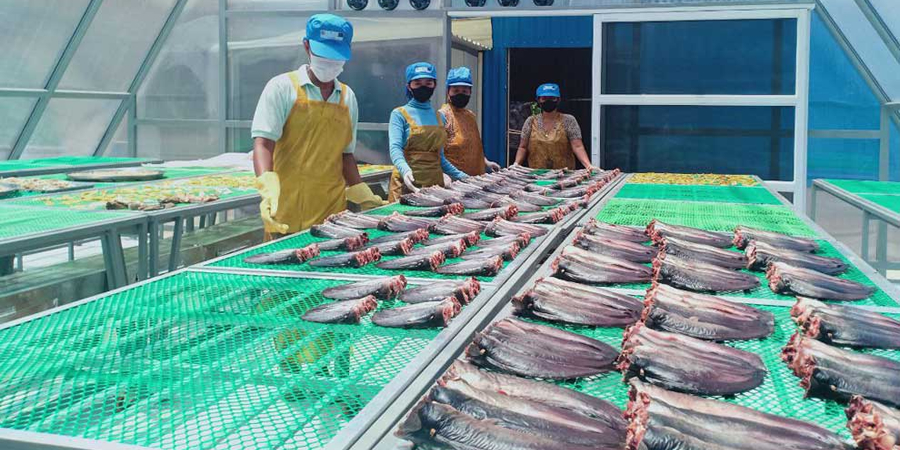
An extensive facility in the Peamro district of Prey Veng province, Cambodia, is producing tens of thousands of fish hatchlings to support the country's aquaculture industry.
Young fish bred at the Freshwater Aquaculture Research and Development Centre (FARDeC), located in Peamro commune's Bati village, have a far higher survival rate than those spawned in the wild and grow much faster, thanks to a precise feeding programme run by specialists at the centre. Thousands of freshwater fish of many species are produced there, as well as a number of other aquaculture species, to meet the demands of Cambodia's fish farmers.
Meng Sothai, head of the FARDeC – administered by the Ministry of Agriculture, Forestry and Fisheries – explained that healthy, fast-growing fish produce better meat than farmed fish imported from neighbouring countries, thanks to the modern breeding techniques practised at the centre.
The centre covers a total area of 16 hectares, including various ponds for fish at different stages of growth, as well as frog and freshwater shrimp rearing facilities and equipment to incubate eggs.
Sothai said that the centre has three roles: first, to research the production of freshwater aquatic species, especially endangered local species and species with a high economic market value. Its second focus is on the production of new fish, or breeding. Young fish are released at the national and provisional level on National Fish Day, or distributed to farmers.
The centre's third task is to transfer knowledge and experience to the students who intern at the facility.
"The centre's staff are divided into two teams: the first is the research group and the second is the breeding group. Both of these teams are very experienced," said Sothai. "Unfortunately, it is a global trend that natural fisheries resources are declining, while consumption is increasing. To meet this demand, we have to raise more aquatic animals, but we need to ensure we balance the existing resources for long-term sustainability."
According to Sothai, the length of time it takes for fish to mature varies from species to species, as does the amount of offspring produced.
After hatching, young fish have different requirements, according to their species.
"In addition, successful breeding can be dependent on the time of year. In the rainy season, the tanks are less healthy, for example, although we can use pumps and supplements to keep the young fish healthy," Sothai said. "In general, we have to choose the right time to raise each type of fish."
Sothai explained that artificially hatched fish have a far higher survival rate, as they are raised in an environment which lacks any natural predators.
He said the ponds do not have to be too large, with one square meter able to support from 500 to 1,000 young fish. In his experience, improved water quality and nutrients means the flesh of the fish is of a higher quality.
Khim Finan, undersecretary of state and spokesman for the agriculture ministry, said that Cambodia has a total of 61,727 aquaculture households with 106,522 people employed in the industry.
"The ministry supports the use of more efficient technology and principles of good hygiene, with the goal of increasing the production of fish meat by 30%, in order to meet domestic demand,' Finan said. "In 2023, aquaculture production totalled 314,000 tonnes, equivalent to one-third of the total fisheries production."
"Breeding pure freshwater fish provides many benefits to the aquaculture industry, such as ensuring the quality of climate-resilient and disease-resistant varieties," Finan said. "The [FARDeC] contributes to improving the livelihoods of farmers and their families by providing them with high-quality fish at low capital costs, while also training them in modern techniques."
- The Star


