


Cargill: From Risk to ROI - Smart Mycotoxin Control for Competitive Swine Operations
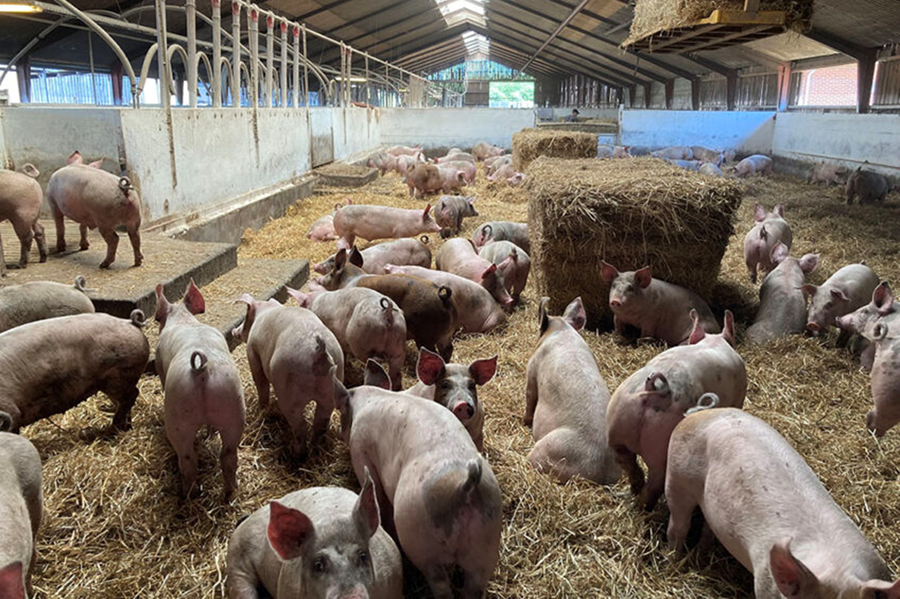
Many modern swine producers operate on thin margins where a 2% fluctuation in feed conversion ratio (FCR) or a slight dip in litter uniformity can be the difference between a profitable quarter and a fiscal loss.
Many metrics that decide profitability are tracked, such as, feed cost/kg gain, days to market, mortality, medication spend, and uniformity. Mycotoxins pressure all of them quietly by degrading intake stability, gut integrity, and resilience. While acute toxicity is rare, the chronic, sub-clinical presence of multiple toxins can potentially erode animal performance and compromise immune systems. This is where a proactive, data-guided partner matters.
Traditional mycotoxin management is often treated as a fixed insurance cost: the same product at the same use rate, all year round. This approach is economically inefficient. When risk is low, producers overpay for protection they do not need; when risk spikes, they remain dangerously under-protected.
To maintain a competitive advantage, the industry is moving from reactive mitigation to predictive feed safety. By integrating digital monitoring, data analysis, impact modeling, and mitigation decisions, proactive mycotoxin management becomes a strategic lever for P&L optimisation rather than just a line-item expense. Producers increasingly seek partners who can support their team on this journey — bringing the data, tools, and swine expertise to translate signals into action.
Cargill Animal & Health provides integrated solutions for swine customers – the people, products, and platforms to mitigate risk and maintain competitive advantage.
The challenge: mycotoxin risk is dynamic — and costly
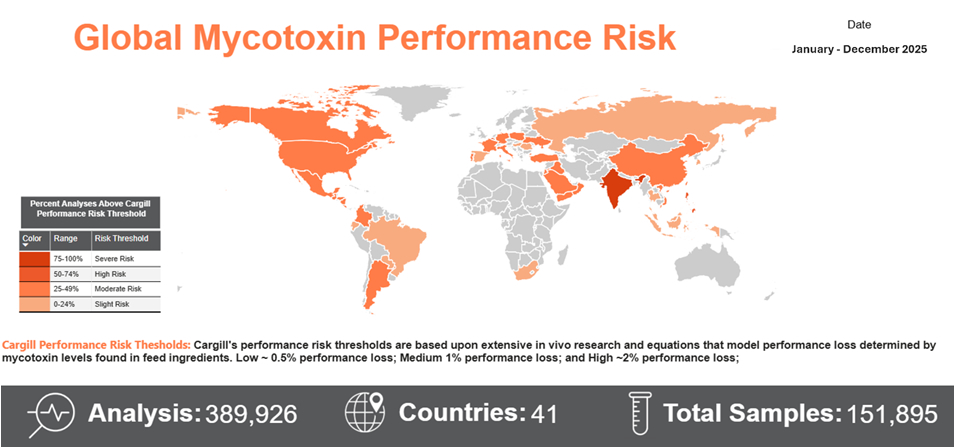
Weather variability and climate shifts are changing fungal ecology, geographic distribution, and mycotoxin patterns. Scientific journal reviews consistently note that temperature, moisture, drought/flood cycles, and extreme events influence fungal colonization and toxin production, and can shift the regional risk map over time. The newly released 2025 Cargill Global Mycotoxins Report confirms this volatility.
With nearly 390,000 analyses across 41 countries, the report data reveals significant regional shifts in contamination patterns. For example, Deoxynivalenol (DON) exceeded performance risk levels in ~60% of samples in North America and China, while fumonisins (FUM) spiked in Central and South America (~64%). Zearalenone (ZEA) surpassed levels in over 50% of samples in multiple regions.
ANH's database also reveals once again that multi-mycotoxin contamination remains a significant concern. Sub-clinical levels of combined mycotoxins can stress animals. For instance, pigs can eat feed that appears fine, but still pay a price with slower growth, feed inefficiency, health, and uniformity issues. These subtle effects have real economic impact. A strategy that isn't dynamic will struggle to keep up. These findings underscore the need for large-scale, high-frequency testing to detect evolving risks. At ANH, global sampling and trend recognition drive local decision making — turning raw results into predictive signals that help producers act early, rather than react late.
The smart farming shift: from reactive to predictive feed safety
The solution is to shift from reacting to being proactive — predicting and preventing mycotoxin problems. This is smart farming at work: using data and tech to stay a step (or many) ahead. Instead of treating mycotoxin control as a static recipe, or an emergency response, make it a continuous, responsive process. This shift is enabled by constant monitoring and predictive analytics.
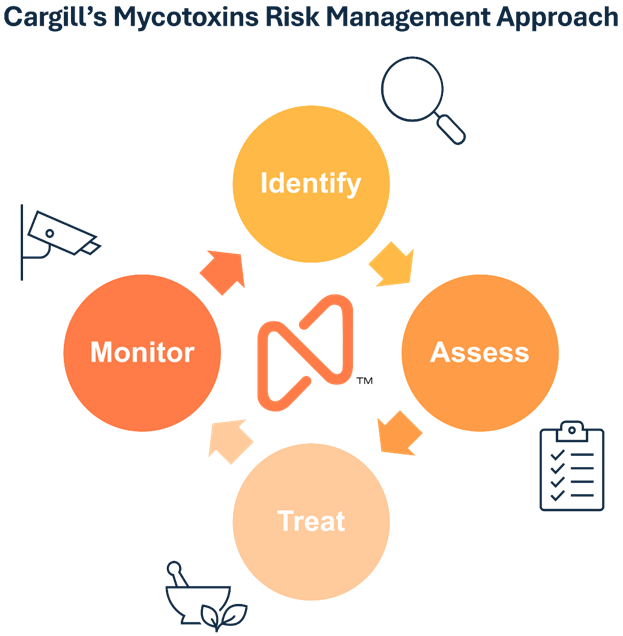
Rather than discovering a toxin issue after swine falters, aim for an early warning and act before damage is done. ANH boils this down to a simple process: Identify – Assess – Treat – Monitor. Each step uses technology and expertise, so mycotoxin management becomes agile and effective, not hit-or-miss.
Identify – Detecting threats early
The first step in effective mycotoxin management is to test and monitor regularly. Check incoming raw materials (with rapid test kits or lab analyses) to catch contamination early. However, effective management also relies on data.
Leveraging a large, dynamic, global mycotoxin analysis database to identify contamination trends rapidly is key to smart sampling. In addition to providing the world's largest mycotoxin sampling database, ANH can connect lab results with practical guidance (by ingredient, geography, and species sensitivity), so producers know what to test, when, and why. A sampling strategy must consider the risks associated with the ingredients, the storage location, and seasonal variations. Above all, it must be dynamic, following and adapting to changes in mycotoxin contamination. That's why ANH's mycotoxin analysis database also functions as the intelligence layer, connecting raw results to trendlines, risk flags, and decision support (e.g., by ingredient, geography, and species sensitivity). This is the smart farming in action: transform scattered results into operational signal.
Assess: Quantifying risk and impact
Detection is only valuable if it is actionable. The question is not just "What is in the feed?" but "What does this mean for pig performance and health, and ultimately for my P&L?" In addition, not every toxin detection means disaster.
The Assess phase separates minor issues from major threats. Thus, ANH offers a unique tool, the Mycotoxin Impact Calculator (MIC), built from more than 250 scientific studies to model the biological impact of mycotoxins on pigs. The MIC translates toxin concentrations and combinations into actionable information, supporting scenario planning and more economically grounded mitigation decisions. This calculator combines lab and database results with swine farm data to generate science-based outputs, such as expected performance impact, projected dollar loss, and recommended mitigation intensity.
MIC can weigh the potential production loss against the cost of intervention. By quantifying the risk in animal and financial terms, you get a data-backed rationale for what to do next.
ANH works alongside farm teams to interpret MIC outputs, align interventions with production goals, and avoiding unnecessary spend. This ensures you only intervene when it's truly justified and choose the right level of response.
Treat: Applying proven AMA solutions
When the data signals a need for intervention, the solution must be evidence-centric. First, use an anti-mycotoxins agent (AMA) product suited to the specific toxins identified.[1] An AMA should first be evaluated with in-vitro mycotoxin mitigation tests. However, to draw relevant conclusions from these tests, the conditions must mirror practical challenges. First, use high mycotoxin concentrations, usually on the order of one to several ppm to create a meaningful stress test. Lower toxin levels can make almost any product look effective, whereas elevated levels reveal true performance differences. Second, test the AMA at its actual recommended inclusion rate (usually around 1 to 2 kg/tonne) rather than an excessive use rates.
Using realistic AMA use rates ensures the results are applicable on-farm. For instance, higher-than-normal use rates would inflate efficacy artificially. Finally, simulate pig gastrointestinal conditions with a two-phase assay: an acidic adsorption phase (stomach-like) followed by a neutral desorption phase (intestinal). This second “desorption" step is critical as it verifies that once mycotoxins are bound, they remain bound under intestinal pH.
Measuring desorption confirms binding stability and lasting mitigation through the entire GI tract. By using high toxin levels, realistic AMA use rates, and a rigorous two-phase GI simulation, in vitro tests yield results that are scientifically sound and more predictive of real-world efficacy.
Next, in-vivo trials are, of course, essential and must demonstrate recovery of health and performance endpoints such as average daily gain, blood biomarkers, organ histopathology, microbiota, etc., under challenging conditions.
ANH's NotoxTM portfolio is evidence-centric with in-vitro and in-vivo validation, including materials and extensive research describing laboratory and farm trials demonstrating the mitigation of oxidative stress, improved biomarkers, and recovery of growth metrics in contaminated diets. This research, combined with the use of the risk calculator, allows for the optimisation of the AMA NotoxTM inclusion according to the detected risk: low-level chronic exposure calls for basal inclusion; acute or high-risk scenarios require escalated inclusion. Mitigation is most profitable when it's targeted: the right solution, at the right use rate, for the right risk window.
Monitor: Validate outcomes and optimise
Smart farming is defined by continuous improvement loops. Mycotoxin control should follow the same logic.
It is always important to monitor key performance indicators (KPI) such as performance, mortality, carcass uniformity, or incident veterinary treatments to validate the effectiveness of the strategy. If the indicators are good, your intervention worked. If not, further adjustments may be needed.
If problems persist or arise, you might increase the use rate, look for other lurking toxins, or do additional tests to better understand the causes. It is also important to feed learnings back into procurement and formulation strategies, allowing for the adjustment of sampling plans and inclusion based on real-world results.
A mycotoxin control plan must be dynamic, as each incident provides data. Document what toxin levels were, what action you took, and the outcome. Over time, these learnings refine your response playbook. With a partner maintaining the feedback loop, each cycle improves sampling plans, sourcing choices, and inclusion precision. Iterative validation converts mitigation from a cost to a controlled investment with measurable ROI and reduced variance.
Monitoring and optimising make mycotoxin control a continuous improvement process rather than a one-and-done task. It keeps you prepared and constantly improves your defense.
Strategic Decision-making and business benefits
Implementing a tech-enabled, proactive mycotoxin programme delivers clear benefits and competitive advantages that map directly to P&L levers. It safeguards performance by preventing unexpected losses and costly outbreaks before they occur, protecting animal health. This translates directly into improved growth rates and feed efficiency allowing more saleable pork per pig, and a higher ROI.
Effective, data-driven mycotoxin management also allows managers to use data to make better grain sourcing decisions, potentially avoiding high-risk batches altogether. Ultimately, this optimises costs and builds trust, as mitigation solutions are applied only when needed, avoiding wasteful spending.
At the same time, running a rigorous control programme demonstrates a strong commitment to feed safety and quality, which builds credibility with customers, integrators, and regulators.
Conclusion: Feed safety becomes a performance technology
Mycotoxins will always exist; however, a smart, proactive approach can keep them from undermining your operation. This is smart farming in action: using data and validated solutions to control what was once uncontrollable.
By partnering with producers to implement the Identify–Assess–Treat–Monitor framework, ANH helps convert mycotoxin control from periodic firefighting into routine operational strength—supported by data, validated solutions, and continuous learning.


