



INDUSTRY NEWS
Lobster fishing in Oman has taken on an economic and social importance for its fishermen, and the state makes an effort to ensure its sustainability. There is an open season for all fishermen to freely fish for lobster and this year it takes place in March and April. Oman's lobster production in the 2017 season totalled 464 tonnes, an increase of 8% from the previous year's 430 tonnes. Oman exported 98 tonnes of lobster last year.
MARCH-APRIL
Oman lobster fishing season now on
Oman's lobster fishing season this year started in March off the Sultanate's southeastern seaboards in the governorates of Dhofar, Al Wusta and South A'Sharqiyah, Gulf News reports.
The report said the season continues until the end of April. Lobster is one of the largest marine resources in the Sultanate.
Saying the lobster fishing season is economically and socially important for the regions' fishermen, Salim Al Araimi, director of fishing department of South Sharqiyah governorate, said the ministry is exerting more effort to regulate work during the season to uphold the Maritime Fishing Law with the fishermen's cooperation.
He asked traditional fishermen to comply with the permitted fishing methods in the waters of the Sultanate in March and April, and to avoid fishing egg-laden lobsters, as well as lobsters that are less than 8 centimeters in length, the report said.
Al Araimi said Oman's lobster production in the 2017 season totalled 464 tonnes, citing statistics from the Ministry of Agriculture and Fisheries. This was an increase of 8% from the previous year's 430 tonnes.
Last year, Oman exported 98 tonnes of lobster to the UAE, Saudi Arabia, Qatar and some Asian and European countries.
BIOTOXINS BELOW ALERT LEVEL
US' Oregon coast now open for commercial crabbing
The state of Oregon in the US has declared the entire Oregon coast open for both commercial and recreational crabbing.
The Oregon Department of Agriculture (ODA) and the Oregon Department of Fish and Wildlife (ODFW) said unrestricted crabbing was opened from Cape Blanco, north of Port Orford, to the California border.
The state agencies said crab samples taken from the area indicated that levels of the marine biotoxin domoic acid have dropped below the alert level.
For commercial crabbing, ODA and ODFW lifted the requirement that all crab harvested from Cape Blanco to the California border be eviscerated (gutted).
It is always recommended that crab be eviscerated and the guts or butter discarded prior to cooking. When whole crab is cooked in liquid, domoic acid may leach into the cooking liquid. It is recommended to discard the cooking liquid, and do not use it in other dishes, such as sauces, broths, soups and roux. The consumption of crab viscera is not recommended either.
ODA and ODFW said it would continue monitoring marine toxins in crab and shellfish to ensure that the concentrations remain below the alert level.
2ND HIGHEST RECORDED
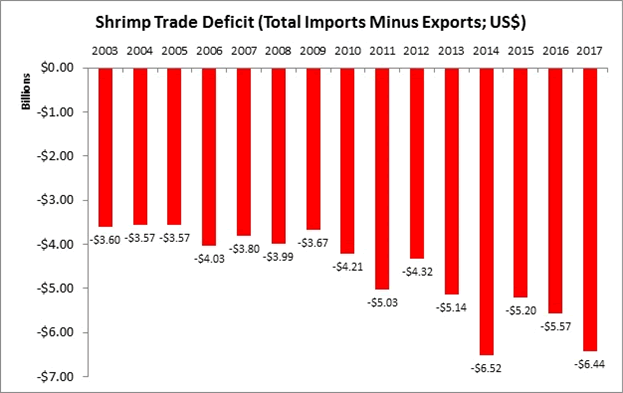
US shrimp trade deficit balloons to $6.4B in 2017
The trade deficit (total imports minus exports) in shrimp products grew substantially last year by 15.6%, according to recently released trade statistics from the US government, the Southern Shrimp Alliance reports.
The total US trade deficit in shrimp products reached a $6.4 billion last year, the second straight year that the country's trade deficit in shrimp products increased, with the amount in 2017 now 23.7% larger than the $5.2 billion deficit seen in 2015.
The massive seafood trade deficit that the US runs with the rest of the world was first highlighted in NOAA's (National Oceanic and Atmospheric Administration) yearbook "Fisheries of the United States" for 2016, which reported that in 2016, the US' seafood trade deficit with Asian nations ran to $6.98 billion. Shrimp, on its own, accounted for 46% of the total seafood trade deficit with these countries.
NOAA Fisheries' reporting came in response to President Trump's executive order regarding an Omnibus Report on Significant Trade Deficits proclaimed in March 2017. At the time the executive order was issued, the US' annual trade deficit in goods exceeded $700 billion.
THREAT TO FARMING AREAS
Oyster virus detected in South Australia
The Pacific Oyster Mortality Syndrome (POMS) virus has been detected in feral Pacific oysters in South Australia. However, the virus has not been detected in oyster farming areas, according to the government agency Primary Industries and Regions South Australia (PIRSA).
PIRSA has banned the removal of all bivalve organisms (oysters, mussels, cockles) from South Australia's affected Port River to reduce the risk of POMS spreading,
POMS causes rapid death and high mortality rates in Pacific Oysters. The disease spreads quickly if introduced and is a serious threat to the oyster farming industry, PIRSA said.
The first Australian case of POMS was recorded in 2010 in New South Wales, and the most recent outbreak in commercially grown oysters was detected in Tasmania in February 2016.
With the outbreak of POMS in Tasmania, the importation of all live oysters and oyster farming equipment from that island state into South Australia was immediate banned. This ban remains in place and is critical to protect South Australia's growing A$32-million (US$25.07-million) oyster industry.
PIRSA Fisheries and Aquaculture Executive Director Sean Sloan clarified that no commercial oyster-growing regions are currently affected by the virus. "There are no disruptions to the supply of South Australian oysters for sale, and healthy table oysters continue to be processed for human consumption", he said.

THEY ARE RISING
Women's roles in aquaculture, biotech crop farming cited
March is internationally focused on women, and a special day, March 8, is observed as International Women's Day. Some countries, like the Philippines, declare the whole month as National Women's Month. The farming sector also takes time to stress the role of women in the industry.
Ireland's Seafood Development Agency (Bord Iascaigh Mhara, or BIM), for one, launched a promotional campaign to profile the important role women play in the country's seafood sector.
Emphasising the agency's role in supporting and encouraging greater female participation in the sector, BIM CEO Jim O'Toole said, "BIM is assisting the Irish seafood sector to capitalise on the talents of women in the wider sector. In addition to training and mentorship, we are also working with women across the catching, aquaculture, processing and retail industries to develop a network to share information and ideas that will further progress and elevate their role".
The BIM pointed out that despite the Irish seafood sector's contributing €1.15 billion to Ireland's GDP in 2017, women's participation in the industry remains low. Just over one in 10 (11.7%) employees in fishing, forestry and agriculture sectors in Ireland is female, which is significantly lower than the EU average of 36.9%.
O'Toole explained that BIM's promotional campaign "tells the stories of talented women in a variety of roles, increasing the visibility of women in the sector and celebrating their contribution to this valuable industry".
BIM has also launched the campaign #Irelandswomeninseafood, which includes a series of podcasts that tell the stories of a selection of women who work in the fisheries sector in Ireland. Hear the stories in Women in Seafood.
Meanwhile, according to a study conducted by the International Service for the Acquisition of Agri-biotech Applications SEAsia Centre (ISAAA) in China, India and the Philippines, women play a significant role in biotech crop farming.
In India, ISAAA said, that while male farmers take charge of the farm activities that require physical labor, women take an active part in farm operations such as weeding, picking and cleaning.
In China, a growing feminization in cotton farming has been noted. Field work is mainly conducted by women, which enable the men to engage in off-farm tasks. Based on focus group discussions, the reduction in pesticide use and less labor requirement of planting GM crops benefitted women.
In the Philippines, according to the ISAAA study, women take charge of managerial tasks such as budgeting farm expenses, deciding on inputs and hiring laborers to work on the farm. "These indicate that women who are engaged in biotech crop farming experience transformation because of the value they provide to their family farm operations and the benefits that they get from the technology", it said.
ISAAA and its network of Biotechnology Information Centers (BICs) are also encouraging women to speak up about the benefits of biotechnology through the social media campaign #ScienceAndShe on Facebook, Twitter and Instagram. Female scientists and science communicators involved in biotechnology share their experiences and aspirations to help bridge the gap between science and the public.
MISSED OPPORTUNITIES
US, EU take steps to revive shellfish trade
The US has proposed to the EU to open each other's market to allow trade of shellfish, saying consumers have been missing out on choices in the marketplace and that businesses in both the US and the EU have missed opportunities for new commerce.
US shellfish imports have not been allowed to enter the EU since 2010, while the US Food and Drug Administration (FDA) has not permitted the import of live, fresh or fresh-frozen molluscan shellfish from the EU since the 1980s.
"…I'm pleased to announce today (March 8) that the FDA and the EU have set in motion steps that will allow molluscan shellfish trade—or what you may know as clams, mussels, oysters and scallops, among others—between the US and the EU for the first time in years", said FDA Commissioner Scott Gottlieb in a statement.
The FDA has published a proposed determination that the safety controls in the EU are equivalent to those of the US. In return, the European Commission is completing administrative procedures for its own proposed determination that US safety controls are equivalent to those in the EU, a necessary step toward resuming trade.
According to the FDA, these critical equivalence determinations are a result of a multi-year, in-depth and cooperative review of shellfish safety systems in the US and the EU, in which technical experts on both sides have concluded that many of the safety controls in the EU and the US are equivalent.
"Both governments recommended these actions after reviewing existing food safety programmes, safety measures for molluscan shellfish, and on-site audits to verify each other's systems", Gottlieb said.
The FDA worked with the Interstate Shellfish Sanitation Conference and the Pacific Coast and East Coast shellfish associations to identify interested US states that volunteered to participate in the initial equivalence evaluation.
If the determination becomes final, Massachusetts and Washington states will again be able to send bivalve molluscan shellfish to the European market. Shellfish exporters from Spain and the Netherlands will also be able to sell raw bivalve shellfish in the US market.
"These states and countries are just the first, and we are committed to continuing to work with the EU on procedures to add more states and European countries", explained Gottlieb.
AQUAVISION 2018
Ban Ki-moon keynote speaker at aquaculture business confab
 Former UN Secretary-General Ban Ki-moon will be keynote speaker at the AquaVision 2018 in Stavanger, Norway, where he will address the food security challenges of the coming decades.
AquaVision, a world-class aquaculture business conference, will be held on June 11-13 and will have as theme "Meeting Tomorrow Today". It will focus on two main topics: "Blue Revolution" and "Beyond Tomorrow".
According to FAO (Food and Agriculture Organisation of the United Nations), global food production needs to increase by 70% by 2050 and that the growth within aquaculture can contribute a significant portion of that future food supply.
The biennial conference will explore ways in which aquaculture can contribute to feeding the growing world population in a sustainable way.
Organised by Skretting and its parent company Nutreco since 1996, AquaVision has established itself as an important meeting place for some 400 participants from around 40 countries.
At this 12th edition of AquaVision, Mr Ban will contribute with his knowledge and experience on global food security for a growing population. He was the eighth UN Secretary-General, serving two consecutive terms, from Jan. 1, 2007 to December 31, 2016.
As Secretary-General, he focused on mobilising world leaders around a set of new global challenges, from climate change and economic upheaval to pandemics and increasing pressures involving food, energy and water.
Skretting and Nutreco said they "will bring a wide range of speakers from all continents and give delegates a unique combination of information and opinion".


