


March 11, 2026
Alltech's Kei Nakayama: A global, customer-centric mindset to make sustainability happen
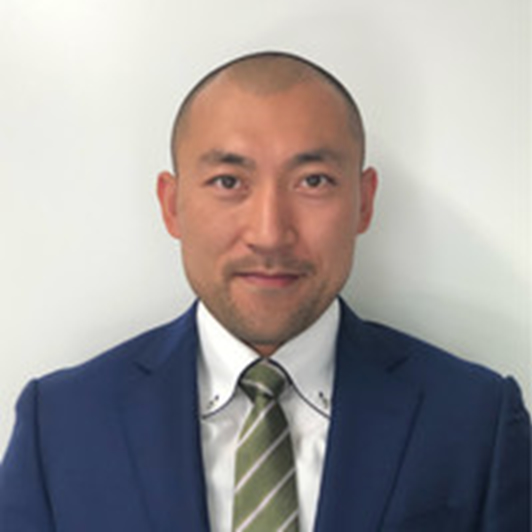
With a love for rugby and baseball, Kei Nakayama, Alltech's managing director for Northeast and Southeast Asia, conveys a passion for the larger agenda of sustainability in global agriculture.
Industrialised food production, as he notes, has a long history, and the onerous task is to provide food that is "accessible and affordable for consumers".
How does Alltech work with its customers to fulfill the world's food needs, in congruence with its "Planet of Plenty" sustainability mission? Nakayama articulates that it lies in the strategic presence of Alltech production sites in key regions, as well as proven solutions the company offers and its teams that comprise strong talents.
He shares more with eFeedLink in this extensive interview.
Kei Nakayama: My role is the managing director for Northeast Asia and Southeast Asia. I'm also supporting some projects that span regionally across the Asia Pacific.
I joined Alltech in 2010, and that was when Alltech Japan was established for the first time in the country.
We decided that we would establish Alltech Japan in Tokyo to better serve our customers by being closer and listening to them firsthand. This would help us better position our solutions and enable us to innovate solutions to address local issues. Before 2010, Alltech conducted business in Japan through a distributor, with whom we worked for about 20 years.
I started as a sales manager in Kyushu. About four years later, I became the national sales manager for Japan.
I was the general manager of Alltech Japan before becoming the regional director in 2018, looking after the Northeast Asian market, which was Japan and South Korea at the time.
In 2024, I served a year as the global commercial head of the technology group, looking after our health portfolio. That was before Mark (Lyons, president and chief executive officer of Alltech) decided that he wanted me back to business management role, looking after the regions of Southeast Asia and Northeast Asia.
Kei Nakayama: We are a global company that is embedded locally worldwide. It's important for everybody in Alltech—whatever their functions or the countries they operate in—to be united by one vision, which is the "Planet of Plenty".
Our actions are always defined by the seven values that everyone in Alltech knows.
We also have a very flat organisation—which means very transparent communication—where anyone can get in touch with anyone in Alltech; that helps us keep connected.
Furthermore, we have what we call a "frontline obsession", a phrase borrowed from the book, "The Founder's Mentality". Frontline obsession is very important in Alltech, as we want to make sure that we keep in touch with the local team and the customers. We stay in close communication with them to understand their challenges and address the issues in a way that's appropriate for that market.
Kei Nakayama: There are indeed several emerging challenges that we need to address, but what's discussed most with customers is still the same: that there are big challenges with animal diseases and biosecurity, especially in Southeast Asia, where African swine fever has had a significant impact, and underlying pressures from other diseases are still persistent. As for poultry, we see huge pressures caused by highly pathogenic avian influenza every season.
Thus, those concerns are very much at the forefront of our customers' minds in terms of how they perceive their business and where the challenges are coming from.
Increasingly so, we are seeing much cost pressure and inflation coupled with changing geopolitical factors that are affecting the supply chain of our customers, whether they are related to (feed) ingredients or other resources that are required for their businesses.
Other issues that are discussed a lot are sustainability and carbon footprint; when we talk to customers, especially those that are exporting to Europe and the United States—and even Japan and China—these are the main issues. Hence, it is very critical for some customers to ensure that they meet the needs of consumers.
One thing I would also like to highlight is talent retention and acquisition. Farming is a very traditional field, with a long history as an industry. We have seen that the average age of farmers is rising, and there are difficulties in getting younger talent to enter this industry. Making sure there is a constant influx of good talent who are receiving the right training is another challenge. I think this is critical for the sustainability of our industry.
I always keep the two A's in mind when I think about this industry: the food that we produce and provide has to be accessible and affordable for consumers.
Being accessible means that the food produced is enough. At the same time, under different economic and social conditions, it has to be affordable so that communities can have the resources to sustain their health and living. These A's always have to come first.
From my experience in the food and catering business, I find that food is intertwined with the culture of each community in a country. In terms of maintaining our culture, making sure that we produce the right kind of food to fit that culture and preserve it is so important.
Additionally, consumers are demanding more transparency (in food production). Such information is now more accessible online. As such, we need to earn the trust of consumers. To do that, we have to be transparent and ensure that we are proactively communicating what's going on within the industry, instead of having narratives being dictated by others.
We work collaboratively throughout the value chain to produce what consumers are demanding. For instance, quite often, what's beneficial for farmers may not be beneficial for the feed mill and vice versa. Sometimes, there can be a conflict of interest.
As a value chain, it's important that we align our direction towards the consumer needs and that we carry through the noble cause of producing good food for the population.
Kei Nakayama: Whether it may complicate the way we do business or not, the only constant in life is change. It's the same for any industry.
We have to be prepared for different challenges, and we have to be open to trying new things to adapt and change.
As I said, the food industry has a noble cause to provide food. That gives us a strong sense of responsibility to see to it that we are resilient to such turmoils.
Additionally, to serve local needs as efficiently as possible, Alltech has over 75 production sites globally. In one example, to continue serving customers (in a situation where one country decided not to import from another), we were able to change the production and source of technologies that we are providing to the country from different production sites within the region. Hence, regardless of government policies or geopolitical shifts, we are always there to maintain supplies to our customers by being flexible with our production capabilities.
We also observe that, when our customers have challenges with fragmented international trade, they would typically look for new procurement or supply chains where they would try to use more locally available ingredients in the feed.
We had a recent example in one country where a customer needed to try to use more fibrous, locally available materials for poultry and swine production. However, those materials are unconventional for use in a typical feed. Thus, we are working with the customer to match those ingredients with our enzyme technologies and customise solutions to improve their nutritional value.
Kei Nakayama: The Planet of Plenty is a vision and mission that unites our team in Alltech. As our late founder, Dr. Pearse Lyons, used to tell us: if we know the "why", we'll find the "how".
The Planet of Plenty is pretty much why Alltech exists and why each team member puts the Alltech pin on and gets to work to achieve this goal. We want to make sure that our customers are the winners. When the customers win, we achieve the Planet of Plenty vision, which is backed by science, sustainability, and storytelling.
It comes down to three pillars. The first is to support local communities and economies by helping farmers. The second is to support the industry in the noble cause of nourishing the population with high-quality food. The third is very important in terms of when we are talking about sustainability, and that is to preserve our natural resources.
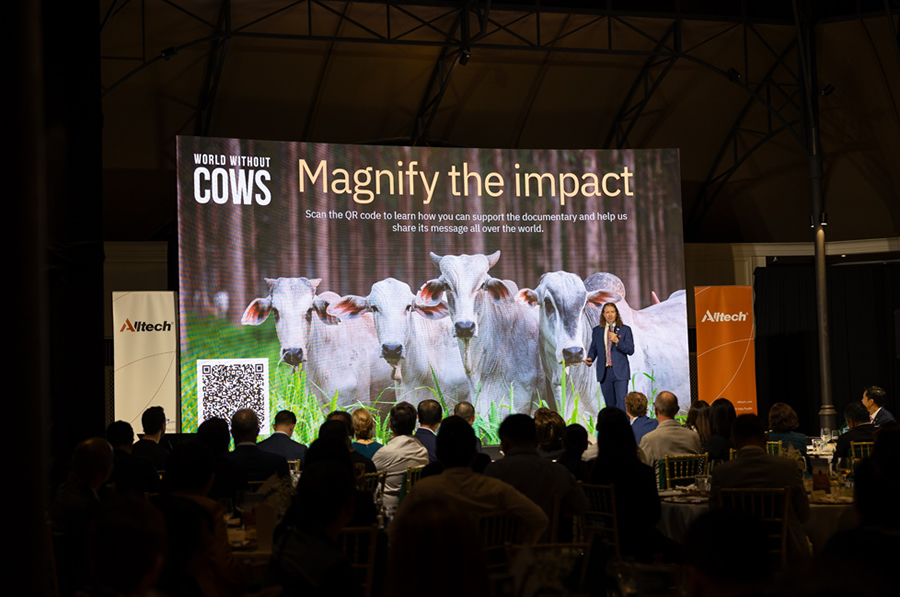
The Planet of Plenty has helped us become a thought leader in sustainability within this industry. In the past years, we have taken another bold step by creating and launching a documentary called "World Without Cows," commissioned by Dr. Mark Lyons. Through such media, we want to put our thoughts into practice and communicate proactively.
We've had numerous occasions to screen this documentary. It's launched in three phases: the first phase is to have our colleagues watch it. The second involves our industry, and the third is to have the documentary available to the general public, which I hope will be done within this year.
Kei Nakayama: I'm quite excited about several launches of new technologies which we have had and coming up recently.
The way the industry is sourcing raw materials is changing, and so are weather patterns, resulting in various challenges faced by our customers. Thus, we need to update our technologies.
In the area of mycotoxin management, we are launching a new technology called Mycosorb A+ Evo and Mycosorb Evo, a new generation of the established brands, Mycosorb and Mycosorb A+. This series is a combination of a yeast cell wall extract and a new bacterial ingredient. It advances binding capacity and offers broader spectrum protection. It underwent numerous in vivo and in vitro trials, ensuring that we are providing a solution for major challenges such as DON (deoxynivalenol) or fusaric acid in feed ingredients.
We are also making upgrades in our enzyme technology, with the new Allzyme® Spectrum, a combination of different proprietary enzymes, prepared to help customers utilise various ingredients more efficiently for animals. They are typically used for swine and poultry, as well as for ruminants.
Another new product, Egalis®, is a silage inoculant technology used to make the silage more nutritious and valuable for ruminants. When you look at "Egalis" backwards, it reads, "silage".
Additionally, Agolin is one company that Alltech acquired, along with its technology, a proprietary blend of essential oils with two advantages: one advantage is to enhance the rumen function of cows through improving the rumen environment, leading to increased milk yield or weight gain in beef cattle; another advantage is the reduction of environmental impact. Research shows that through this technology, farmers can enjoy the benefits of improving animal health and production while mitigating enteric methane emissions and supporting efforts to lower carbon footprint in operations. This is something that we want to strongly promote within the region to help customers become more efficient and sustainable.
Also focusing on carbon footprint, we have a service called E-CO₂ that measures the carbon footprint from farms and conducts environmental assessment for feed mills.
Finally, through our marketing team, we are able to help farmers and customers get up-to-date information about ingredients from global and regional perspectives through harvest analysis, as well as an Asia-based import risk analysis. On it fifth edition the Alltech Asia Import Risk Analysis will be available on March 26.
Kei Nakayama: We are very happy to have BK on board with us, especially given his role in the region, as we want to continue refreshing the way we think and interact with customers and within our team.
Changes in the industry are very rapid, and it's quite evident that the producers are consolidating, in that the bigger ones are getting bigger, and we're seeing fewer smaller producers. In such a scenario, when producers are becoming more sophisticated and larger, we want to keep updating how we deliver the information and the technologies fit for a new customer segment. As such, we don't want to just have a traditional model of one salesperson contacting one customer.
To represent Alltech, it's good to have a very strong connection. We seek to ensure that Alltech is working as a team that has more 'surface-to-surface' interactions with its customers. Hence, the mindset of the key account director has to be team-oriented: coordinating efforts together and making a difference as a team.
We are always open to strengthening our team skills, experiences, and resources. We are adapting to the changing behaviour of industry and consumers, so we must always be constantly thinking about ourselves.
Talent is one of the most important assets in our company. In the end, it comes down to people who bring out the ideas, materialise them, and work with our partners.


