


February 27, 2026
Food prices in South Korea rocked by livestock disease outbreaks
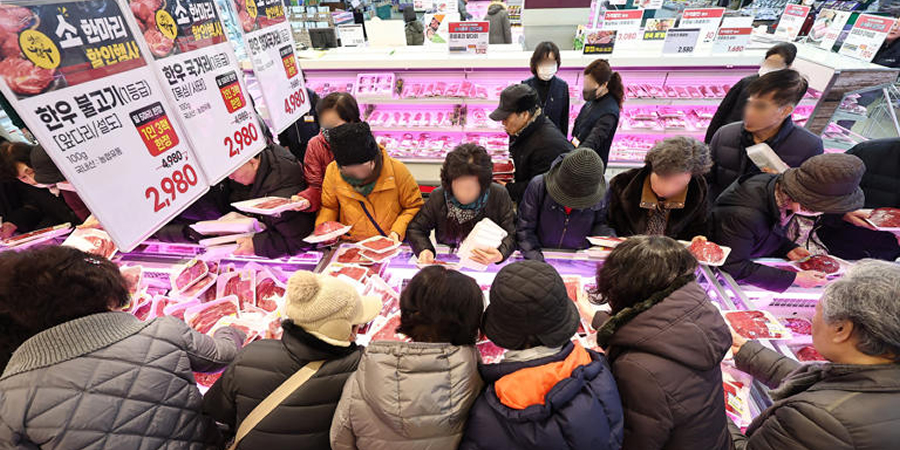
A simultaneous outbreak of livestock diseases across cattle, pigs, and poultry in South Korea has caused fluctuations in food prices.
Concerns over a 'triple inflation' in food prices—affecting beef, pork belly, and eggs—are growing as African swine fever (ASF), highly pathogenic avian influenza (AI), and foot-and-mouth disease (FMD) spread, including near Seoul.
According to the Livestock Products Quality Evaluation Service's distribution data on February 22, major livestock product prices rose by up to 12% compared to the same period last year, immediately after the Lunar New Year holiday. Beef saw the largest increase. With a declining cattle population compounded by FMD, Hanwoo (Korean native cattle) tenderloin priced at ₩14,016 (US$10.80) per 100 grams on February 21, up 9% from a year ago (₩12,869, or US$9.90). Sirloin and brisket rose 9.4% and 11.6%, respectively, over the same period.
After FMD was confirmed in Ganghwa County, Incheon, and Goyang, authorities raised the crisis alert to the highest level, "severe." Since all affected farms are Hanwoo farms, beef price instability is expected to continue for the time being.
Egg prices are also surging. The price of a 10-egg tray of extra-large eggs rose over 20% (from ₩3,253, or US$2.50) to ₩3,949 (US$3.04)) compared to a year ago, with a 30-egg tray nearing ₩8,000 (US$6.15) at the highest national price.
On February 19, highly pathogenic AI (H5N1 type) was confirmed at a layer farm in Bonghwa County (104,000 birds), and a meat duck farm in Gurye County (29,000 birds). This winter, there have been 46 cases of highly pathogenic AI. With 1.33 million migratory birds still in the country, further spread cannot be ruled out.
Pork prices are also rising. Pork belly prices increased by about 6% (from ₩2,576, or US$1.98) to ₩2,725, or US$2.10, per 100 grams) compared to a year ago. Following the 16th ASF case in Hwaseong City, Gyeonggi Province, additional infections were confirmed at a pig farm in adjacent Pyeongtaek City (830 pigs), putting local farms on high alert.
The Central Disaster Management Headquarters issued a 24-hour movement ban (standstill) and initiated full-scale disinfection in five adjacent cities and counties, including Hwaseong, Yongin, and Pyeongtaek. With nationwide inspections of over 5,300 pig farms ongoing, market shocks such as wholesale price hikes are inevitable if culling expands.
The Ministry of Agriculture, Food and Rural Affairs views this week as a turning point for livestock disease control and price stabilisation, mobilising a full-scale response system. This follows increased human and vehicle movement after the Lunar New Year holiday, raising virus transmission risks.
North Gyeongsang Province is urgently culling poultry at AI-affected farms and conducting intensive disinfection around major roads and barns. Farms in Goyang City, Gyeonggi Province, are also culling Hanwoo cattle due to FMD.
Menawhile, the ASF Central Disaster Management Headquarters said: "Relevant agencies and local governments must focus on rapid culling, precise testing, and intensive disinfection to prevent further spread."
It also called on pig farms to strictly follow administrative orders, including banning gatherings of farm workers and prohibiting the import or storage of illegal imported livestock products.
Additionally, the FMD Central Disaster Management Headquarters stated: "Livestock farms must adhere to basic quarantine measures, including thorough vaccination, disinfection inside and outside farms, and changing boots when entering barns."
The government plans to operate nationwide disinfection days and inspect distribution channels to prevent excessive price hikes driven by livestock disease fears.
- The Chosun Daily


