


February 20, 2023
Nearly three times as many pig farms in EU to be affected by bloc's plan to cut emissions
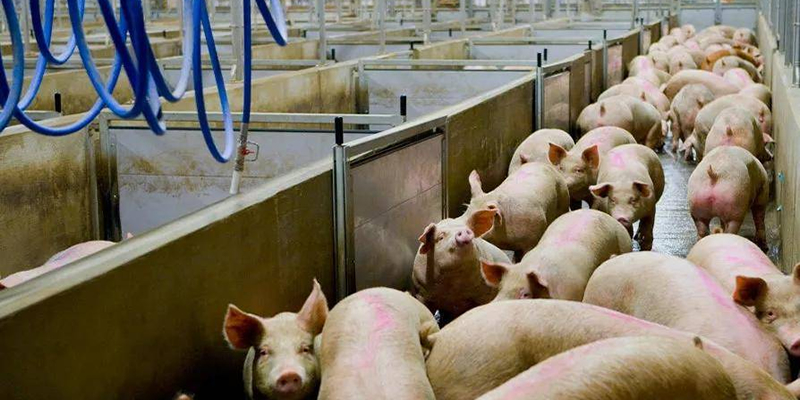
The European Union's plans to slash industrial emissions could hit over three times as many pig farms and almost four times as many poultry farms as previously suggested due to the use of outdated 2016 data sets, according to a leaked European Commission's document seen by EURACTIV.
The document, which was presented by the commission's environmental service (DG ENV) in the working party on the environment of the EU Council on January 30, offers an overview of the current state of play of the industrial emissions directive (IED) proposal.
The proposed overhaul of the directive, unveiled by the EU executive in April 2022, aims to reduce harmful emissions coming from industrial installations, the scope of which is being expanded to include some of the largest livestock farms in the EU.
The leaked presentation demonstrates that the data used as the basis for the current proposal, including the controversial threshold for ‘livestock units' (LSUs) figure – the point at which farms will be defined as ‘industrial' and therefore penalised under the directive (see below for details) – is from a Eurostat Farms Surveys from 2016.
This survey, which provides information on the size and number of farms in the EU, was used as the baseline for the commission's impact assessment and to reach its proposed 150 LSU threshold. Calculated in this way, estimations for the impact of this proposed figure stands at 18% of pig farms, 15% of poultry farms and 10% of cattle farms, including beef and dairy, adding up to an overall EU average of 13% of livestock production.
But these outdated figures hide the true cost to the sector.
When calculated using the most recent 2020 figures, the presentation estimates that the percentage of impacted farms triples to 61% for pigs and 58% for poultry farms. Cattle, on the other hand, rise by only 2.5% to 12.5%.
Combined with mixed farms, of which 27% stand to be affected, this brings the overall average of impacted EU livestock farms up to 20%, according to the presentation.
By comparison, a figure of 300 LSUs – currently favoured by agriculture ministers – would see 47% of pig farms hit, as well as 41% of poultry farms and only 3% of cattle farms, adding up to an EU-wide average of 9%.
The data from the 2020 Eurostat Farms Surveys is, however, undergoing final verification checks by the EU's statistical bureau and, for this reason, has not yet been officially released. However, the lack of the latest information has not stopped policymakers forging ahead with the proposal.
EU countries are pushing back against the commission's plans to expand new rules to curb pollution in the industrial sector to include livestock, citing concerns over increased administrative burden and unworkable thresholds.
As it stands, the directive already covers a small number of livestock farms – about 2% of EU livestock farms.
However, the EU executive has proposed to adapt this framework and expand it to a more significant portion of the livestock sector in efforts to help align the emission reduction pathway with the EU's Green Deal objectives and methane strategy.
According to the presentation, the reason behind such a reduction in the number of farms can be explained by a combination of a concentration of the sector between 2016 and 2020, especially in the pig and poultry sector, together with an improved methodology to reduce risks of double counting of mixed farms.
"The proposed 150 LSU covers an overall higher share of the relevant sector, but significantly fewer farms," the presentation concluded. This means that, for the 150 LSU threshold, a "higher share of polluting emissions is covered" compared to the initial assessment, as well as a lower number of farms, which it contends "reduces the administrative costs".
Meanwhile, the presentation contends that the larger average size of farms covered increases the efficiency of measures taken by farmers.
According to the commission's presentation, this, therefore, creates a "more positive overall societal benefits to cost ratio".
However, the new calculations are likely to raise the hackles of the European Parliament's agriculture committee and farmers alike, who have already rallied against the impact of the current threshold.
As the IED is a directive, a two-year transitional period will be permitted before its entry into force.
Practically speaking, this means that even if a deal on the IED is sealed in 2023, the directive will not be implemented until 2025 – by which point, the data used to set threshold limits will be nearly a decade old.
- EURACTIV


