


February 16, 2023
Selko's Dr. Swamy Haladi: A better-informed action against mycotoxins worldwide
Now in its fourth year, the Global Mycotoxin Review by Selko — the feed additives brand of Nutreco — offered a worldwide perspective of mycotoxin contamination on January 31.
The webinar was split into two sessions: one for the Asian and African regions, followed by another focusing on Europe and the Americas.
"This year's review is quite interesting; unlike the past years, we saw many issues with T-2 mycotoxins," Dr. Swamy Haladi, Selko's Global Technical Commercial Manager of the Mycotoxin Risk Management Programme and the webinar's key presenter, tells eFeedLink. Selko had analysed more than 50,000 samples for its latest review, he reveals.
Usually, deoxynivalenol (DOM) and fumonisin (FUM) were the most commonly occurring mycotoxins. But it was not the case in 2022, Dr. Haladi points out. As T-2 was more prominent last year, most cases linked to the mycotoxin originated from the North American region.
Some parts of the world, including Europe, witnessed increased aflatoxin cases in "the later part of 2022," Dr. Haladi says.

Dr. Swamy Haladi, Selko's Global Technical Commercial Manager of the Mycotoxin Risk Management Programme
He identifies grain-related by-products — like dried distillers grains (DDGs) - — as chief sources of higher levels of mycotoxins. One kilogramme of corn DDGs, he says, has "three times more mycotoxin concentration as compared to corn."
On a year-by-year basis, global mycotoxin contamination varies. Climate change and shifting weather patterns have a huge sway on how molds proliferate and produce mycotoxins, Dr. Haladi says.
A more complete view of mycotoxin contamination
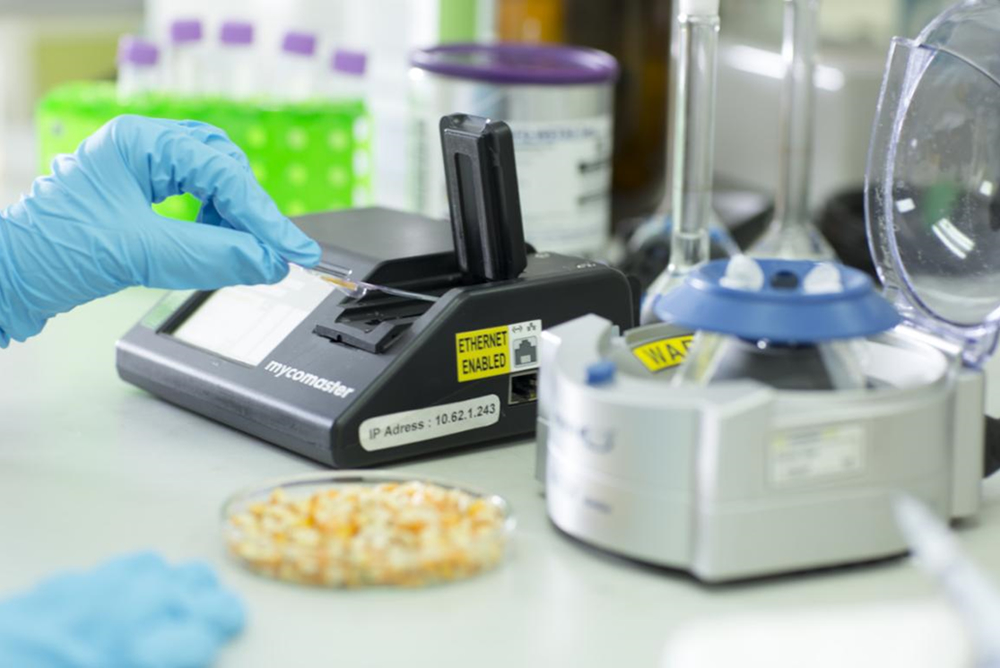
The Global Mycotoxin Review based its findings on customer data collated and examined with the help of more than 200 mycotoxin analysis instruments including rapid analysis device Mycomaster.
Dr. Haladi highlights that "more customers have sent samples for analysis in 2022" over concerns of raw material quality and as "they are using more by-products."
During the webinar, he described the actions taken to produce a more comprehensive and accurate review. This year, for instance, Selko introduced a seasonal variation parameter into its presentation of mycotoxin contamination. It also relied on a data measurement of median values rather than average ones.
Dr. Haladi explains that average values can give inaccurate inference, as few outliers can greatly skew the average. This becomes more acute when different regions are compared.
He suggests ranking mycotoxin concentrations from lowest to highest, and from there, establishing the median value. "The median value is a very (accurate) value without much of an induced error," he remarks, noting that it would help feed producers to better respond to mycotoxin contamination.
Furthermore, median values project a more precise view of mycotoxins where they matter. "We need to be careful not to overwhelm the customers with challenges," Dr. Haladi advises. "For example, if I say that 100% of grains in the US or Asia are contaminated with mycotoxins, what should the customer (look at)? We need to be realistic about (dealing with) these challenges."
Pinpoint data can better guide nutritionists in formulating feed, especially when cross-examining contamination levels in each set of raw materials. They can also aid in developing interventions to control mycotoxin-linked toxicity.
Taking on the mycotoxin challenge
The first step to dealing with a mycotoxin challenge is to understand where the problem lies and its extent. "Once we understand that there is a problem, we do a diagnostic through our analytical system [which produces a report for the nutritionist]," Dr. Haladi explains.
With the report, nutritionists create a diet "with different levels of mycotoxins for different livestock species." This is followed by the on-farm monitoring, during which animals are observed post-feeding to spot symptoms that may be related to mycotoxins.
"From there, they (can act to) provide better nutrition," Dr. Haladi says. "For example, by increasing protein, the animal's liver and other organs can be better detoxified. Mould inhibitors can also be used in feed so that fungus growth is minimised during the storage of raw materials."
Final actions entail using "a mycotoxin binder to bind the toxin inside the animal's gut, or add suitable components to improve their immune system and gut health."
Mycotoxin contamination, if left unchecked, can have very debilitating effects on animal health and performance. They can upset various biological pathways of several organs which are key for the production of proteins, hormones, enzymes and co-factors. Additionally, it can lead to a reduction in the antibody levels and alter cytokine profile, leading to poor disease resistance, Dr. Haladi says.
"We need to look at a more holistic approach that strengthens the resilience of animals given the number of mycotoxins (to cope with)," Dr. Haladi says.
Better educated in fighting mycotoxins
This year's Global Mycotoxin Review "is just reconfirming the challenge" of mycotoxin contamination, Dr. Haladi says.
The introduction of the seasonal variation parameter is therefore a vital component for a more in-depth view of mycotoxin contamination. This comes in handy to understand the role of change in the weather conditions on the mold growth and mycotoxin production.
"What I would like to see is analysing the grains for mycotoxins immediately after harvest and make the right decisions to import or not to import (raw materials from there)," Dr. Haladi says, outlining the analytical approach to sourcing raw materials. Considering this benefit, the webinar aimed to educate on where to get better raw materials.
Dr. Haladi hopes that participants can use the information from the review "as an indicator of the potential challenges and make (improvements)" in feed mill and farm management.
Participants should also have a stronger knowledge of improving feed mill and silo hygiene, controlling mold growth, adopting good storage practices and monitoring animals.
"Look at what the analytical values are telling and combine this information with (the understanding of) mycotoxin effects in animals," Dr. Haladi says.
- Terry Tan, eFeedLink


