


February 11, 2005
Review of China's lysine market in January 2005 - prices continue downward course of 2004 amid intense market competition
An eFeedLink Exclusive Report
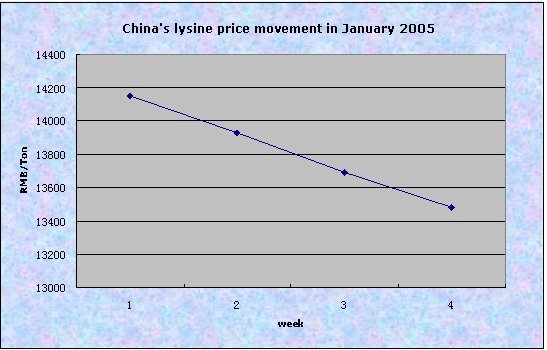
In January 2005, lysine prices in China continued the downward course of 2004 amid intense competition and an oversupplied market. As at end-January, the actual transacted prices (delivered-to-feedmill) of lysine in the eight major importing regions averaged RMB 13.48/kg. This was a fall of RMB 0.68/kg, or 4.7% compared with RMB 14.16/kg recorded early in the month.
I Key market features in January 2005
1 Ample supply in the market despite reduced lysine imports
Imports of a key foreign producer of lysine registered a sharp decline in January 2005, but this did not have a substantial positive impact on the market.
Market analysts attributed the current abundant lysine supply to the following factors:
- High volume of lysine stocks carried forward from 2004.
- The market share of imported lysine has declined considerably following the surge in domestic lysine production in recent years.
- Production at local lysine plants operated at normal levels in January.
2 Intense market competition further weigh on prices
Market competition has intensified between locally produced and imported lysine, among locally produced products as well as between 98.5%-lysine and 65%-lysine. Although lysine prices have reached record low levels in recent years, producers continue to downward adjust their offer prices in a bid to obtain a larger market share, or to ease the buildup in their inventories. Most producers (including foreign producers) have stopped the practice of issuing open price offers. Instead, they have adopted a more flexible approach; to determine prices based quantity and prevailing market rates.
3 Local producers limit output to reduce losses
With profit margins becoming narrower, local producers are also facing mounting pressure from production costs. According to industry players, lysine prices in January had put most local Chinese producers under immense financial strain, with some incurring losses as much as RMB 2,000/kg. Thus, many producers have scaled back production in order to minimize losses.
4 Emergence of new players worsen supply and demand situation
The emergence of new entrant producers further worsened the supply-outstripping-demand situation in China's lysine market. Guangdong Zhaoqing Star Lake Bioscience's 22,000-ton production line commenced operations on January 21 this year, while Shandong Xiwang Group's lysine facility is set to begin production in February. Heilongjiang Cheng Fu Group's 20,000-ton lysine plant has completed construction, and is also expected to begin operations in March. Meanwhile, Degussa and Cathay Biotechnology will establish a new joint venture for the production of L-Lysine in Jinan, Shandong.
5 Improved trade as feed millers increase procurement prior to the Spring Festival
Boosted by feed millers replenishing their inventory prior to the Spring Festival, transaction volume in China's lysine market improved in January as compared to December. Feed millers are also generally more receptive to the current historical low levels of lysine prices, leading to increased demand in the market.
II Outlook for China's lysine market in February
According to analysts, the oversupplied situation in China's lysine market is expected to persist in the weeks ahead. Faced with narrow profit margins and increasing financial strain, some local lysine producers are considering modifying existing facilities to produce glutamic acid while others have chosen to scale back on production. However, with new producers focusing efforts to commence production in the coming weeks, the production capacity and output of lysine in China are set to reach even greater heights.
February is traditionally the low season for lysine demand in China. The increased slaughtering of animals due to the Spring Festival had sharply reduced farm inventories, leading to a substantial fall in demand for lysine. Furthermore, with most feed millers already replenished their inventories to meet production requirements in anticipation of the weeklong (February 9-15) festive holidays, lysine procurement in the markets is expected to return to normal only in late February.
Concluding, with supply still outstripping demand, coupled with intense market competition, lysine prices in China are expected to continue its downslide in February. However, price falls are seen limited as current price levels are already at record lows. According to analysts, prices of imported and locally produced lysine are forecast to hover at RMB 13/kg and RMB 12/kg respectively.


