


February 9, 2026
Environmental authority in Mexico stops construction of poultry farm in Yucatan over absence of permit
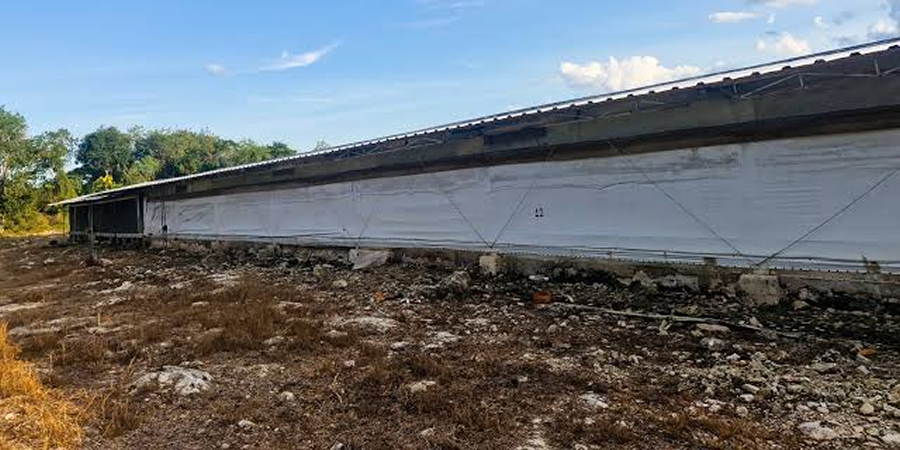
Mexico's Federal Attorney for Environmental Protection (PROFEPA) has temporarily shut down construction and related activities by Productora Nacional de Huevo (CRÍO) at a poultry farm in Hoctun, Yucatan, citing the illegal change of land use on forested land without the required permit from the Ministry of Environment and Natural Resources (SEMARNAT).
The action was taken under the General Law on Sustainable Forest Development.
According to PROFEPA, CRÍO — one of Mexico's largest egg and poultry producers — cleared 8.9 hectares of natural vegetation to make way for the expansion and future construction of industrial poultry sheds and an access road. The affected area consisted of secondary arboreal vegetation typical of medium-height deciduous forest. Inspectors documented the complete removal of vegetation through clearing and stripping of natural soil, with branches, trunks, and entire trees left along the site perimeter, as well as evidence of heavy machinery use.
The enforcement action stems from a forestry inspection carried out on January 22, when PROFEPA confirmed that the site was part of the CRÍO Hoctun poultry farm. The agency returned to the property on January 9 and January 12 to reinstall closure seals.
In addition to the 8.9 hectares cleared, inspectors identified leveling work and the construction of internal roads across roughly 2.8 hectares. They also documented the opening of an access road measuring approximately 80 meters in length and 20 meters in width, covering about 0.16 hectares, with stone material laid to support vehicle traffic.
PROFEPA concluded that these activities constituted an unauthorised change of land use on forest land linked to the expansion of poultry production facilities. The agency said no prevention, mitigation, or compensation measures had been implemented to reduce damage to forest ecosystems. As a precautionary measure, PROFEPA ordered the total temporary closure of the site.
The Hoctun case follows several federal enforcement actions involving CRÍO activities in Yucatan. On January 13, PROFEPA expanded a criminal complaint related to repeated violations of a closure order at a deforested site in Kinchil. The agency said it widened its filing before the Office of the Attorney General after confirming that closure seals and precautionary measures had been deliberately breached.
During a verification visit on January 9, 2026, inspectors found that a total temporary closure imposed on November 12, 2025, had not been respected. Heavy machinery was again operating at the site despite the absence of SEMARNAT authorisation for a land-use change on forested terrain. Authorities seized a backhoe and a tracked bulldozer used to level land for access roads and planned industrial poultry facilities.
PROFEPA said the machinery belonged to a rental company and was operated by workers contracted by CRÍO. A follow-up inspection on January 12 revealed further noncompliance: construction personnel refused to sign the inspection order, one seized machine had been moved and stripped of official seals, and the second machine was no longer on the property.
The agency described these actions as a serious and repeated breach of safety measures and reinstalled seals on the bulldozer found on site. On January 13, PROFEPA formally expanded its criminal complaint to include tampering with seized assets and continued violations of the closure order, stating it will coordinate with federal prosecutors to ensure enforcement of environmental law.
The Kinchil site was initially shut down in November 2025 following the illegal clearing of approximately 13.7 hectares of forest, despite a suspension order issued by the National Institute of Anthropology and History (INAH). INAH intervened after the Kinchil Community Council reported damage to ancient structures at the archaeological site of Tzeme, allegedly linked to CRÍO's expansion plans.
Tzeme is recognized by INAH as the ancient western capital of the Yucatan Peninsula and was once home to more than 10,000 people. The site contains multiple Maya pyramids and architectural structures, including one estimated to be 20 meters high. Community representatives said more than six hectares of low-lying forest were cleared roughly 300 meters from the main pyramids, damaging or destroying buried archaeological remains, including foundations, burial sites and a spiritually significant area known as Kolotso. Residents reported finding ceramics, jade fragments and carved stones scattered across the cleared area.
INAH inspectors confirmed the damage following a formal complaint on October 17, 2025, placing official suspension seals on the property. Despite the order, residents reported heavy machinery operating on November 3.
Local Maya residents, many of whom depend economically on livestock and beekeeping, warned that CRÍO's activities threaten livelihoods beyond cultural heritage. Machinery noise has disrupted cattle, while emissions and odors from poultry operations affect honeybees.
- Mexico Business News


