Alltech: Rising mycotoxin complexity - A growing threat to animal health and productivity
Alltech: Rising mycotoxin complexity - A growing threat to animal health and productivity
Invisible yet pervasive, mycotoxins remain one of the most significant —and oftenunderestimated — challenges in modern livestock production. Historically, industryattention has centred on a limited number of well-known toxins, such as aflatoxins andzearalenone. Today, however, the reality is far more complex.
Mycotoxins produced by fungi in crops now span a wide and evolving spectrumandtheyrarely occur in isolation. Instead, multiple mycotoxins frequently co-exist within thesame feed or forage. The consequence is a growing threat to feed quality, animal healthand performance and, ultimately, farm profitability.
Among the most prevalent are Type B trichothecenes, including deoxynivalenol (DON), commonly referred to as "vomitoxin." In 2024, DON was detected in more than 85% of global wheat and corn silage samples, with typical concentrations ranging from300to1,200 ppb. In dairy cattle, exposure at these levels is associated with reduced feedintake, by as much as 10%, alongside immune suppression, both of which can negativelyimpact milk production.
Crucially, DON rarely appears alone. It is frequently accompanied by other mycotoxinssuch as fusaric acid and penicillic acid, increasing the overall toxic burden. Fusaric acid, also produced by Fusarium species, is generally considered less toxic in isolation. However, it can act as a potent "amplifier" intensifying the harmful effects of other mycotoxins by disrupting blood pressure regulation, growth and key physiological functions.
Penicillic acid, typically produced by Penicillium molds, is increasingly detected ingrasssilage and forage commonly used in ruminant diets. Recent analyses indicate that, insome regions, penicillic acid is present in over 55% of forage samples, often alongsidemultiple Fusarium-derived mycotoxins.
What makes this situation particularly concerning is not simply the presence of individual toxins, but the pattern of co-contamination. Feed samples frequently contain six toeight different mycotoxins at once. Under these conditions, the combined or synergistic effectson animal health and performance can be significantly greater than the impact of anysingle toxin alone.
This multi-toxin reality is now observed across grains, silage, forages, compoundfeedsand individual ingredients worldwide. A range of factors contribute to this trend, including changing climate patterns, global grain trade, variable agronomic practices, and harvesting and storage conditions.
In this evolving landscape, traditional mycotoxin control strategies, often designedtoaddress a narrow group of toxins, are increasingly insufficient. The industry must nowadopt solutions capable of managing the full complexity of modern mycotoxin challenges.
The need for more efficient, broad-spectrum defenses
As mycotoxin complexity increases, so too do the consequences for livestock producers. Reduced feed intake, compromised immunity, impaired growth, lower milk yields and suboptimal reproductive performance are among the most common outcomes of chronicexposure to complex mycotoxin loads. For producers, these biological effects translatedirectly into measurable economic losses.
Effective mitigation can no longer rely solely on conventional binding approaches. Instead, next-generation solutions must deliver:
• Broad-spectrum coverage, capable of addressing multiple mycotoxins simultaneously
• Improved binding efficacy, to minimise absorption and reduce negative performance impacts
• Support for animal resilience, helping maintain health and productivity evenunder ongoing exposure
• Flexibility, allowing strategies to be aligned with differing risk levels, species andproduction systems
In response to these evolving needs Alltech has developed a new generation of mycotoxin mitigation solutions: the Mycosorb® Evo range, comprising Mycosorb®A+Evoand Mycosorb® Evo.
Mycosorb® A+ Evo and Mycosorb® Evo: science-backed, multi-toxin protection
The Mycosorb® Evo range builds on the proven performance of Alltech's establishedMycosorb® technologies, with enhanced functionality designed specifically for today'smulti-toxin environment.
At the core of Mycosorb Evo is a functionalised yeast cell wall extract combined withabacterial ingredient. This formulation significantly improves adsorption efficiency, enabling effective binding across a broader spectrum of mycotoxins.
Mycosorb A+ Evo extends this capability further. In addition to yeast-derived andbacterial components, it incorporates algae-derived ingredients, enhancing its effectiveness against Penicillium-produced toxins such as penicillic acid —whichareincreasingly prevalent in forage and silage-based ruminant diets.
Extensive Alltech laboratory and field research underpins the performance of thesesolutions:
• In vitro studies demonstrate that Mycosorb Evo delivers approximately doublethebinding capacity for DON and three times stronger adsorption of fusaric acidcompared with earlier binder technologies
• Pig intestinal cell models show approximately 33% higher cell viability under DONchallenge, and 47% higher viability under combined DON and fusaric acidexposure when treated with Mycosorb
• Poultry trials conducted under Fusarium challenge conditions showimprovedfeedconversion efficiency, minimized systemic toxin levels, enhanced immune responses and supported gut health
Together, these in vitro and in vivo findings confirm that the Mycosorb Evo range represents more than incremental progress — it reflects a step change in howtheindustry can manage increasingly complex mycotoxin risks.
Strategy and flexibility: matching protection to risk
A key strength of the Mycosorb Evo technologies is its strategic flexibility. Rather thana"one-size-fits-all" approach, producers can align protection with specific risk profiles:
• Mycosorb A+ Evo is designed for high-risk situations or particularly vulnerableanimal groups, such as youngstock, breeding animals, or systems reliant onforage or silage with elevated contamination risk
• Mycosorb Evo provides robust, effective protection in moderate-risk environmentswhere mycotoxin exposure is variable or less severe
This tiered strategy allows producers to avoid both under- and over-treatment, supporting cost-effective and targeted mycotoxin management.
Importantly, the Mycosorb Evo range is not intended as a standalone solution. It formspart of Alltech's broader, proactive mycotoxin management programme, which integratesregular feed testing, data-driven insights from regional harvest analyses, and expert technical support.
Raising the standard for feed safety and livestock health
In a global feed supply chain where mycotoxin contamination is no longer definedbyasmall number of known threats, reliance on outdated mitigation strategies is no longer viable. The challenge has evolved, and so must the response.
With co-contamination on the rise, synergistic toxin effects increasingly recognised, andboth regulatory and economic pressures intensifying, proactive mycotoxin management is no longer optional. It is an essential component of sustainable, profitable animal production.
The Mycosorb Evo range is designed to deliver strong protection not only against individual mycotoxins, but against the complex and unpredictable challenges that definemodern feed systems.
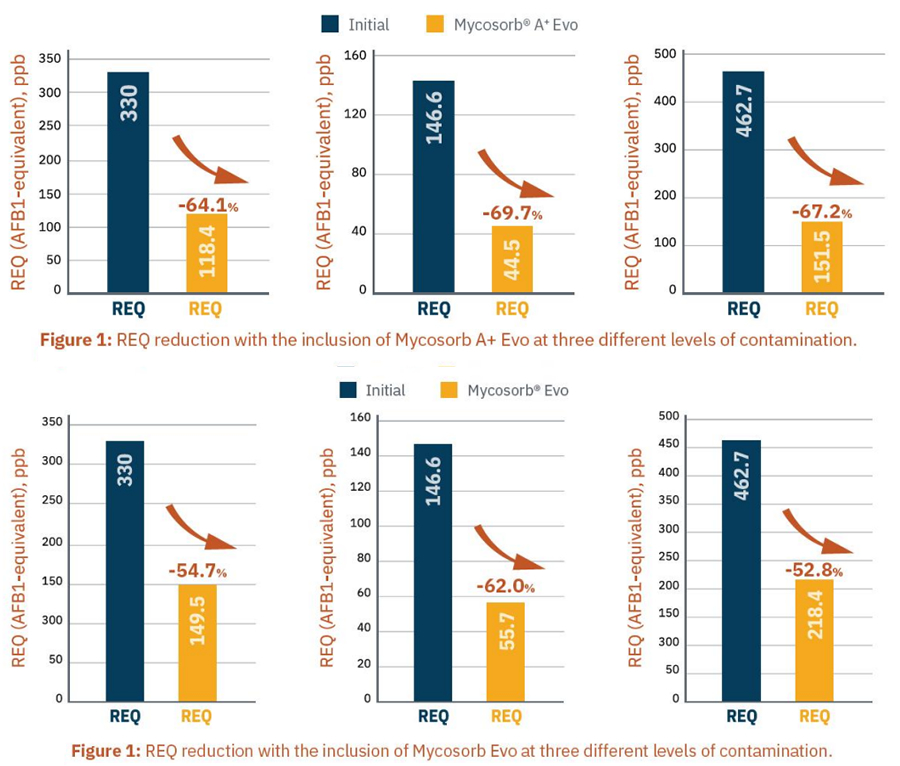
Alltech's REQ (Risk Equivalent Quantity) tool measures mycotoxin risk in animal feedusing a single value for multiple toxins. Lower REQ values mean safer feed, helpingproducers quickly evaluate contamination and make informed decisions to protect animal health. The below figures show REQ at baseline and with the use of Mycosorb A+Evoand Mycosorb Evo.