



Thailand was the leading shrimp producer in the world back in 2012 until later that year when it was dealt a devastating blow as the early mortality syndrome (EMS) disease hit its shrimp farms. When will it be back to its old form? Those in the business believe this will come onlyin 2020. Meanwhile, the country is in recovery mode.
THE LONG WAIT
Thai shrimp industry seen to fully recover by 2020
Thailand was the leading shrimp producer in the world back in 2012. That year, however, it was dealt a devastating blow when the early mortality syndrome (EMS) disease hit its shrimp farms.
Today Thai shrimp production has been cut by more than 50% from its peak in 2012, when production reached 640,000 tonnes. It now produces only 300,000-310,000 tonnes, a slight recovery from the low 200,000-tonne output per annum between 2012 and 2015.
Thailand is still in a recovery mode. Meanwhile, it has been overtaken by India as the world's top producer of shrimp.
Full recovery of the Thai shrimp industry will only be realised by 2020, according to the managing director of the seafood trading firm Siam Canadian Group, James Gulkin, as reported by the Bangkok Post.
"Production dropped significantly in Thailand, but the problems that affected it in 2012 have been mostly resolved, and the industry is growing again," Gulkin was quoted as saying.
While India has beaten Thailand, Indonesia and Vietnam have experienced strong growth. All three have filled the supply gap left by Thailand.
Last year, India's shrimp production totaled almost 500,000 tonnes. Shrimp production in Vietnam in the first five months topped 144,000 tonnes, a tremendous 46% growth over the final period of 2016, and is set to surpass Thailand's output this year.
Nevertheless, according to Gulkin, Thailand has benefited from a more cohesive market, led by leading food producers CP Group and Thai Union.
COULD BE EXPORTER, TOO
Arab states' aquaculture potentials cited
Aquaculture could potentially increase seafood production in Arab states, which has seen an average of only 10 kilogrammes per capita, only almost half the international average seafood supply, according to a fisheries expert.
"This situation requires significant efforts to increase seafood supplies to fish markets in many of the Arab states, which could increase the average to at least 15 kg/capita within five years", says Izzat H. Feidi, Egypt's fisheries development consultant.
In an article Feidi authored and posted by the Global Aquaculture Alliance (GAA) on its website,
he cites several types of aquaculture systems that can be developed in Arab states, including offshore and nearshore cage systems; and land-based, open-flow or RAS (recirculation aquaculture system) ponds, tanks and raceways.
One of the most promising and sustainable systems is offshore cage aquaculture, or open sea farming, Feidi said, citing several suitable sites along the waters of Arab states to deploy offshore cages, particularly in the Arabian Sea with land bases in Oman and Yemen.
"With 3,700 kilometers of coastline between them, Oman and Yemen have significant untapped potential to develop a marine offshore aquaculture industry. In addition, the Arabian Sea has the most intense coastal upwelling system in the world, generating rich nutrients for feeding shellfish", he said.
23,000-km coastline
The entire Arab world has a coastline of about 23,000 kilometers, and has substantial natural resources to increase its wild capture fisheries and aquaculture production, he added.
While Oman and Yemen are almost self-sufficient in their local fish landings, extra supplies from such ventures could be directed for export to other Arab countries that import large fish quantities, such as Egypt, Saudi Arabia and other Arab markets and possibly to other regional and international markets, the article said.
Increased fish production would open various opportunities to establish fish processing plants to produce value-added seafood products for local and international markets, Feidi said. Other Arab states that may also engage in such an investment are Morocco and Mauritania, extending into the waters of the east-central Atlantic Ocean.
Feidi said a marine aquaculture industry in the Arabian Sea would increase food security and mitigate the depletion of sparse water for agricultural resources.
He added that several high-value fish and shellfish species are good candidates for offshore aquaculture in the Arabian Sea. These include sea bass, some high-value tuna species such bigeye and yellowfin, cobia, grouper, snappers, barramundi (Asian sea bass) and some valuable filter-feeding bivalves.
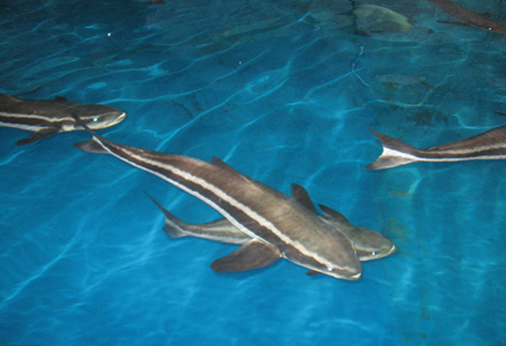
Cobia is one of several high-value fish species that are good candidates for offshore
STUDY:
Chinook salmon most susceptible to soybean meal-induced enteritis
Soybean meal-induced enteritis (inflammation of the intestines) has been found to be most severe in Chinook salmon, less so in Atlantic salmon and negligible in pink salmon.
Results of a study by Canadian researchers, published in the Jan. 20, 2018, issue of Aquaculture journal, showed that solvent-extracted soybean meal (SBM) at low levels causes soybean meal-induced enteritis (SBMIE) in Atlantic salmon.
The researchers assessed and compared the effects of SBM on intestinal morphology, inflammation and microbiome composition of Chinook salmon (Oncorhynchus tshawytscha), pink salmon (O. gorbuscha) and Atlantic salmon (Salmo salar).
Atlantic, Chinook and pink salmon were fed for three weeks on a diet with 20% inclusion of SBM or a control diet with fish meal. After one week on the SBM diet, Atlantic and Chinook salmon showed increased submucosa thickness in the distal intestine compared with the fish fed on the fishmeal diet.
Intestinal inflammation in these species increased over time, with a further increase in submucosa thickness.
3-week SBM diet
After three weeks on the SBM diet, intestinal inflammation was most severe in Chinook salmon. In contrast, pink salmon only showed a slight increase in submucosa thickness, and no significant increase in inflammatory cell infiltrate.
Sequence-based analysis of the intestinal microbiome (total microorganisms and their collective genetic material) showed a significant difference in overall microbiome composition between species, but did not show an effect of the SBM diet on microbiome diversity or composition in any of the three salmon species.
The researchers concluded that SBM-fed Chinook salmon were more susceptible to SBMIE than Atlantic salmon, whereas pink salmon were not susceptible to SBMIE at the levels of SBM tested.
SBM is an attractive protein source for fish feed because of its high protein content, favorable amino acid profile, and low cost.
The study suggested that utility of soybean meal in salmonid diets requires species-specific research on inclusion rate and feeding regimes.
PHILIPPINE RESEARCHERS FIND:
Breeding ponds with cool water produce more tilapia fingerlings
It takes cool water to produce more tilapia fingerlings.
Two Filipino researchers said tilapia produces more spawn in cool, rather than warm, water. In tropical weather, this would entail providing shades to breeding ponds to lower water temperature.
Dr. Veronica Grande and Prof. Marjorie Ramos, researchers of the Mariano Marcos State University College of Aquatic Sciences and Applied Technology in Ilocos Norte province in the Philippines, said the shading technology is effective in summer season when the temperature of the pond is above 32 degrees Celsius, according to a report by the Philippine News Agency (PNA).
They said that raisers could produce up to 77.3% more spawn in water temperature that is at least 28 to 30 degrees Celsius than in non-shaded, higher-temperature breeding ponds.
It was observed that tilapia could not produce the desired volume of spawn if their environment exceeded 28 to 30 degrees Celsius.
The researchers said using a collapsible shade for the ponds could regulate water temperature, which is conducive for the continuous spawn production of tilapia throughout the year.
The shade may consist of silver straw net that provides 40% shading capacity and with bamboo poles serving as braces and ropes to tie the net.

RECORD HIGH
Norway seafood export value reaches US$11.73B in 2017
Norway exported 2.6 million tonnes of seafood in 2017, up 7% from 2016, according to the Norwegian Seafood Council (NSC). These exports were worth a record-high NOK94.5 billion (US$11.73 billion), up 3% or NOK3 billion.
The NSC said that of the total value of Norwegian seafood exports last year, 72% (NOK 67.7 billion or $8.4 billion) came from aquaculture, while seafood from the fisheries was responsible for 28%. Value increased by NOK2.3 billion or 3.6% from 2016.
In terms of volume, the distribution was 40% from aquaculture (1 million tonnes of fish) and 60% from fishing. Exported volume of aquaculture fish was at the same level as 2016.
Norway exported 1.6 million tonnes of seafood from fishing, up 12% or by 170,600 tonnes from 2016. They were worth NOK26.8 billion in 2017, or an increase of NOK628 million or 2.4%.
Dampened demand for salmon in EU
Demand for salmon among European consumers was dampened after its price increased. Since Europe is the dominant market for Norwegian salmon, a reduction in salmon sales largely effected the export price. This has contributed to lower salmon prices in the last six months of the year, said Renate Larsen, NSC managing director.
Salmon is the most important species for Norwegian seafood exports with over 68% of the total export value and 38% of the volume.
Norway exported 1.6 million tonnes of seafood to the EU, the top market, in 2017, up 2%. The total value of these exports was NOK61 billion, the same level as 2016.
Norway exported 539,000 tonnes of seafood to Asia, the second-largest market, in 2017, up 12% or 59,000 tonnes from 2016. Value was NOK18.7 billion, up 8% or NOK1.3 billion.
The seafood industry is one of Norway's most important export industries. This year's record exports strengthen the industry's position, the NSC said.
SO FAR GO GOOD
Vietnam seafood exports up 19% in first 11 months of 2017…
Vietnam's seafood exports in the first 11 months of 2017 reached over US$7.6 billion, up 19% compared with the same period in 2016, according to preliminary statistics released by the General Department of Vietnamese Customs.
The US, Japan and China were the top three importers of Vietnamese seafood. Exports to the US reached over US$1.3 billion, accounting for 17% of total seafood exports. Shipments to the US, however, dropped 1.74% during the 11-month period.
Vietnamese seafood exports to Japan from January to November were estimated at nearly $1.2 billion, accounting for 20%, while those to China reached $1 billion, accounting for 13.3% and increasing by 64.4%.
Most of the main importing markets recorded positive growths during the period, with Denmark registering the strongest growth rate of 88.7%. Export value reached $61.52 million.
Vietnam's seafood exports also rose in several markets including Israel, up 63%; Brazil, up 72.5%; the Philippines, up 60.6%; and China, up 64.4%.
Vietnam's shrimp exports in the first 11 months in 2017 was estimated at nearly $3.5 billion, an increase of 22% compared with the same period in the previous year. It is forecast that shrimp export value in 2017 will reach $3.8 billion, or an increase of 20% from 2016.
Meanwhile, tra fish export value in the first 11 months reached $1.627 billion, or an increase of 5.3% compared with the same period in 2016. In 2017, tra fish export value is expected to reach $1.79 or $1.8 billion, which is mainly attributed to increase in China's purchase.
…and shrimp exports up 22% in 2017…
Vietnam's shrimp rxport value was estimated at US$3.8 billion in 2017, up 22% from 2016, according to the Vietnam Association of Seafood Exporters and Processors (VASEP), VNA reported.
The EU was the top importer of Vietnamese shrimp, buying more than $780 million worth of the country's shrimp products in the first 11 months of 2017. The EU purchase represented 22.2% of Vietnam's total shrimp export revenue during the period and an annual increase of 42.4%.
The Netherlands' Vietnamese shrimp imports increased 70.5%, the strongest growth among the EU's three major markets, followed by the UK (54.5%) and Germany (5.9%).
VASEP General Secretary Truong Dinh Hoe said the strong sales to the EU was due to the preferential treatments offered by the 28-member bloc to some Vietnamese shrimp products under the Generalised System of Preferences (GSP). Thailand and China do not enjoy this advantage, he pointed out.
He foresees that Vietnamese shrimp exports will increase further as the country's competitor, India, faces a ban on its shrimp exports due to antibiotics problems. Vietnamese products are a potential replacement, he said.
Also seen to boost Vietnamese shrimp shipments to the EU is the EU-Vietnam Free Trade Agreement, which is expected to take effect this year, the VASEP said. Under this trade deal, tariff for a number of products, which are currently 20%, will be eliminated.
The second-biggest importer of Vietnamese shrimp in 2017 was Japan, followed by China, whose purchase during the January-November period was valued at $637.9 million, or 60.2% more than the previous year.
Based on VASEP's forecast, China will surpass Japan to become the second-biggest importer of Vietnamese shrimps in the first quarter of 2018.
…has been biggest supplier of shrimp to Switzerland for past 10 years
Vietnam has served as Switzerland's biggest supplier of shrimp over the past 10 years, according to the Vietnam Association of Seafood Exporters and Producers (VASEP), VNS reports.
VASEP said Vietnamese shrimp accounts for over 50% of total shrimp imports of Switzerland, which buys some 8,500 tonnes of shrimp yearly.
Frozen shrimp and processed shrimp in sealed bags are the two main products imported into Switzerland, of which Vietnam is the largest supplier of these two products, according to VASEP.
Together with Germany, Denmark, Ecuador and Bangladesh, Vietnam enjoys free import duty on frozen shrimp accorded by Switzerland, VASEP said.
Despite the free import duty, German and Danish shrimp are less affordable than Vietnamese shrimp, which has to compete, however, with shrimp from Ecuador and Bangladesh, as well as other Asian countries including Thailand and India.
Switzerland ranks 10th among Vietnam's main shrimp import markets, accounting for 1.03% of the Southeast Asian country's total shrimp exports to all the markets.
As of Nov. 15, Vietnam's shrimp exports to Switzerland has reached US$34.3 million, up 17.3% over the same period last year.
NEVER HAD IT SO GOOD
Indian shrimp exports going stronger
Indian shrimp exports are likely to surpass 0.55 million tonnes in fiscal year 2018 (April 2017-March 2018), a 30% increase from FY 2017's 0.43 million tonnes, a report by the rating agency Icra said, India's Business Standard reported.
The increase is attributed to strong orders, despite negative sentiments resulting from a ban on Indian shrimps by some countries including Thailand.
"Following 19 percent volume growth registered during FY17, the trend continued in the first half of FY18 (April-September 2017) with volumes growing 33.6 percent year-on-year", Icra said, adding that India currently accounts for 35% of the global frozen shrimp exports.
In FY 2017, frozen shrimp exports from India grew 25% year-on-year to Rs24,370 crore (US$3.84 billion) from Rs19,492 crore ($3.070 billion) in FY 2016, helped by a 19% year-on-year volume growth.
The US Department of Commerce's reduction of the anti-dumping duty on Indian shrimps from 2.2% (ninth administrative review) to 0.84% (10th administrative review) in September 2017 is expected to support exports growth to the US, according to the report.
It added that the weak production dynamics in Vietnam, coupled with increasing demand in Japan and the EU-top two export destination for Vietnam - is also expected to push up growth.
The report said Indian shrimp exports to China is likewise expected to grow due to lower domestic production in China in 2017 owing to persistent disease issues.
The recent bans on shrimp imports by Thailand and Kuwait, meanwhile, will have a negligible impact on the Indian frozen shrimp industry, as they constitute only 0.3% (Rs43.5 crore, or $6.85 million, in first half of FY18) of the total frozen shrimp exports from India.
"Also, majority of the Indian exports to Thailand are for further re-processing and are in the medium count range (31-40 counts). But closely following the Kuwait ban, the Thailand suspension could impact public perception of the quality of Indian shrimps; this needs to be watched," said Pavethra Ponniah, vice president and sector head (corporate sector ratings) of Icra.


