


January 16, 2024
Canadian innovation based on genetic selection to cut dairy cattle's methane emissions awarded
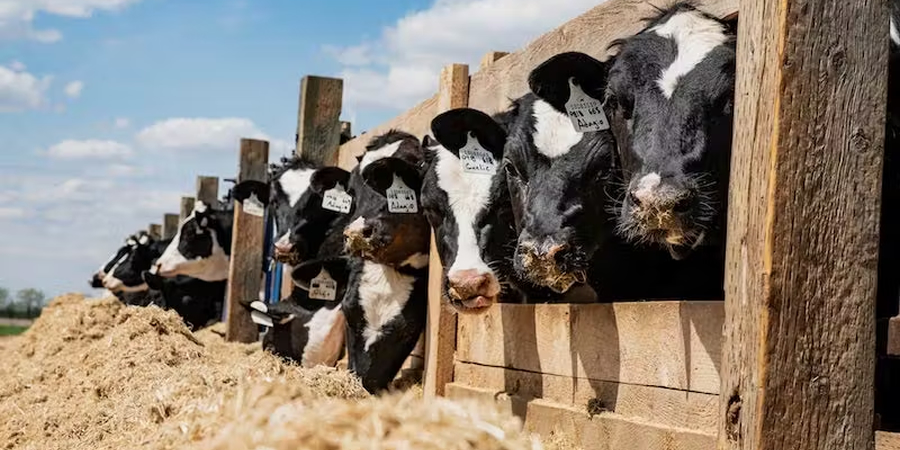
A University of Guelph (Canada) innovation that uses genetic selection methods to reduce methane emissions in dairy cattle has received the university's Innovation of the Year Award for 2023.
The team behind the innovation comprise an international collaboration of researchers and industry partners, including University of Guelph (U of G) researchers Dr. Christine Baes, Dr. Flavio Schenkel and Dr. Saeed Shadpour from the Department of Animal Biosciences in the Ontario Agricultural College, as well as Dr. Filippo Miglior from Lactanet Canada and Dr. Francesca Malchiodi from Semex.
They developed a national genetic evaluation to identify dairy cattle with traits that help reduce methane emissions.
The team gathered data on milk, feed intake, methane emissions, fertility and health in dairy cattle, and genomic information. This comprehensive collection enabled them to establish a significant reference population, measuring individual cows' methane emissions and creating a dataset for genetic selection.
The researchers then used mid-infrared reflectance spectroscopy data (MIRS) from milk samples to accurately predict cows' methane emissions.
"I believe genomic selection holds significant potential in addressing challenging traits," said Dr. Baes. "Whether it's grappling with the complexities of climate change or other environmental issues, the right people and a strategic movement forward can play a crucial role in contributing to their resolution."
Her team collaborated with two key industry partners: Lactanet, a prominent milk recording agency responsible for national genetic evaluations in dairy; and Semex, a leading genetics company.
"Lactanet and Semex were instrumental in financing, providing data and driving the practical application of the research," said Dr. Baes. "Thanks to this collaboration, Canada has become the first country in the world to have national evaluations for methane emissions."
"Lactanet Canada proudly invests in collaborative research projects led by the University of Guelph's Centre for Genetic Improvement of Livestock," said Brian Van Doormaal, chief services officer, Lactanet Canada. "Through these collaborations, Lactanet Canada is a global leader in implementing innovative genomic tools to enhance dairy cattle sustainability, contributing to the industry's net-zero objective by 2050."
In response to climate change, the dairy industry aims to achieve a net-zero status by 2050.
"Semex is excited about Dr. Baes and her team's groundbreaking work at the University of Guelph to reduce methane emissions," said Michael Lohuis, vice president of research and innovation at Semex. "Their breakthrough in predicting methane emissions from a milk sample has led to the development of genetic rankings, simplifying the selection of lower methane genetics for dairy producers."
The research, started in 2012 through a collaboration between U of G researchers and Lactanet, involved collecting MIRS data from milk samples in registered herds in Canada. Lactanet has been storing this data for national genetic evaluations of dairy cattle ever since.
The Efficient Dairy Genome Project (EDGP), launched in 2015 and led by Miglior and Dr. Paul Stothard from the University of Alberta, focused on gathering methane emission and feed efficiency data for a standardised database.
The Resilient Dairy Genome Project (RDGP) began in 2019 and grew from the EDGP. For the RDGP, Dr. Baes, Stothard, Dr. Ronaldo Cerri from University of British Columbia and Dr. Marc-André Sirard from Université Laval, expanded the database to include additional methane and feed efficiency data, as well as information on novel fertility and health traits.
Dr. Baes said a new project in this series has recently been approved. The team will aim to collect large-scale data on commercial farms in Canada, further developing the reference population.
"The goal is to collaborate with Environment and Climate Change Canada as well as dairy nutritionists and life cycle analysts to quantify greenhouse gas emissions from dairy cattle more accurately," said Dr. Baes. "The ultimate goal is to contribute to Canada's greenhouse gas emission inventory in reducing its environmental footprint."
- University of Guelph


